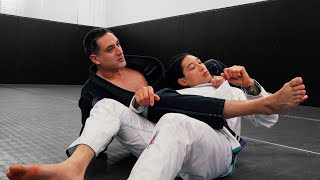
Establishing High Mount Position
The instructor begins in a high mount, controlling the opponent's shoulders to elbows rather than positioning lower where the opponent can generate leverage through elbow frames and hip escapes. This superior positioning prevents the opponent from creating space and executing shrimping movements that would compromise the technique.
Controlling the Arm and Transitioning to S-Mount
From the initial control, the instructor pushes the elbow while grabbing the wrist, then squeezes the knees and sits up to apply pressure. The instructor then transitions to S-mount by sliding the knee between the opponent's elbows, trapping the arm regardless of whether the opponent keeps their hand inside or removes it.
Rolling and Securing the Shin Grip
The instructor drops and rolls onto the right shoulder while releasing the wrist and immediately securing a grip on their own shin. This creates a locked configuration where the trapped arm remains caught, with the heel positioned on the opponent's hip to generate spinal leverage and prevent stacking.
Face Wrap from Home Alone Position
When the opponent crosses their arms in the home alone position, the instructor grabs the thumb and pulls it free, then slips the arm across the head. The opposite leg is brought up to pin the arm as the instructor pulls the head up before transitioning onto the right shoulder.
Triangle Lock with Back Leverage
As the instructor drops and turns the hip, they release and grab into a triangle formation while walking back to slip the foot inside. This creates a tangled submission where the opponent faces pressure from both the arm entanglement and leveraging against the back, making escape significantly more difficult.
Variation: Direct S-Mount to Triangle
For taller practitioners with longer limbs, the instructor demonstrates going straight to S-mount rather than the initial face wrap. The instructor rolls to the right side, grabs the shin between the elbows, and walks back to slip the foot inside, achieving the same triangle configuration with back leverage.
Resetting from Top Position
If the opponent escapes initial threats, the instructor can reposition by lifting the shoulders and turning to return to top mount while maintaining the triangle lock and arm control. This reset allows the instructor to reapply pressure from a dominant position if the submission is defended.
Escaping Grip Fights with Thumb Control
When the opponent successfully frees a hand and creates a grip fight, the instructor targets the thumb, pulling it out as they drop down. This thumb control provides additional leverage to complete the arm trap and prevents the opponent from using the free hand to defend the submission.
Finishing with Armpit Control
As a final option when the opponent aggressively defends, the instructor drives weight forward and hooks into the opponent's armpit to force the arm deeper into the locked position. This driving pressure, combined with the existing arm and choke configuration, overcomes resistance and secures the submission.
Face wrap / gift wrap Submissions
Key Takeaways
- •Establishing High Mount Position
- •Controlling the Arm and Transitioning to S-Mount
- •Rolling and Securing the Shin Grip
- •Face Wrap from Home Alone Position
I filled this video with a ton of moves! But stay till the end for a simple armlock anyone can do (and almost no one knows)... be sure to check out all three of my instructionals (The BoneBreaker - The headhunter - and the leg strangler all 50% off for a limited time only! @jiu_jitsu_brotherhood Code: spiderninja50 Link in bio! https://www.jiujitsubrotherhood.com/collections/bjj-books-and-videos/mike-bidwell #bjjafter40 #spiderninja
Related Techniques
Frequently Asked Questions
What does this video teach about gift wrap lapel choke?
This video covers establishing high mount position, controlling the arm and transitioning to s-mount, rolling and securing the shin grip. It provides detailed instruction from BJJ After Forty.
How long does it take to learn gift wrap lapel choke?
The basic mechanics can be understood in a single session, but developing reliable execution requires consistent drilling over weeks of practice. This 9-part breakdown helps structure your training by isolating each phase of the technique.
What are the key details for finishing gift wrap lapel choke?
When the opponent successfully frees a hand and creates a grip fight, the instructor targets the thumb, pulling it out as they drop down. This thumb control provides additional leverage to complete the arm trap and prevents the opponent from using the free hand to defend the submission.