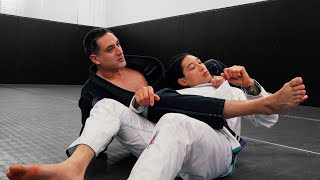
Initial Control and Grip Setup
The instructor establishes control by securing the opponent's lapel with both hands positioned close to the chest. The grip must remain tight and controlled before transitioning into the choke sequence. This foundational positioning ensures stability throughout the technique.
Grip Transition and Body Positioning
When executing the grip change, the instructor sits up while maintaining tightness against the chest. This positioning keeps the opponent's body in contact and prevents them from creating escape angles. The chest-to-chest connection is critical for controlling the opponent's movement.
Knee Positioning and Hand Placement
From the knee prep position, the instructor uses one hand to push the opponent's elbow while simultaneously positioning the opposite leg to execute a triangle setup. The hand placement on the inside of the grip creates the foundation for the submission lock.
Triangle and Armbar Transition
After securing the triangle position by grabbing the wrist, the instructor can finish the choke or transition to an armbar by pushing and rotating. The hand positioning inside the lock allows for flexibility in finishing options based on the opponent's defense.
Reading Opponent Defense and Switching Angles
When the opponent defends one side of the triangle, the instructor shifts pressure to the opposite side by pushing and pulling the arm across the body. This directional change traps the opponent's hand and creates the triangle opening on the alternate side.
Arm Drag Setup and Elbow Lift Detail
The instructor uses an arm drag to reposition, then employs the elbow to lift around the opponent's hand as a detail that prevents early hand escapes. This technical nuance is especially effective when the opponent anticipates the hand trap and attempts to keep their hand away.
Securing the Lapel and Collar Control
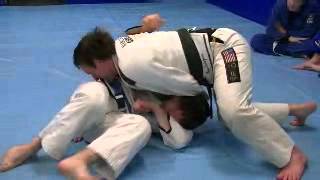
Once positioned correctly, the instructor lifts their elbow under the opponent's collar to establish lapel control. As the opponent attempts to escape by pushing, the instructor rotates to the opposite side to complete the triangle position.
Triangle Finishing Mechanics
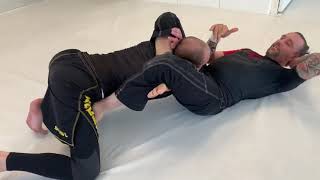
The instructor tucks under the opponent's leg and rotates to secure the triangle. As the opponent pulls their arm out, the instructor lifts their hips while keeping their own arm centered at chest level, using body pressure rather than arm strength to finish.
Arm Rotation and Thumb Direction
The instructor explains that arm rotation should be directed against the opponent's thumb rather than with it. By visualizing the thumb position and rotating away from it, the instructor can apply tighter pressure and prevent the opponent from escaping the submission.
Chest-Based Control vs. Arm Strength
Rather than relying on hand grip strength, the instructor emphasizes hugging the opponent's arm against the center of the chest. This body-centric approach makes it significantly harder for the opponent to rotate their hand and escape, while maintaining maximum control throughout the finish.
Gift Wrap Triangle
Key Takeaways
- •Initial Control and Grip Setup
- •Grip Transition and Body Positioning
- •Knee Positioning and Hand Placement
- •Triangle and Armbar Transition
Related Techniques
Frequently Asked Questions
What does this video teach about gift wrap lapel choke?
This video covers initial control and grip setup, grip transition and body positioning, knee positioning and hand placement. It provides detailed instruction from Applied Pressure MMA.
How long does it take to learn gift wrap lapel choke?
The basic mechanics can be understood in a single session, but developing reliable execution requires consistent drilling over weeks of practice. This 10-part breakdown helps structure your training by isolating each phase of the technique.
What are the key details for finishing gift wrap lapel choke?
The instructor explains that arm rotation should be directed against the opponent's thumb rather than with it. By visualizing the thumb position and rotating away from it, the instructor can apply tighter pressure and prevent the opponent from escaping the submission.