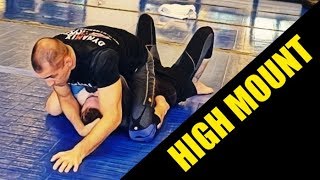
Introduction to Mount Position Attacks
The instructor addresses a common problem among students: difficulty converting positioning once they achieve mount control. This lesson deconstructs fundamental mount attack sequences to build a systematic understanding of offensive opportunities from this dominant position.
Foundational Principle: Hand Control
Before executing any attack from mount, the instructor must work to establish hand control, typically by positioning behind the opponent's elbow or securing an underhook. Hand positioning determines which attacks become available and which defensive options remain for the bottom player.
Double Cross Wrist Setup
When the opponent assumes a crossed-arm defensive posture, the instructor establishes a double cross wrist grip to control both hands simultaneously. By pushing the hands toward the floor while reading the opponent's shoulder rotation, the instructor determines which wrist to isolate for the next attack sequence.
The Americana: Mechanics and Limitations
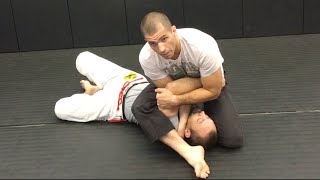
The Americana arm lock is demonstrated with proper mechanics: pinning the hand near the head, inserting the grip inside, and rolling the wrists over to apply pressure. However, the instructor emphasizes that this technique has low success rates at competitive levels because experienced opponents can bridge and hip escape, making it primarily valuable as a positional threat rather than a reliable finish.
Hand Transfer to Underhook Progression
Rather than committing to the Americana finish, the instructor transitions the hand trap into an underhook position by passing the wrist control to the opposite hand. This progression forces the opponent to expose the elbow, which opens the path to more effective control sequences.
The Meathook and Shoulder Control
Once the underhook is established, the instructor works the grip into a meathook position by securing underneath the opponent's armpit. Pulling the shoulder inward while pushing the head forward creates a mechanical advantage that enables back control and transition to the back take.
Back Take Finish: Figure-Four Seatbelt
From the meathook control, the instructor hollows the hips and snakes behind the opponent's elbow to achieve back control. The position is locked with a figure-four seatbelt grip, allowing the instructor to transition to the back with high-percentage control.
Reading Opponent Structure and Adjusting
An opponent's body angle and weight distribution determine which control method proves most effective. When the opponent rotates onto their side, the underhook becomes easier to execute because the elbow sits in a more vulnerable position for the meathook transition.
Advanced Defense Recognition
Experienced competitors will not voluntarily expose their elbow or commit weight to their side. The cross-frame wrist defense indicates a knowledgeable opponent, requiring the instructor to use the Americana threat as a setup tool rather than expecting the submission itself to finish the exchange.
Dominate the Mount with the Meathook System (BJJ Control Blueprint)
Key Takeaways
- •Introduction to Mount Position Attacks
- •Foundational Principle: Hand Control
- •Double Cross Wrist Setup
- •The Americana: Mechanics and Limitations
Want to make your mount unescapable and turn every reaction into a submission? In this video, I break down the Meathook System — a powerful control position that lets you dominate your opponent’s shoulders and launch a full sequence of high-percentage attacks based on their reactions. Whether you’re a white belt learning control or a competitor looking to finish more fights, this system gives you a clear roadmap from mount to submission. 🧠 What you’ll learn: • How to establish and maintain the Meathook control • A chain of attacks based on your opponent’s defense • How to shut down common escapes before they even start This is the exact system I teach at Precision MMA, and it works at every level. 👇 Drop a comment if you’ve hit this in training or have questions! #BJJ #MountControl #MeathookSystem #PrecisionMMA #SubmissionGrappling #BrazilianJiuJitsu
Frequently Asked Questions
What does this video teach about standard high mount?
This video covers introduction to mount position attacks, foundational principle: hand control, double cross wrist setup. It provides detailed instruction from Precision MMA .
How long does it take to learn standard high mount?
The basic mechanics can be understood in a single session, but developing reliable execution requires consistent drilling over weeks of practice. This 9-part breakdown helps structure your training by isolating each phase of the technique.
What are the key details for finishing standard high mount?
An opponent's body angle and weight distribution determine which control method proves most effective. When the opponent rotates onto their side, the underhook becomes easier to execute because the elbow sits in a more vulnerable position for the meathook transition.