Dominant Tie-Up Position with Underhook
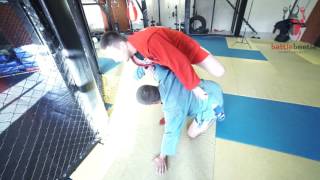
The instructor demonstrates a fundamental control position using an underhook and head placement. The controller establishes a crouched stance while maintaining head position in the opponent's neck area, allowing them to redirect the opponent toward the outer boundary through continuous pressure and positioning adjustments.
Overhook Counter-Control
When the opponent responds with an overhook (sometimes termed a wizard position), the controller demonstrates how to maintain dominance through proper head positioning and crouching stance. The angled hip placement and back leg positioning prevent the opponent from escaping lateral movement.
Cutting Off Escape Angles
The instructor emphasizes the principle of cutting off, which requires positioning the body to block opponent escape routes rather than simply circling. Proper cutting-off involves moving to intercept the opponent's path while maintaining control of the tie-up.
Head Position Recovery When Underhook Is Lost
When the opponent gains head position while the controller retains an underhook, the controller can recover by ducking their head underneath and rolling it beneath the opponent's jaw and face. Using the hardness of the skull against soft tissue makes this recovery difficult for the opponent to prevent.
Control Prevents Defensive Options
Maintaining arm control during head position transitions prevents the opponent from executing defensive counters such as wrist snaps or head snaps. Losing control of both arms exposes the controlling player to immediate counterattacks while attempting repositioning.
Drilling Head Position Recovery
The instructor prescribes repeated drilling of the head roll technique, with the opponent deliberately resisting by burying their head. Practitioners perform multiple repetitions to develop muscle memory and smooth execution of the recovery movement under resistance.
Control Your Opponent EASY with THIS!!
Key Takeaways
- •Dominant Tie-Up Position with Underhook
- •Overhook Counter-Control
- •Cutting Off Escape Angles
- •Head Position Recovery When Underhook Is Lost
This video I breakdown a simple tie up using an underhook and a wrist control to to dominate and prevent your opponent from using offense. Check out the details and you are sure to find something useful! Enjoy! If you have any questions, comments, or suggestions, please comment below. More videos to come! Please like, share, and subscribe!! PLEASE Click this link to SUPPORT the TeachMeGrappling Channel!!! https://www.patreon.com/TeachMeGrappling or https://www.paypal.me/CoachBrianPeterson Your contribution is much appreciated and will help me continue to bring you content! 🙏 www.NextLevelGuy.com The NextLevelGuy Podcast with Coach Brian Peterson has been released!! Check it out!
Related Techniques
Frequently Asked Questions
What does this video teach about wrist control?
This video covers dominant tie-up position with underhook, overhook counter-control, cutting off escape angles. It provides detailed instruction from TeachMeGrappling Coach Brian.
How long does it take to learn wrist control?
The basic mechanics can be understood in a single session, but developing reliable execution requires consistent drilling over weeks of practice. This 6-part breakdown helps structure your training by isolating each phase of the technique.
What are the key details for finishing wrist control?
Maintaining arm control during head position transitions prevents the opponent from executing defensive counters such as wrist snaps or head snaps. Losing control of both arms exposes the controlling player to immediate counterattacks while attempting repositioning.
Related videos
3 Ways To Defend The Russian Tie
Stay Safe Martial Arts
Teaching BEGINNERS "Elbow Control" for Takedowns! Part 2
TeachMeGrappling Coach Brian
How To Arm Drag | Technical Tuesday |
The Bomb MMA
The BASIC Inside Wrist Control from Wrestling!
TeachMeGrappling Coach Brian
Two Armbars and a rolling kneebar from a Russian Tie by Kirill Sementov from Battle beetle
BeyondGrappling