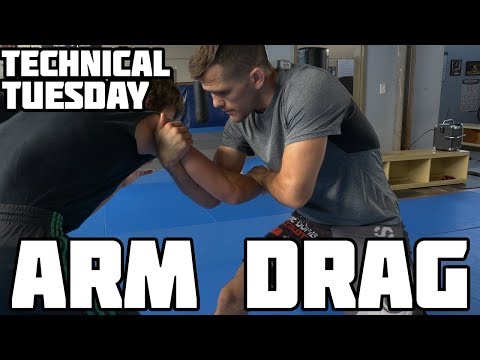
How To Arm Drag | Technical Tuesday |
0
Arm Drag·The Bomb MMA
Whats up YouTube Family! This week on Technical Tuesday I brake down a couple arm drag variations that will help in bjj …
Translation: arm drag
The Arm Drag family covers clinch techniques where the attacker grips the opponent's arm and pulls it across their body, using the drag motion to clear the arm and access the opponent's side or back. [1] The arm drag is one of the most versatile clinch tools because it simultaneously removes a defensive barrier (the dragged arm) and creates an angular advantage, placing the attacker on the opponent's flank. [1],[2] Arm drags can be executed to the inside (pulling the arm across the opponent's centreline) or to the outside (pulling the arm away from the body), each creating different follow-up opportunities. [2],[3]
The arm drag has roots in folk wrestling traditions worldwide and was systematised in American collegiate wrestling during the early 20th century. [1] It became a signature technique of many elite wrestlers and was further popularised in Brazilian Jiu-Jitsu by Marcelo Garcia, who used seated arm drags extensively in competition. [2],[3]
The arm drag is one of the most efficient and high-percentage techniques for creating angles in the clinch, requiring minimal energy expenditure for maximum positional gain. [1] Welker rates it as a fundamental offensive technique that translates across all grappling disciplines. [1] Petrov notes that the arm drag is effective even against significantly stronger opponents because it relies on timing and redirection rather than brute force. [2]
The arm drag is one of the most commonly used setups in collegiate wrestling, with NCAA champions such as Jordan Burroughs using it as a primary entry to leg attacks. [1]
No images yet for this technique.
Sign in to suggest an image.
Whats up YouTube Family! This week on Technical Tuesday I brake down a couple arm drag variations that will help in bjj …
No instructional courses yet for this technique.
Sign in to suggest a course.
Risk of injury to the person this technique is applied to
Arm control positions limit opponent's offense; low direct injury risk
Skill level needed to execute this technique reliably
Whether this technique is allowed under major competition rule sets
Freestyle Wrestling: A Complete Guide for Coaches and Wrestlers (Petrov, 1977)
Alias sources — [1] Wrestling Physical Conditioning Encyclopedia (Welker, 2010) [2] Wrestling for Fighting (Couture, 2007) [3] Mastering Jujitsu (Gracie & Danaher, 2003)
Effectiveness sources — [1] Wrestling Physical Conditioning Encyclopedia (Welker, 2010) [2] Freestyle Wrestling: A Complete Guide (Petrov, 2005)
Standard katakana transliteration of Western martial arts terminology (外来語) — used in Japanese MMA, boxing, and BJJ communities
Alias sources — [1] Wrestling Physical Conditioning Encyclopedia (Welker, 2010) [2] Wrestling for Fighting (Couture, 2007) [3] Mastering Jujitsu (Gracie & Danaher, 2003)
Effectiveness sources — [1] Wrestling Physical Conditioning Encyclopedia (Welker, 2010) [2] Freestyle Wrestling: A Complete Guide (Petrov, 2005)
grip strength, upper body endurance, balance under pressure
strong arms and shoulders, stable base
forearms, deltoids, core, hip muscles
Every move, in any martial art, shares a few universal traits. Mix and match below to pinpoint the right tool — or compare equivalents across styles.
The Inside Arm Drag subfamily executes arm drags where the attacker pulls the opponent's arm across their centreline toward the inside, creating access to the far side of the opponent's body. [1] The inside arm drag typically involves gripping the opponent's wrist or tricep with the lead hand and pulling it diagonally across while the attacker steps to the outside, ending up on the opponent's flank or behind them. [1,2] This drag direction is effective because it compromises the opponent's structure by pulling their arm across their own body, disrupting their balance and exposing the back. [2,3]
The Outside Arm Drag subfamily covers arm drags where the attacker pulls the opponent's arm to the outside, away from the opponent's centreline, creating access to the near side of the body. [1] The outside arm drag involves gripping the opponent's arm and pulling it outward while the attacker steps inside, collapsing the opponent's defensive frame on that side. [1,2] This direction of drag is particularly effective for setting up single-leg takedowns and inside trips, as the attacker ends up in close proximity to the opponent's lead leg. [2,3]
Go high on the armpit rather than just grabbing the elbow. If it slips from the armpit, you'll still have control of the elbow and tricep, but if you grab the elbow first and it slips, you lose the grip entirely.
Take your far arm and switch it down to the opponent's knee, then run through them to establish control.
Grab down and push the arm down rather than grabbing up, as grabbing up makes it too easy for your opponent to execute a self-defense escape.
The Arm Drag family covers clinch techniques where the attacker grips the opponent's arm and pulls it across their body, using the drag motion to clear the arm and access the opponent's side or back. The arm drag is one of the most versatile clinch tools because it simultaneously removes a defensive barrier (the dragged arm) and creates an angular advantage, placing the attacker on the opponent's flank.
The arm drag has roots in folk wrestling traditions worldwide and was systematised in American collegiate wrestling during the early 20th century. It became a signature technique of many elite wrestlers and was further popularised in Brazilian Jiu-Jitsu by Marcelo Garcia, who used seated arm drags extensively in competition.
Unified MMA: legal — Legal — clinching is integral to MMA; IJF: legal — Legal — kumi-kata (grip fighting) is fundamental to judo; IBJJF: legal — Legal — standing grip fighting and clinch work permitted; IFMA: legal — Legal — the clinch is a core element of Muay Thai, clinch dominance is highly…; WBC/Boxing: restricted — Holding is technically a foul — referee breaks clinch, excessive holding resu…; K: restricted — 1/GLORY — One attack from clinch allowed, then referee breaks; WAKO: restricted — Clinch generally broken by referee — limited or no clinch fighting in most fo…; UWW: legal — Legal — clinch is fundamental to wrestling, the primary position in Greco-Roman
Danger rating 3/10. Moderate — arm control positions limit opponent's offense; low direct injury risk
The standard setup chain: Close Distance → Establish Primary Grip → Position the Hips → Apply Pressure.
Standard counters include: Pummeling — fight for inside position by swimming arms under opponent's grips / Frame and Push — create distance using forearm frames against the chest or neck / Grip Break — systematically strip the opponent's controlling grips / Posture Up — straighten the spine and drive the hips forward to break clinch control.
Common variants: Standard variation (primary clinch configuration from the most common entry); Gi variation (adapted with collar and sleeve grips for gi-based grappling); No-gi / MMA variation (modified for no-gi or cage fighting conditions); Offensive variation (configured to set up strikes, takedowns, or submissions f…).
The arm drag is one of the most commonly used setups in collegiate wrestling, with NCAA champions such as Jordan Burroughs using it as a primary entry to leg attacks.
Top errors to watch for: Dragging the arm without moving your body — the arm pull and body step must happen simultaneously / Pulling the arm toward you instead of past you — the arm goes behind your hip, not into your chest / Gripping only the wrist — you need the two-on-one (wrist and tricep) for a complete drag / Dragging too slowly — the opponent re-centres and you're left reaching.
The Arm Drag is also known as Āmu Doraggu, Arm Drag Position, Drag Control, Arm Pull.