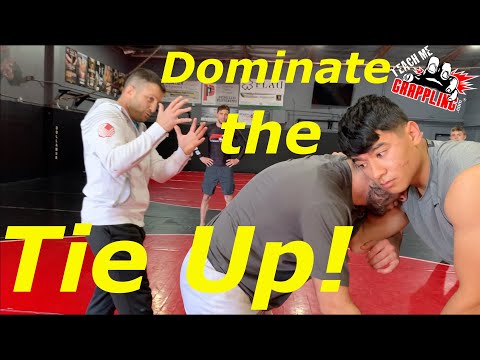
Control Your Opponent EASY with THIS!!
0
Wrist Control·TeachMeGrappling Coach Brian
This video I breakdown a simple tie up using an underhook and a wrist control to to dominate and prevent your opponent f…
Translation: wrist control
The Wrist Control family covers clinch positions where the attacker's primary control mechanism is gripping one or both of the opponent's wrists, providing direct control over the hands and their ability to grip, frame, or strike. [1] Wrist control is the most distal arm control — controlling at the wrist allows the attacker to manage the opponent's hand placement and prevent them from establishing offensive grips or defensive frames. [1],[2] Single wrist control is commonly used as an initial point of contact in the clinch, while double wrist control creates a more dominant position that limits the opponent's options significantly. [2],[3]
Wrist control is one of the most ancient grappling concepts, present in virtually every martial arts tradition from Japanese jujutsu to European catch wrestling. [1] In judo, controlling the opponent's gripping hand (kumi-kata) at the wrist is a fundamental skill that has been systematically developed since the art's founding. [2],[3]
Wrist control is a fundamental grip-fighting tool used across all clinch-based martial arts to disrupt the opponent's ability to establish grips, frame, or strike. [1] Welker identifies wrist control as one of the first hand-fighting techniques taught in wrestling because it provides immediate tactical utility without requiring significant strength. [1]
Wrist control tactics are fundamental in judo competition, where the initial grip exchange often determines the match outcome. [1]
No images yet for this technique.
Sign in to suggest an image.
This video I breakdown a simple tie up using an underhook and a wrist control to to dominate and prevent your opponent f…
No instructional courses yet for this technique.
Sign in to suggest a course.
Risk of injury to the person this technique is applied to
Arm control positions limit opponent's offense; low direct injury risk
Skill level needed to execute this technique reliably
Whether this technique is allowed under major competition rule sets
Freestyle Wrestling: A Complete Guide for Coaches and Wrestlers (Petrov, 1977)
Alias sources — [1] Wrestling Physical Conditioning Encyclopedia (Welker, 2010) [2] Muay Thai: The Art of Fighting (Kraitus & Kraitus, 1988) [3] Kodokan Judo (Kano, 1986)
Effectiveness sources — [1] Wrestling Physical Conditioning Encyclopedia (Welker, 2010)
Aikido technique naming conventions
Established Japanese martial arts naming convention — native Japanese term (和語/漢語)
Alias sources — [1] Wrestling Physical Conditioning Encyclopedia (Welker, 2010) [2] Muay Thai: The Art of Fighting (Kraitus & Kraitus, 1988) [3] Kodokan Judo (Kano, 1986)
Effectiveness sources — [1] Wrestling Physical Conditioning Encyclopedia (Welker, 2010)
grip strength, upper body endurance, balance under pressure
strong arms and shoulders, stable base
forearms, deltoids, core, hip muscles
Every move, in any martial art, shares a few universal traits. Mix and match below to pinpoint the right tool — or compare equivalents across styles.
The Double Wrist Control subfamily covers positions where the attacker controls both of the opponent's wrists simultaneously, completely managing the opponent's hand placement and grip establishment. [1] Double wrist control is a highly dominant arm control position because it neutralises both of the opponent's arms, preventing strikes, frames, and grip fighting. [1,2] From double wrist control, the attacker can release one grip to transition into deeper positions while maintaining control with the other hand, or use the position to set up push-pull off-balancing sequences. [2,3]
The Single Wrist Control subfamily covers positions where the attacker controls one of the opponent's wrists, maintaining control of that hand while keeping the other hand free for offensive actions. [1] Single wrist control is the most common initial clinch contact — one hand grabs the opponent's wrist while the free hand can be used for collar ties, underhooks, or strikes. [1,2] The asymmetric nature of single wrist control creates an advantage because the attacker has one hand free to work while the opponent's controlled hand is occupied. [2,3]
Coach Brian emphasizes keeping your head tight in the pocket and not letting your opponent disengage—if they try to back up or run away, stay close and use head pressure to keep them engaged. Maintaining strict head position makes it difficult for them to escape or execute defensive moves like underhook chucks.
Constantly push and steer your opponent toward the middle of the circle rather than letting them move freely around the perimeter. Apply consistent pressure while steering so they feel controlled and can't dictate their own positioning.
Coach Brian notes that having the underhook with head position versus the overhead position with head position are not wrong or right—just different approaches. The key is maintaining head position either way, as this prevents your opponent from successfully executing escapes.
Keep strict head position so when they attempt to chuck the underhook, they cannot pull you off balance. If they manage to get their head underneath, you can defend with a wrist snap or a head snap depending on which arm has control.
The Wrist Control family covers clinch positions where the attacker's primary control mechanism is gripping one or both of the opponent's wrists, providing direct control over the hands and their ability to grip, frame, or strike. Wrist control is the most distal arm control — controlling at the wrist allows the attacker to manage the opponent's hand placement and prevent them from establishing offensive grips or defensive frames.
Wrist control is one of the most ancient grappling concepts, present in virtually every martial arts tradition from Japanese jujutsu to European catch wrestling. In judo, controlling the opponent's gripping hand (kumi-kata) at the wrist is a fundamental skill that has been systematically developed since the art's founding.
Unified MMA: legal — Legal — clinching is integral to MMA; IJF: legal — Legal — kumi-kata (grip fighting) is fundamental to judo; IBJJF: legal — Legal — standing grip fighting and clinch work permitted; IFMA: legal — Legal — the clinch is a core element of Muay Thai, clinch dominance is highly…; WBC/Boxing: restricted — Holding is technically a foul — referee breaks clinch, excessive holding resu…; K: restricted — 1/GLORY — One attack from clinch allowed, then referee breaks; WAKO: restricted — Clinch generally broken by referee — limited or no clinch fighting in most fo…; UWW: legal — Legal — clinch is fundamental to wrestling, the primary position in Greco-Roman
Danger rating 3/10. Moderate — arm control positions limit opponent's offense; low direct injury risk
The standard setup chain: Close Distance → Establish Primary Grip → Position the Hips → Apply Pressure.
Standard counters include: Pummeling — fight for inside position by swimming arms under opponent's grips / Frame and Push — create distance using forearm frames against the chest or neck / Grip Break — systematically strip the opponent's controlling grips / Posture Up — straighten the spine and drive the hips forward to break clinch control.
Common variants: Standard variation (primary clinch configuration from the most common entry); Gi variation (adapted with collar and sleeve grips for gi-based grappling); No-gi / MMA variation (modified for no-gi or cage fighting conditions); Offensive variation (configured to set up strikes, takedowns, or submissions f…).
Wrist control tactics are fundamental in judo competition, where the initial grip exchange often determines the match outcome.
Top errors to watch for: Holding wrist control statically without transitioning — it's a setup position, not a fighting position / Gripping with just the fingers instead of a full C-grip — weak grip that's easily broken / Pulling the wrist toward you (drawing them closer) when you want distance — push or redirect laterally instead / Ignoring the opponent's other hand while controlling one wrist — they're free to punch or grip with the other.
The Wrist Control is also known as Tekubi Seigyo, Wrist Tie, Wrist Grip, Hand Control.