Head Position Fundamentals
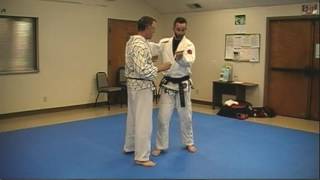
When an opponent controls the clinch by grabbing the neck, maintaining an elevated head position is essential. Looking downward allows the opponent to control the body's alignment, making throws, strikes, and knee attacks more effective. The practitioner should rest the head on the opponent's shoulder while using peripheral vision to monitor incoming knee attacks.
Advantages of Upright Head Posture
Keeping the head elevated reduces the opponent's ability to manipulate and whip the defender around the clinch. This position enables offensive striking opportunities while maintaining active defense. The elevated posture provides better mobility and prevents being controlled into a vulnerable stance.
Hand Block for Knee Defense
The practitioner extends the hands outward to block the opponent's thighs as knee strikes are attempted. The hands should maintain a neutral distance—neither pulled in too close nor extended too far—to prevent the opponent from threading strikes around the guard. This allows the defender to block successive knee strikes while maintaining head position.
Hip Control Block
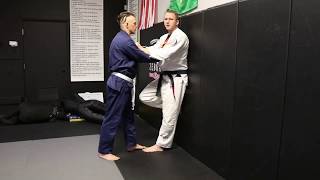
By posting the hands on the opponent's hips, the defender prevents forward hip movement necessary to generate effective knee strikes. This positioning restricts the opponent's ability to generate power and maintain proper mechanics for knee attacks.
Elbow Piercing Block
The defender positions one hand at the opponent's upper back while placing the opposite elbow across the body at hip height. As the opponent attempts a knee strike, the defender shifts the elbow into the path of the incoming knee, using it as a sharp blocking surface against the opponent's thigh. This technique is particularly effective due to the concentrated force of the elbow point meeting the large quadriceps muscle.
Preventive Body Wrap Defense
Rather than reacting to a knee strike, the defender immediately moves into a body wrap upon the opponent initiating the clinch grab. The defender steps in with the hips, creating a limbo-like body angle while wrapping the opponent's torso. This proactive approach closes the distance and prevents knee strikes by eliminating space and destabilizing the opponent's base.
Timing and Application in Body Wrap
The body wrap defense requires proper timing and should be executed as soon as the opponent secures the neck clinch, before knee attacks develop. When executed correctly, the defender's arms become sandwiched between the two bodies, preventing the opponent from fully securing their own body wrap. This creates positional dominance and compromises the opponent's balance and base structure.
Adapting to Knee Variations
The defender must remain in a neutral stance capable of responding to various knee attack angles, including straight thrusting knees, curved knees, and high knees. Overcommitting to blocking one line leaves the defender vulnerable to alternative attack angles. The neutral position allows for small positional adjustments to meet the incoming strike path.
Blocking Knees From Clinch
Key Takeaways
- •Head Position Fundamentals
- •Advantages of Upright Head Posture
- •Hand Block for Knee Defense
- •Hip Control Block
Proper head posture is important when getting clinched. Here we demonstrate proper head posture along with a few techniques to defend knees. #mma #submission #grappling #escape #ufc #jiujitsu #wrestling #throwing
Related Techniques
Frequently Asked Questions
What does this video teach about body clinch?
This video covers head position fundamentals, advantages of upright head posture, hand block for knee defense. It provides detailed instruction from Personal Training Tactics by Don Kaecher.
How long does it take to learn body clinch?
The basic mechanics can be understood in a single session, but developing reliable execution requires consistent drilling over weeks of practice. This 8-part breakdown helps structure your training by isolating each phase of the technique.
What are the key details for finishing body clinch?
The body wrap defense requires proper timing and should be executed as soon as the opponent secures the neck clinch, before knee attacks develop. When executed correctly, the defender's arms become sandwiched between the two bodies, preventing the opponent from fully securing their own body wrap. This creates positional dominance and compromises the opponent's balance and base structure.