Seoi Nage Definition and Body Positioning
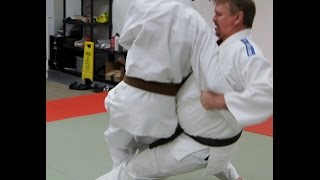
Seoi nage literally means to carry across or over the back. The attacker positions their knees pointing left, buttocks to the right, and maintains a straight back while loading the opponent across their back for the throw.
Hand Technique Classification
Seoi nage is classified as a tewaza (hand technique) in Kodokan Judo, not a hip technique. The hands perform the primary work by lifting, pulling, and controlling the opponent to create space and enable the back carry.
Standard Grip and Balance Breaking
The attacker establishes a standard kubikata grip: left hand on the sleeve between elbow and shoulder, right hand on the lapel. The attacker breaks the opponent's balance with an upward pull before executing the technique.
Entry and Arm Lock
As the opponent is elevated, the attacker curls their right arm inward and jams it under the opponent's armpit. The attacker simultaneously spins into position with proper knee and hip alignment to set up the back carry.
Common Translation Misconception
The term seoi is often mistranslated as shoulder throw in English, causing confusion about the technique's mechanics. The attacker throws the opponent over and across the back, not over the shoulder or onto the shoulders.
Back Step Entry and Rotation
After locking in the arm position, the attacker back-steps naturally to rotate into alignment. The body positioning remains consistent with knees pointing left and buttocks slightly right, creating the back-carry position.
Throwing Mechanics and Follow-Through
The attacker pulls with a straight line of motion similar to chopping wood. The throw is completed by rotating the hips and back to carry the opponent over the back in a fluid, continuous motion.
WHY SEOI NAGE IS A HAND THROW
Key Takeaways
- •Seoi Nage Definition and Body Positioning
- •Hand Technique Classification
- •Standard Grip and Balance Breaking
- •Entry and Arm Lock
This video analyzes why Seoi Nage is categorized as a Te Waza or Hand Technique in Kodokan Judo. #seoinage #kodokan #kodokanjudo #judo #judothrow #tewaza #nagewaza #judotraining #judotechnique #judotechniques Go to http://www.ymaa.com/ to get Steve Scott's books THE JUDO ADVANTAGE, SAMBO ENCYCLOPEDIA , JUJI GATAME ENCYCLOPEDIA and TRIANGLE HOLD ENCYCLOPEDIA. Visit our web sites at http://www.welcomematjudoclub.com/ and http://www.judoblackbelt.com/ Join the Steve Scott Training Group on Facebook at https://www.facebook.com/groups/1094841137237608/ Donations are appreciated. To donate, use this link https://www.paypal.com/cgi-bin/webscr?cmd=_s-xclick&hosted_button_id=85EKWV8KBFASS Our channel was started in 2010 as an extension of our program at Welcome Mat. Welcome Mat was founded in 1969 by Steve Scott in Kansas City, Missouri, USA and has produced thousands of successful students, athletes and coaches in a variety of grappling sports. View over a thousand videos on the subjects of judo, freestyle judo, Shingitai Jujitsu, sambo, submission grappling and sport jujitsu are on our YouTube channel. Browse through our playlists to see what we have on our channel. If a video is listed as "private" is it because that video is still in development or scheduled for later viewing. We strive to provide fundamentally sound and technically innovative skills and information on a variety of grappling sports. Music for some videos provided by YouTube Copyright Free Audio featuring "Fiend" by Sting and performed by the Jingle Punks and "All This Down Time" by Sting and performed by the Jingle Punks. Comments are moderated. Please keep your comments on topic and think before posting them. Comments containing profanity, racial, religious or sexual slurs and comments that are insulting will not be permitted and those posting such comments will be blocked from the channel. Criticism is okay but trolling isn't. You can subscribe for free to our channel at http://www.youtube.com/user/welcomematstevescott/. Please tell other about our channel. Our videos are all original material and are copyrighted. Reproduction or showing these videos without the specific permission of Steve Scott is prohibited.
Related Techniques
Frequently Asked Questions
What does this video teach about hand technique throw — te waza?
This video covers seoi nage definition and body positioning, hand technique classification, standard grip and balance breaking. It provides detailed instruction from welcomematstevescott.
How long does it take to learn hand technique throw — te waza?
The basic mechanics can be understood in a single session, but developing reliable execution requires consistent drilling over weeks of practice. This 7-part breakdown helps structure your training by isolating each phase of the technique.
What are the key details for finishing hand technique throw — te waza?
After locking in the arm position, the attacker back-steps naturally to rotate into alignment. The body positioning remains consistent with knees pointing left and buttocks slightly right, creating the back-carry position.
Related videos
Dummy throwing drills for judo: Te-waza (hand techniques part 1 of 2)
Judo Link by Lincoln Han
10th Planet Springfield Warmup B4
Superhero Jiu Jitsu Academy
tenbin nage, ude kimi nage
Denzel Aiki
Mastering the Osoto Gari Throw in Judo For Self Defense
Joey GAINZalez
Yokosutemi-waza (Side-sacrifice techiques) Full set
Odawa Judo