Introduction to the Cartwheel Guard Pass
The cartwheel guard pass is an effective and visually impressive technique that requires only basic cartwheel proficiency. Popularized by fighters like Sakuraba in PRIDE and attempted by Henzo Gracie against Marcelo Garcia at Abu Dhabi, this pass is efficient enough to catch trained opponents multiple times. The technique rewards practice with both effectiveness and the satisfaction of successful execution.
Prerequisites: Basic Cartwheel Ability
Practitioners need only demonstrate fundamental cartwheel mechanics: one hand contacts the ground, followed by the second hand, before completing the rotation. This basic movement forms the foundation for the guard pass variation and is achievable regardless of age or physical conditioning.
Solo Progression: Uneven Height Cartwheels
Before attempting the technique against a resisting opponent, practitioners should build proficiency through solo drills using uneven surfaces. The progression begins with one hand on the ground and one hand on a medicine ball, advancing to larger unstable surfaces. This conditioning develops the balance and spatial awareness necessary to execute the pass against a moving training partner.
Setup Against Butterfly Guard
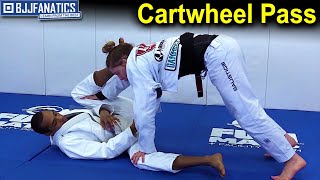
The cartwheel pass is most effectively introduced against the butterfly guard position, where the opponent's legs remain grounded and present minimal entanglement risk. The passer places one hand on the ground between the opponent's legs while positioning the other hand on the shoulder to facilitate the rotation and maintain control. This position is ideal for beginners as it minimizes complications from leg entanglement.
Execution and Transition to Seatbelt Control
As the passer completes the cartwheel rotation, they immediately establish seatbelt control (over-under grip) on the opponent's torso. From this dominant position behind the opponent, the passer can either progress to hook placement or execute a rear-naked choke, creating a high-percentage finish. The opponent's defensive focus on hook prevention often leaves them vulnerable to the choke.
Finishing Options: Hooks and Choke
Two primary submissions emerge from the seatbelt position following the cartwheel pass: progressive hook insertion leading to a fully locked rear-naked choke, or an immediate rear-naked choke from the seatbelt grip alone. The choke is particularly effective because opponents rarely anticipate finishing from this position without hooks established. Training partners frequently tap despite the apparent incompleteness of the position.
Side Position Execution
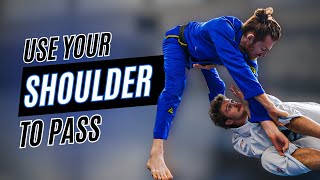
The technique executes identically from either side, with the lead foot determining hand placement. The forward-side hand contacts the ground first, followed by the opposite hand on the opponent's shoulder, maintaining consistency in body mechanics throughout the rotation. This bilateral capability allows practitioners to initiate the pass from any setup.
Training Recommendations and Guard Considerations
While the cartwheel pass functions against multiple guard variations, practitioners should prioritize butterfly guard practice before advancing to positions with elevated legs. Guards with active leg positioning increase entanglement risk and technical difficulty. This progressive approach ensures solid fundamentals before addressing more complex defensive scenarios.
How To Do the Cartwheel Guard Pass
Key Takeaways
- •Introduction to the Cartwheel Guard Pass
- •Prerequisites: Basic Cartwheel Ability
- •Solo Progression: Uneven Height Cartwheels
- •Setup Against Butterfly Guard
Stephan Kesting teaches the Cartwheel Guard Pass for BJJ and Submission Grappling. Free Newsletter and Book: http://www.grapplearts.com/book The Most Powerful Guard: http://www.grapplearts.com/lp/get-to-the-top2.php
Frequently Asked Questions
What does this video teach about standard cartwheel pass?
This video covers introduction to the cartwheel guard pass, prerequisites: basic cartwheel ability, solo progression: uneven height cartwheels. It provides detailed instruction from Stephan Kesting.
How long does it take to learn standard cartwheel pass?
The basic mechanics can be understood in a single session, but developing reliable execution requires consistent drilling over weeks of practice. This 8-part breakdown helps structure your training by isolating each phase of the technique.
What are the key details for finishing standard cartwheel pass?
The technique executes identically from either side, with the lead foot determining hand placement. The forward-side hand contacts the ground first, followed by the opposite hand on the opponent's shoulder, maintaining consistency in body mechanics throughout the rotation. This bilateral capability allows practitioners to initiate the pass from any setup.