Introduction to O Guruma and Ashi Guruma
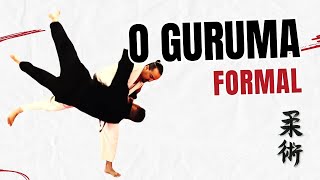
Mark Elston, with third-degree black belt Justin McCready, presents O Guruma (big wheel), Elston's favored throw for many years, and its related technique Ashi Guruma (foot wheel). Both throws are classically taught with a spinning entry, though variations exist in foot placement and entry mechanics.
Classical Spinning Entry for O Guruma
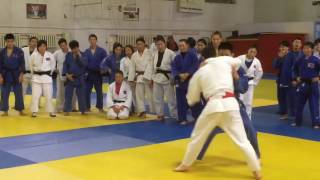
The instructor demonstrates the traditional O Guruma entry by stepping to the side and spinning with a high foot placement near the opponent's waist. The left arm pulls strongly upward while the right arm pushes, concluding with a snapback motion to complete the throw.
Ashi Guruma Entry and Foot Position
Ashi Guruma uses the same spinning entry as O Guruma but targets the shin midway up the leg rather than the waist. Critical to both techniques is maintaining a flexed foot position to generate lateral strength, contrasting with sweeping throws like Osoto Gari that require toe-pointed positioning for vertical leg motion.
Modern Momentum-Based Entry Method
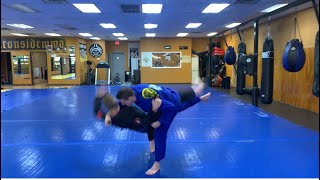
Elston prefers a momentum-driven spinning approach over classical technique. The practitioner steps backward and turns with raised arm, allowing the turning motion to pull the opponent forward while simultaneously pushing into the opponent's head or neck via the right arm, creating strong off-balance.
Distance Variance Between O Guruma and Ashi Guruma
O Guruma requires close proximity, with the foot catching below the waist, while Ashi Guruma demands greater distance with the foot catching the shin. The distance chosen affects entry timing and connects to related throws like Uchi Mata, which is employed when the practitioner is too far away for effective wheel placement.
O Guruma as a Sequence Finisher
O Guruma functions effectively as a finishing throw in combination sequences, particularly when the opponent is already leaning forward from previous attacks. For example, following a failed Ko Soto Gari, the opponent's forward lean positions them ideally for O Guruma without requiring major repositioning.
Building Combination Sequences
Extended throwing sequences are constructed using progressive foot entries: Uchi Gari, Ko Uchi Gari, Uchi Mata, Tai Otoshi, and O Guruma. Each technique builds momentum and off-balance while responding to the opponent's defensive reactions, allowing the practitioner to adjust attack placement throughout the sequence.
Transition to Yoko Otoshi
When O Guruma fails, practitioners naturally transition to Yoko Otoshi, a sacrifice throw appropriate as the sequence conclusion. If the opponent blocks during O Guruma, their forward hip thrust leaves them vulnerable to being taken over via the sacrifice throw from that position.
O Guruma
Key Takeaways
- •Introduction to O Guruma and Ashi Guruma
- •Classical Spinning Entry for O Guruma
- •Ashi Guruma Entry and Foot Position
- •Modern Momentum-Based Entry Method
Mark Gilston, 4th degree judo black belt, shows ways to throw O Guruma (Major Wheel Throw) and Ashi Guruma (Foot Wheel Throw) and demonstrates combination throws using O Guruma. http://www.coopermma.com
Related Techniques
Frequently Asked Questions
What does this video teach about o guruma?
This video covers introduction to o guruma and ashi guruma, classical spinning entry for o guruma, ashi guruma entry and foot position. It provides detailed instruction from Seiryoku Zenyo.
How long does it take to learn o guruma?
The basic mechanics can be understood in a single session, but developing reliable execution requires consistent drilling over weeks of practice. This 8-part breakdown helps structure your training by isolating each phase of the technique.
What are the key details for finishing o guruma?
Extended throwing sequences are constructed using progressive foot entries: Uchi Gari, Ko Uchi Gari, Uchi Mata, Tai Otoshi, and O Guruma. Each technique builds momentum and off-balance while responding to the opponent's defensive reactions, allowing the practitioner to adjust attack placement throughout the sequence.