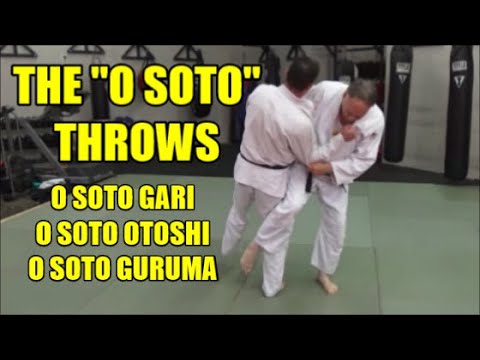
THE O SOTO THROWS O Soto Gari O Soto Otoshi O Soto Guruma
0
O Soto Guruma·welcomematstevescott
This video focuses on the similarities between O Soto Gari, O Soto Otoshi and O Soto Guruma. Go to www.amazon.com or ww…
Translation: major outer wheel
O Soto Guruma is a judo throwing technique classified as ashi waza (foot/leg technique) in the Kodokan syllabus. [1] The attacker breaks the opponent's balance to the rear and sweeps both legs simultaneously by driving the attacking leg across both of the opponent's legs in a wheel-like motion, rather than reaping a single leg as in O Soto Gari. [1],[2] The key distinction from O Soto Gari is that the reaping leg contacts across both legs, creating a wheel effect that topples the opponent directly backward. [2] It is classified in the Gokyo no Waza (five groups of instruction) and appears in multiple Kodokan judo references as a fundamental ashi waza technique. [1]
Kodokan judo lineage: Jigoro Kano (1860–1938) systematized this technique as part of the Kodokan judo curriculum. Transmitted through the Kodokan instructor system to judo federations worldwide. Adopted into BJJ through Mitsuyo Maeda → Carlos Gracie → the Gracie family lineage. [1]
Recognized Kodokan judo technique but rarely seen in modern IJF competition due to rule changes favoring forward-throwing techniques. Occasionally appears in kata demonstrations and regional tournaments. [1]
No images yet for this technique.
Sign in to suggest an image.
This video focuses on the similarities between O Soto Gari, O Soto Otoshi and O Soto Guruma. Go to www.amazon.com or ww…
No instructional courses yet for this technique.
Sign in to suggest a course.
Risk of injury to the person this technique is applied to
Backward fall with both legs swept can cause head/back impact if ukemi is poor.
Skill level needed to execute this technique reliably
Whether this technique is allowed under major competition rule sets
Kano, J. Kodokan Judo. Kodansha International.
[1] Kano, Kodokan Judo, Nage-waza chapter
[2] Kudo, Judo in Action, p. 106
Official Kodokan ground technique classification system
Standard Japanese martial arts terminology (kanji/hiragana)
Established Japanese martial arts naming convention — native Japanese term (和語/漢語)
[1] Kano, Kodokan Judo, Nage-waza chapter
[2] Kudo, Judo in Action, p. 106
strong legs for the sweeping wheel motion, upper body strength for kuzushi
hip extensors, quadriceps, core for driving force
O soto guruma (major outer wheel) sweeps both of the opponent's legs simultaneously using a large sweeping action. Distinguished from o-soto-gari by targeting both legs rather than just one. (Kano, Kodokan Judo)
You can use pretty much any grip you want, but a same-side sleeve and lapel grip is a solid choice for this technique.
Either approach works—some instructors prefer pulling down, while others pull up. Choose whichever feels more natural and effective for your timing.
O Soto Guruma uses a sweeping action where you shoot across and sweep the opponent's leg with a Guruma (wheeling) motion, similar to but distinct from O Soto Otoshi.
O Soto Guruma is a judo throwing technique classified as ashi waza (foot/leg technique) in the Kodokan syllabus. The attacker breaks the opponent's balance to the rear and sweeps both legs simultaneously by driving the attacking leg across both of the opponent's legs in a wheel-like motion, rather than reaping a single leg as in O Soto Gari.
O Soto Guruma is one of the original 40 throws of Kodokan judo (Gokyo no Waza), classified under ashi waza (foot/leg techniques). It was systematized by Jigoro Kano as part of the judo curriculum and remains a standard technique taught at all levels.
IJF Judo: Legal: legal — classified in Gokyo no Waza; Unified MMA: Legal: legal — all throws permitted; FIAS Sport Sambo: Legal: legal — all throws permitted; IBJJF: Legal: legal — takedowns and throws permitted
Danger rating 6/10. High — backward fall with both legs swept can cause head/back impact if ukemi is poor.
The standard setup chain: Push-pull to break balance backward → O Soto Guruma sweep → Failed O Soto Gari → continue sweep across both legs → O Soto Guruma → Lapel grip pull → opponent steps back → immediate wheel sweep.
Standard counters include: Step over the sweep — lift the targeted leg / O Uchi Gari counter — hook the sweeping leg / Sacrifice throw — use the forward momentum against the attacker.
Common variants: High sweep (targeting above the knees); Low sweep (targeting at ankle level); Combination entry (following O Soto Gari attempt).
Recognized Kodokan judo technique but rarely seen in modern IJF competition due to rule changes favoring forward-throwing techniques. Occasionally appears in kata demonstrations and regional tournaments.
Top errors to watch for: Sweeping only one leg — that makes it O Soto Gari, not O Soto Guruma / Not breaking balance to the rear before sweeping / Leaning back instead of driving forward / Insufficient follow-through on the sweep.
The O Soto Guruma is also known as Osoto Guruma, Osoto-Guruma, O-Soto-Guruma, Big Outside Whirl, Major Outer Wheel Throw.