Grip Setup for O Soto Gari
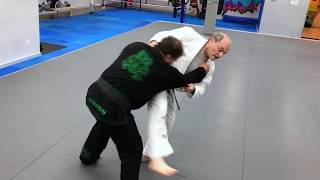
The practitioner establishes control by gripping behind the collar with one hand and grabbing high on the tricep area with the other hand, maintaining a firm grip on the gi. Proper grip placement is foundational for executing the technique with stability and control.
Off-Center Positioning
Rather than standing directly mirrored to the opponent, the practitioner shifts slightly off-center to create the optimal angle for the sweep. This angular positioning allows the hip to brush past the opponent's hip during the technique execution.
Initial Step Placement
The first step is taken very close to the opponent's foot, with just enough space for the sweeping leg to pass through without collision. This close proximity is essential for maintaining control and generating effective momentum.
Weight Distribution and Balance Breaking
As the step is taken, the practitioner maintains forward weight while applying subtle off-balancing pressure to shift the opponent's weight onto the leg that will be swept. The off-balancing is gentle, similar to steering rather than forcing the opponent over.
Forward Lean Mechanics
Leaning forward rather than backward is critical to maintaining positional advantage in the mirrored stance. If the practitioner leans back, the opponent gains the opportunity to execute a counter-throw.
Sweep Leg Execution and Toe Position
The sweeping leg scrapes along the ground with toes pointed downward as it passes behind the standing leg. Keeping the toes pointed down throughout the motion prevents injuries that can occur when toes contact the opponent's shin during live execution.
Knee Drive and Completion
After the sweeping leg scrapes through, the knee is driven upward while maintaining downward toe position to complete the throwing motion. The technique is finished with smooth, controlled acceleration once proper mechanics are established.
Solo Drill Using Doorway
When training without a partner, a doorway frame can serve as a substitute, with the frame edge representing the opponent's leg and hip position. The practitioner practices the stepping and sweeping motion while visualizing the collar and sleeve grips, maintaining the same mechanical principles.
Doorway Drill Mechanics
During the doorway drill, the practitioner brushes the hip gently past the frame and executes the leg sweep motion while keeping toes pointed downward and close to the ground. This solo practice builds muscle memory for the technique before live partner training.
O SOTO GARI (Judo Drills at Home)
Key Takeaways
- •Grip Setup for O Soto Gari
- •Off-Center Positioning
- •Initial Step Placement
- •Weight Distribution and Balance Breaking
This video will give you a quick, basic description and demonstration of O Soto Gari so you can visualize when you're practicing by yourself at home with a shadow drill that we show you!
Related Techniques
Frequently Asked Questions
What does this video teach about o soto gari?
This video covers grip setup for o soto gari, off-center positioning, initial step placement. It provides detailed instruction from IronsideMartialArts.
How long does it take to learn o soto gari?
The basic mechanics can be understood in a single session, but developing reliable execution requires consistent drilling over weeks of practice. This 9-part breakdown helps structure your training by isolating each phase of the technique.
What are the key details for finishing o soto gari?
When training without a partner, a doorway frame can serve as a substitute, with the frame edge representing the opponent's leg and hip position. The practitioner practices the stepping and sweeping motion while visualizing the collar and sleeve grips, maintaining the same mechanical principles.