Which Knee on Belly Choke is Right For You?
0
Arm Triangle Choke — From Knee-on-Belly – Reverse Angle·ROYDEAN
Jiu Jitsu Instructionals: https://roydeanacademy.com One Channel. Every Instructional: https://roydean.vhx.tv/browse S…
Translation: Shoulder Hold / Head-and-Arm Choke — Reverse Angle from Knee-on-Belly
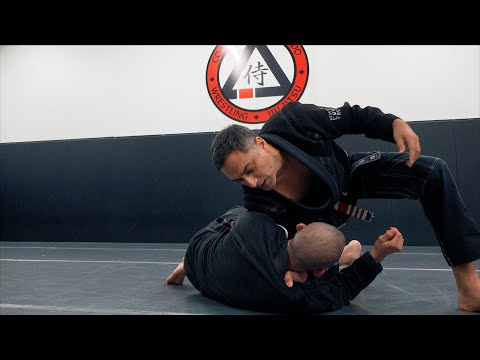
A kata gatame (head-and-arm choke) applied from knee-on-belly using a **reverse finishing angle**. Instead of walking your chest toward the opponent’s head (standard finish), you rotate so your head and chest face more toward the opponent’s **hips**, tightening the head-and-arm seal with shoulder drop and elbow adduction. This is an arm-triangle throughout—no leg triangle involved.
Modern BJJ adaptation of kata gatame emphasizing alternate finishing angles from knee-on-belly; commonly taught as a way to finish when the standard head-side walk meets stubborn frames.
The reverse angle seals space that persists in the standard arm triangle entry, making it effective against opponents who create frames on the choking-side hip. [1]
The reverse-angle arm triangle from KOB approaches the choke from the opposite side, catching opponents who defend the standard entry. [1]
This advanced variation is seen at high-level BJJ competition. [1]
No images yet for this technique.
Sign in to suggest an image.
Jiu Jitsu Instructionals: https://roydeanacademy.com One Channel. Every Instructional: https://roydean.vhx.tv/browse S…
No instructional courses yet for this technique.
Sign in to suggest a course.
Risk of injury to the person this technique is applied to
Direct vascular choke from dominant top control; once sealed, loss of consciousness can occur quickly.
Skill level needed to execute this technique reliably
Whether this technique is allowed under major competition rule sets
Kodokan Judo — Official Katame-waza Classification (肩固め Kata-gatame)
Japanese terminology sourced from Kodokan Judo — Official Katame-waza Classification (肩固め Kata-gatame)
Official Kodokan ground technique classification system
Established Japanese martial arts naming convention — native Japanese term (和語/漢語)
Japanese terminology sourced from Kodokan Judo — Official Katame-waza Classification (肩固め Kata-gatame)
hip flexibility, long legs relative to torso
longer limbs for easier figure-four lock around head and arm
hip adductors, hamstrings, quadriceps
“Reverse” in this entry refers to the finishing **body angle of kata gatame (arm triangle choke)**, where the attacker rotates chest/head toward the opponent’s hips instead of toward the head. This is not to be confused with the **reverse triangle (gyaku sankaku jime)**, which is a leg-based choke belonging to the sankaku family.
Open the collar and grab the ridged material, then circle your elbow around so your forearm is tight across the opponent's head starting at the middle. Your top arm becomes the wall while your bottom wrist comes up into the neck (ROYDEAN).
Let them turn into you—this actually helps the technique. When they turn, you can grab the collar, circle your forearm, and continue with the choke setup (ROYDEAN).
For bigger opponents, instead of putting your pinky in the crook of your elbow, place your hand flat on your forearm and roll your wrist up as you compress with your chest and body weight (ROYDEAN).
You want your arm pressing into your hand while your shoulder presses into the opponent's neck, then roll your bottom wrist up into the neck while putting all your body weight onto your tricep (ROYDEAN).
A kata gatame (head-and-arm choke) applied from knee-on-belly using a **reverse finishing angle**. Instead of walking your chest toward the opponent’s head (standard finish), you rotate so your head and chest face more toward the opponent’s **hips**, tightening the head-and-arm seal with shoulder drop and elbow adduction.
Modern BJJ adaptation of kata gatame emphasizing alternate finishing angles from knee-on-belly; commonly taught as a way to finish when the standard head-side walk meets stubborn frames.
Danger: 9/10 | Direct vascular choke from dominant top control; once sealed, loss of consciousness can occur quickly.
The standard setup chain: Achieve Controlling Position → Isolate the Neck → Set the Grip → Apply Pressure.
Standard counters include: Tuck Chin — protect the neck by lowering the chin to prevent the choke from sinking / Two-on-One Grip Fight — use both hands to strip the choking grip before it locks / Turn Into — rotate toward the choking arm to relieve carotid pressure / Posture Up — straighten the spine and create distance to break the choking angle.
Common variants: Standard (head-side) KOB arm triangle finish; Reverse-angle finish to mounted kata gatame; Reverse-angle finish with wrist-control feed; Reverse-angle to d’arce/anaconda switch if arm slips Training Notes Maintain **knee ride pressure** to pin hips; Keep the opponent’s **elbow high and across**; if it drops under the chin, re-feed; The finish comes from **angle + shoulder drop**, not just arm squeeze; If space remains, rotate a touch more toward hips or transition to mount for tighter compression..
This advanced variation is seen at high-level BJJ competition.
Top errors to watch for: Leaning too far forward (risking sweep) / Trying to finish without the arm truly across the neck / Keeping head too high (leaves space) / Squeezing without rotating to reverse angle—becomes neck crank instead of clean choke..
The Arm Triangle Choke — From Knee-on-Belly – Reverse Angle is also known as Kata Gatame — Reverse Angle, From Knee-on-Belly, Reverse Arm Triangle from KOB, Reverse-Angle Kata Gatame, Knee Ride Reverse Head-and-Arm.