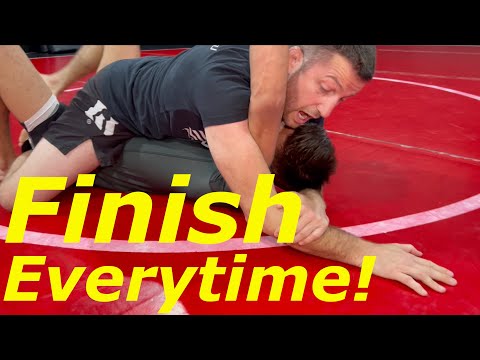
Knee on Belly to Arm Triangle!
0
Arm Triangle Choke — From High Knee-on-Belly·TeachMeGrappling Coach Brian
This video I teach some details on mounting from knee on belly and going for the arm triangle. Check out the details an…
Translation: Shoulder Hold / Head-and-Arm Choke — From High Knee-on-Belly
A kata gatame (head-and-arm choke) variation performed from a high knee-on-belly position, where the attacker slides the knee further up toward the opponent’s chest or shoulder line. This elevated base increases shoulder and chest pressure into the opponent’s neck, creating a tight arm-triangle configuration while maintaining positional dominance.
Evolved from classical kata gatame; the “high knee ride” variation became common in modern BJJ as practitioners experimented with mobility and pressure attacks from knee-on-belly.
High knee placement creates additional respiratory restriction that compounds the choking pressure, making the arm triangle finish faster and more difficult to defend. [1]
The arm triangle from high knee-on-belly combines the pressure of KOB with the head-and-arm strangle, developed in modern BJJ. [1]
This transition is seen at advanced BJJ competition levels where positional control leads to submission opportunities. [1]
No images yet for this technique.
Sign in to suggest an image.
This video I teach some details on mounting from knee on belly and going for the arm triangle. Check out the details an…
No instructional courses yet for this technique.
Sign in to suggest a course.
Risk of injury to the person this technique is applied to
Stronger neck compression than standard KOB due to higher leverage and restricted chest expansion; unconsciousness may occur rapidly.
Skill level needed to execute this technique reliably
Whether this technique is allowed under major competition rule sets
Kodokan Judo — Official Katame-waza Classification (肩固め Kata-gatame)
Japanese terminology sourced from Kodokan Judo — Official Katame-waza Classification (肩固め Kata-gatame)
Official Kodokan ground technique classification system
Established Japanese martial arts naming convention — native Japanese term (和語/漢語)
Japanese terminology sourced from Kodokan Judo — Official Katame-waza Classification (肩固め Kata-gatame)
hip flexibility, long legs relative to torso
longer limbs for easier figure-four lock around head and arm
hip adductors, hamstrings, quadriceps
The higher knee ride adds both positional pressure and psychological discomfort, often forcing opponents to expose defenses faster.
Coach Brian emphasizes never closing your right elbow in tight because once your opponent clamps that arm and executes a bridge, you'll be off balance enough for them to escape.
If your opponent has guard recovery and feeds in the lockdown, you need to take the leg out immediately; otherwise they'll stretch the lockdown to escape and potentially go to your back via triangle.
Coach Brian stresses using your balance to stay safe—if you're on your left knee and your opponent kicks off the knee-on-belly, use your balance to shift, and always maintain a safe position rather than driving forward.
Don't rush the technique; take your time and always ask your partner to fight back with consistent resistance so you can refine your execution against real opposition.
A kata gatame (head-and-arm choke) variation performed from a high knee-on-belly position, where the attacker slides the knee further up toward the opponent’s chest or shoulder line. This elevated base increases shoulder and chest pressure into the opponent’s neck, creating a tight arm-triangle configuration while maintaining positional dominance.
Evolved from classical kata gatame; the “high knee ride” variation became common in modern BJJ as practitioners experimented with mobility and pressure attacks from knee-on-belly.
Danger: 9/10 | Stronger neck compression than standard KOB due to higher leverage and restricted chest expansion; unconsciousness may occur rapidly.
The standard setup chain: Achieve Controlling Position → Isolate the Neck → Set the Grip → Apply Pressure.
Standard counters include: Tuck Chin — protect the neck by lowering the chin to prevent the choke from sinking / Two-on-One Grip Fight — use both hands to strip the choking grip before it locks / Turn Into — rotate toward the choking arm to relieve carotid pressure / Posture Up — straighten the spine and create distance to break the choking angle.
Common variants: Standard knee-on-belly arm triangle; High knee ride to mounted kata gatame transition; Wrist control feed across to high KOB; High knee ride to reverse kata gatame.
This transition is seen at advanced BJJ competition levels where positional control leads to submission opportunities.
Top errors to watch for: Not lifting knee high enough (loses chest control) / Overcommitting forward, giving opponent a bridge/sweep / Squeezing arms without dropping shoulder and angling properly (results in crank, not choke)..
The Arm Triangle Choke — From High Knee-on-Belly is also known as Kata Gatame — From High Knee-on-Belly, High Knee Ride Arm Triangle, High KOB Kata Gatame, Shoulder Pin Choke from Knee-on-Belly.