Introduction and Context
Hugh Knight, Fechmeister of the Schlach Schule, introduces a focused lesson on the bind (Winden) in longsword technique. He notes widespread misunderstandings about the bind circulating online and intends to clarify the technique by returning to primary source texts.
Purpose of the Bind
The bind allows a fencer to seize control of the engagement when the opponent resists with strength. Rather than yielding to superior strength, the bind enables the fencer to overcome resistance by moving the strong of their own sword onto the weak of the opponent's blade, maintaining point control while thrusting.
First Common Error: Lateral Evasion
Many practitioners incorrectly avoid the opponent's strong bind by stepping sideways rather than directly overcoming it. While this may succeed tactically, it contradicts the textual instruction to move the strong of the sword onto the weak of the opponent's blade and is slower than the correct method.
Second Common Error: Winding in Place
Some fencers wind the sword without actually moving it onto the opponent's weak; they rotate the blade without changing its position relative to the opponent. This technique only functions against compliant partners and fails against active resistance, revealing its fundamental incompatibility with the system.
Third Common Error: Loss of Point Control
Practitioners often instinctively push the opponent's sword sideways to create space, causing their point to deviate from the opponent's centerline. This loss of control allows the opponent to thrust through, making it essential to maintain point alignment throughout the bind.
Correct Execution: Straight Retraction
Master Sigmund instructs the fencer to pull the sword straight back while keeping the heel forward of the head. The bind is taken at the minimum distance necessary to establish control—what one student terms the "nexus of control"—without over-committing to a predetermined endpoint.
Sensing the Nexus of Control
The point at which control transfers cannot be precisely defined in advance; it must be felt through tactile feedback developed by practice. Each practitioner's sword grip, strength, and blade pressure will vary slightly, requiring sensitivity to the exact moment control is established rather than mechanical repetition.
Footwork Integration
Although the source text omits footwork, closing distance after the bind requires foot movement to maintain striking range. A gathering step—retracting the back foot while stepping forward with the front foot—allows the fencer to advance while executing the bind, eliminating the delay of sequential foot and blade movements.
Winden Lesson
Key Takeaways
- •Introduction and Context
- •Purpose of the Bind
- •First Common Error: Lateral Evasion
- •Second Common Error: Winding in Place
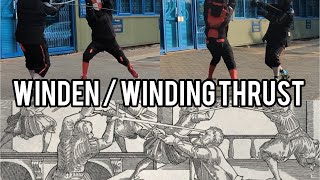
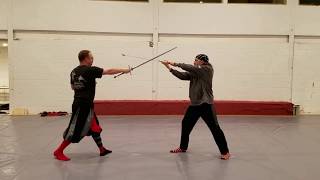
This is another in the series of instructional videos I've been presenting for the German Longsword. In this video you will learn how to do die erste Winden am Schwert--the first winding at the sword--from Ringeck's Fechtbuch: "When you strike a Zornhau and he displaces it and remains strong at the sword hold strongly against it. With the strong of your sword, slide up to the weak of his blade, wind the hilt in front of your head while remaining am Schwert, and thrust into his face from above." Ringeck ff. 20r-v. Demonstrators: Hugh Knight and Chris Bertell. Camera: Chad Cordero.
Related Techniques
Frequently Asked Questions
What does this video teach about winding — winden?
This video covers introduction and context, purpose of the bind, first common error: lateral evasion. It provides detailed instruction from Schlachtschule.
How long does it take to learn winding — winden?
The basic mechanics can be understood in a single session, but developing reliable execution requires consistent drilling over weeks of practice. This 8-part breakdown helps structure your training by isolating each phase of the technique.
What are the key details for finishing winding — winden?
The point at which control transfers cannot be precisely defined in advance; it must be felt through tactile feedback developed by practice. Each practitioner's sword grip, strength, and blade pressure will vary slightly, requiring sensitivity to the exact moment control is established rather than mechanical repetition.