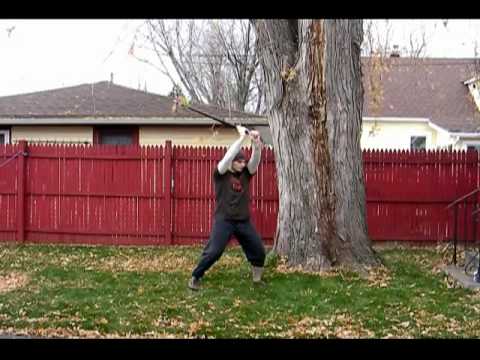
Guard Transition Drill: German Longsword
0
Guard — Huten·Djemps
Guard Transition Drills taken from Tobler's "Fighting with the German Longsword". Hanwei Practical H&H with scabbard so …
Translation: guard — huten
The Guard (Huten) subfamily covers the four principal guards (Vier Leger) of the German longsword tradition — Vom Tag, Ochs, Pflug, and Alber — which form the positional framework from which all attacks and defences originate. [1] Each guard protects specific lines while threatening others: Vom Tag threatens from above, Ochs guards the upper openings while threatening a thrust, Pflug guards the lower openings while threatening a thrust, and Alber invites the opponent's attack while preparing rising cuts. [1],[2] Liechtenauer's system teaches that guards are not static positions but transitional states through which the sword passes during continuous combat flow. [2],[3]
The four guards are a core element of the Liechtenauer tradition, first recorded in the fourteenth century and glossed in detail by Ringeck, von Danzig, and Talhoffer in the fifteenth century. [1] Fiore dei Liberi's Italian tradition uses a different set of twelve guards (poste) but the tactical logic — controlling lines through guard selection — is analogous. [2],[3]
Huten (guards) in the Liechtenauer longsword system serve as both defensive positions and attack platforms, with each guard covering specific lines and enabling specific techniques. [1]
The German longsword guard system was codified in the Liechtenauer tradition (14th century onward), described in Fechtbücher by masters like Ringeck, Danzig, and Lew. [1]
Liechtenauer guards are the starting positions used in HEMA longsword competition worldwide. [1]
No images yet for this technique.
Sign in to suggest an image.
Guard Transition Drills taken from Tobler's "Fighting with the German Longsword". Hanwei Practical H&H with scabbard so …
No instructional courses yet for this technique.
Sign in to suggest a course.
Risk of injury to the person this technique is applied to
Edged weapons cause fatal lacerations; historical battlefield mortality rates >30% (Amberger 1999)
Skill level needed to execute this technique reliably
Whether this technique is allowed under major competition rule sets
The Art of Combat (Joachim Meyer, 1570)
Alias sources — [1] Forgeng, J., The Art of Combat (Palgrave Macmillan, 2003) [2] Tobler, C., Fighting with the German Longsword (Freelance Academy Press, 2004)
Effectiveness sources — [1] Fighting with the German Longsword (Tobler, 2004)
Mixed Japanese-Western terminology — combines traditional Japanese terms with katakana loanwords
Alias sources — [1] Forgeng, J., The Art of Combat (Palgrave Macmillan, 2003) [2] Tobler, C., Fighting with the German Longsword (Freelance Academy Press, 2004)
Effectiveness sources — [1] Fighting with the German Longsword (Tobler, 2004)
wrist control for edge alignment, grip endurance, footwork precision
quick wrists, strong forearms, good posture
forearm extensors/flexors, deltoids, core, calves
Every move, in any martial art, shares a few universal traits. Mix and match below to pinpoint the right tool — or compare equivalents across styles.
Alber (the fool) is the low guard that positions the longsword with the point directed toward the ground in front of the fencer, arms extended downward. [1] Alber is considered a provocative or 'foolish' guard because it appears to leave the upper body completely open, inviting the opponent to attack — which is precisely its tactical purpose, as it sets up counter-cuts and Unterhau responses. [1,2] Ringeck and von Danzig note that Alber is used to draw the opponent into over-committing to an attack. [2,3]
Ochs (the ox) is a high guard that positions the longsword beside the head with the point aimed at the opponent's face or upper chest, hilt at temple height. [1] Ochs threatens an immediate thrust to the opponent's face while simultaneously protecting the upper line with the crossguard and blade. [1,2] The guard can be held on either side of the head, with left Ochs and right Ochs covering different lines and threatening different angles of thrust. [2,3]
Pflug (the plough) positions the longsword at hip level with the point aimed at the opponent's chest or throat, resembling the forward-pointing share of a plough. [1] Pflug is the mirror image of Ochs applied to the lower line, guarding the midsection while threatening a powerful centreline thrust. [1,2] Like Ochs, Pflug can be held on either side of the body, and transitioning between left and right Pflug is a fundamental defensive movement that redirects incoming attacks. [2,3]
Vom Tag ('from the roof' or 'from the day') is the high guard that raises the longsword above or behind the head, poised to deliver powerful descending cuts. [1] Vom Tag is the most aggressive of the four principal guards, threatening devastating Oberhau and Zornhau cuts with maximum gravitational and rotational force. [1,2] The guard has several variants — with the sword held over the right shoulder, directly overhead, or behind the head — each offering slightly different tactical properties. [2,3]
The Guard (Huten) subfamily covers the four principal guards (Vier Leger) of the German longsword tradition — Vom Tag, Ochs, Pflug, and Alber — which form the positional framework from which all attacks and defences originate. Each guard protects specific lines while threatening others: Vom Tag threatens from above, Ochs guards the upper openings while threatening a thrust, Pflug guards the lower openings while threatening a thrust, and Alber invites the opponent's attack while preparing rising cuts.
The four guards are a core element of the Liechtenauer tradition, first recorded in the fourteenth century and glossed in detail by Ringeck, von Danzig, and Talhoffer in the fifteenth century. Fiore dei Liberi's Italian tradition uses a different set of twelve guards (poste) but the tactical logic — controlling lines through guard selection — is analogous.
Traditional martial arts: legal — Practiced in traditional kata/forms and weapon-specific competition under var…; IWUF: legal — Legal in wushu taolu if applicable; HEMA: legal — Legal in applicable historical weapon categories
Danger rating 9/10. Extreme — edged weapons cause fatal lacerations; historical battlefield mortality rates >30% (Amberger 1999)
The standard setup chain: Assume Guard (Kamae/Hut) → Measure Distance (Ma-ai) → Initiate Cut/Thrust → Follow Through (Zanshin).
Standard counters include: Parry (Absetzen) — deflect the incoming blade with a counter-displacement / Void (Step Back) — withdraw from measure to avoid the cutting arc / Counter-Cut (Nachreisen) — strike into the opponent's opening during their attack.
Common variants: Standard cut (primary cutting angle from the ready stance); Thrust (tsuki) (straight thrust targeting the throat, chest, or face); Rising cut (kiri-age) (upward diagonal cut from low to high); Diagonal cut (kesa-giri) (downward diagonal cut following the kimono line).
Liechtenauer guards are the starting positions used in HEMA longsword competition worldwide.
Top errors to watch for: Staying in a guard position without attacking — guards are transitional; use them as launching points for techniques / Only using one guard — each guard has strengths and weaknesses; all four must be developed / Holding the guard with tension — the guard should be ready and loaded but not tense; tension slows response / Not understanding which attacks each guard threatens — each guard has natural offensive options; know them.
The Guard — Huten is also known as Kamae / Hūten, Huten, Leger, Longsword Guards, Four Guards.