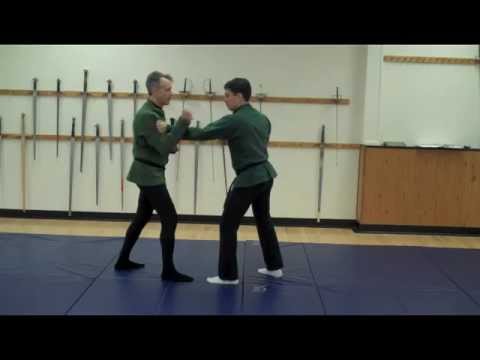
Ringen 02-10-13
0
Grappling At The Sword — Ringen Am Schwert·Northwest Fencing Academy - Medieval Martial Arts
Ringen Study Group Fabian Von Auerswald Review: Lock Wrestling Second Lock Wrestling February 10, 2013
Translation: grappling at the sword
The Grappling at the Sword (Ringen am Schwert) subfamily covers the close-quarters wrestling techniques performed while both combatants retain their longswords, a distinctive feature of German HEMA that integrates swordsmanship with grappling. [1] When the distance closes beyond cutting or thrusting range, the fight transitions to Ringen am Schwert, where fighters use their crossguards, pommels, and half-swording grips to throw, disarm, or lock the opponent. [1],[2] These techniques include pommel strikes to the face, crossguard hooks to the neck, arm locks using the blade as a lever, and takedowns that use the sword as a wrestling aid. [2],[3]
Ringen am Schwert is extensively documented in the German fight-book tradition, with Fiore dei Liberi's gioco stretto (close play) and the German Ringen sections of Talhoffer and Codex Wallerstein providing detailed illustrated techniques. [1] This integration of wrestling with swordsmanship distinguishes European medieval combat from many other sword traditions. [2],[3]
Ringen am Schwert (Grappling at the Sword) comprises close-range techniques executed when fencers are too close for effective cutting or thrusting, including disarms, throws, pommel strikes, and wrestling actions performed while maintaining grip on the sword. [1] These techniques are essential to historical longsword combat because the bind frequently brings fighters into grappling range; the ability to transition from swordplay to wrestling determines outcomes in close quarters. [2] Hans Talhoffer's fight books depict extensive Ringen am Schwert sequences including arm locks and takedowns. [3]
Ringen am Schwert is documented in all comprehensive Liechtenauer-tradition manuscripts, with particularly detailed coverage in Talhoffer's fight books (1443–1467) and in the Codex Wallerstein. [1] Fiore dei Liberi devotes an entire section of Fior di Battaglia to sword grappling (gioco stretto — the close game), demonstrating its importance across European traditions. [2]
Sword grappling is allowed in most HEMA longsword rule sets and is used at major tournaments when fighters close to grappling range. [1]
No images yet for this technique.
Sign in to suggest an image.
Ringen Study Group Fabian Von Auerswald Review: Lock Wrestling Second Lock Wrestling February 10, 2013
No instructional courses yet for this technique.
Sign in to suggest a course.
Risk of injury to the person this technique is applied to
Edged weapons cause fatal lacerations; historical battlefield mortality rates >30% (Amberger 1999)
Skill level needed to execute this technique reliably
Whether this technique is allowed under major competition rule sets
The Art of Combat (Joachim Meyer, 1570)
Effectiveness sources — [1] Forgeng, J., The Art of Combat (Palgrave Macmillan, 2003) [2] Tobler, C., In Saint George's Name (Freelance Academy Press, 2010) [3] Talhoffer, H., Medieval Combat (Greenhill Books, 2000, trans. Rector)
Lineage sources — [1] Talhoffer, H., Medieval Combat (Greenhill Books, 2000, trans. Rector); Codex Wallerstein, Universitätsbibliothek Augsburg [2] Fiore dei Liberi, Fior di Battaglia (1409), Getty MS Ludwig XV 13
Established Japanese martial arts naming convention — native Japanese term (和語/漢語)
Effectiveness sources — [1] Forgeng, J., The Art of Combat (Palgrave Macmillan, 2003) [2] Tobler, C., In Saint George's Name (Freelance Academy Press, 2010) [3] Talhoffer, H., Medieval Combat (Greenhill Books, 2000, trans. Rector)
Lineage sources — [1] Talhoffer, H., Medieval Combat (Greenhill Books, 2000, trans. Rector); Codex Wallerstein, Universitätsbibliothek Augsburg [2] Fiore dei Liberi, Fior di Battaglia (1409), Getty MS Ludwig XV 13
wrist control for edge alignment, grip endurance, footwork precision
quick wrists, strong forearms, good posture
forearm extensors/flexors, deltoids, core, calves
Every move, in any martial art, shares a few universal traits. Mix and match below to pinpoint the right tool — or compare equivalents across styles.
No—avoid locking the arm. Instead, use hip twist to open up opportunities for control, as demonstrated at Northwest Fencing Academy.
Position is critical; if you're in the wrong place relative to your opponent, the throw won't execute even if you hook and lift correctly. Ensure proper positioning before committing to the technique.
The Grappling at the Sword (Ringen am Schwert) subfamily covers the close-quarters wrestling techniques performed while both combatants retain their longswords, a distinctive feature of German HEMA that integrates swordsmanship with grappling. When the distance closes beyond cutting or thrusting range, the fight transitions to Ringen am Schwert, where fighters use their crossguards, pommels, and half-swording grips to throw, disarm, or lock the opponent.
Ringen am Schwert is extensively documented in the German fight-book tradition, with Fiore dei Liberi's gioco stretto (close play) and the German Ringen sections of Talhoffer and Codex Wallerstein providing detailed illustrated techniques. This integration of wrestling with swordsmanship distinguishes European medieval combat from many other sword traditions.
Traditional martial arts: legal — Practiced in traditional kata/forms and weapon-specific competition under var…; IWUF: legal — Legal in wushu taolu if applicable; HEMA: legal — Legal in applicable historical weapon categories
Danger rating 9/10. Extreme — edged weapons cause fatal lacerations; historical battlefield mortality rates >30% (Amberger 1999)
The standard setup chain: Assume Guard (Kamae/Hut) → Measure Distance (Ma-ai) → Initiate Cut/Thrust → Follow Through (Zanshin).
Standard counters include: Parry (Absetzen) — deflect the incoming blade with a counter-displacement / Void (Step Back) — withdraw from measure to avoid the cutting arc / Counter-Cut (Nachreisen) — strike into the opponent's opening during their attack.
Common variants: Standard cut (primary cutting angle from the ready stance); Thrust (tsuki) (straight thrust targeting the throat, chest, or face); Rising cut (kiri-age) (upward diagonal cut from low to high); Diagonal cut (kesa-giri) (downward diagonal cut following the kimono line).
Sword grappling is allowed in most HEMA longsword rule sets and is used at major tournaments when fighters close to grappling range.
Top errors to watch for: Ignoring Ringen am Schwert in longsword training — it is a core part of the system, not an optional addition / Releasing the sword to grapple — Ringen am Schwert techniques are performed while maintaining grip on the weapon / Not training the transition from cutting range to grappling range — the entry to Ringen happens from the bind and mus… / Using excessive force in Ringen techniques — like all grappling, technique and leverage are more important than strength.
The Grappling At The Sword — Ringen Am Schwert is also known as Ken-jō no Kumi-uchi, Ringen am Schwert, Sword Grappling, Abrazare at the Sword, Close-Quarter Sword Work.