Winden Lesson
0
Winding — Winden·Schlachtschule
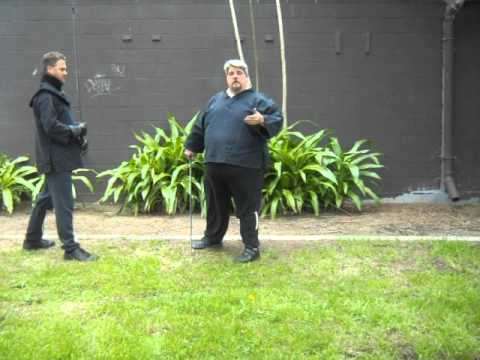
This is another in the series of instructional videos I've been presenting for the German Longsword. In this video you …
Translation: winding — winden
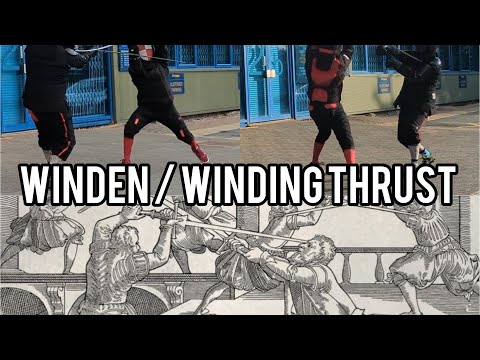
The Winding (Winden) subfamily covers the blade manipulation techniques performed when two longswords are crossed in the bind (Binden), one of the most distinctive and sophisticated aspects of the German tradition. [1] Winding involves rotating the sword around the axis of the bind — by turning the hands and hips — to change the angle of threat from a cut-line to a thrust-line or vice versa, without breaking contact with the opponent's blade. [1],[2] Winding is governed by the principle of Fühlen (feeling) — sensing the opponent's pressure through the crossed blades to determine whether they are hard or soft in the bind, and responding accordingly. [2],[3]
Winding is a core concept of the Liechtenauer tradition that has no direct parallel in most other sword arts, making it one of the most distinctive features of German longsword. [1] The glossators describe Winden as the art of turning the sword from above to below and from below to above within the bind to find openings. [2],[3]
Winden (Winding) is the core close-range technique of the Liechtenauer tradition, executed from the bind (when blades are in contact) by rotating the sword to direct the point at the opponent's openings while maintaining blade pressure. [1] It is arguably the most important intermediate-to-advanced technique in the German system because it enables the fencer to attack from the bind without separating from the opponent's blade, maintaining control and preventing counter-attacks. [2] Liechtenauer's Zettel places Winden alongside the concept of Fühlen (feeling the opponent's pressure through the blade) as the key to winning in close-range combat. [3]
Winding is a core technique at HEMA longsword tournaments, used by advanced competitors to gain advantage at the bind. [1]
No images yet for this technique.
Sign in to suggest an image.
This is another in the series of instructional videos I've been presenting for the German Longsword. In this video you …
In this video, I look at the winden thrust and do my best to explain how to perform it. Braking down the key movements t…
No instructional courses yet for this technique.
Sign in to suggest a course.
Risk of injury to the person this technique is applied to
Edged weapons cause fatal lacerations; historical battlefield mortality rates >30% (Amberger 1999)
Skill level needed to execute this technique reliably
Whether this technique is allowed under major competition rule sets
The Art of Combat (Joachim Meyer, 1570)
Effectiveness sources — [1] Forgeng, J., The Art of Combat (Palgrave Macmillan, 2003) [2] Tobler, C., Fighting with the German Longsword (Freelance Academy Press, 2004) [3] Tobler, C., In Saint George's Name (Freelance Academy Press, 2010)
Lineage sources — [1] Forgeng, J., The Art of Combat (Palgrave Macmillan, 2003) [2] Fiore dei Liberi, Fior di Battaglia (1409), Getty MS Ludwig XV 13
Mixed Japanese-Western terminology — combines traditional Japanese terms with katakana loanwords
Effectiveness sources — [1] Forgeng, J., The Art of Combat (Palgrave Macmillan, 2003) [2] Tobler, C., Fighting with the German Longsword (Freelance Academy Press, 2004) [3] Tobler, C., In Saint George's Name (Freelance Academy Press, 2010)
Lineage sources — [1] Forgeng, J., The Art of Combat (Palgrave Macmillan, 2003) [2] Fiore dei Liberi, Fior di Battaglia (1409), Getty MS Ludwig XV 13
wrist control for edge alignment, grip endurance, footwork precision
quick wrists, strong forearms, good posture
forearm extensors/flexors, deltoids, core, calves
Every move, in any martial art, shares a few universal traits. Mix and match below to pinpoint the right tool — or compare equivalents across styles.
The most common mistake is not actually winding onto the sword—people wind in place instead of winding onto the weak of their opponent's front sword. Another frequent error is rotating the sword before pulling back, which can get you caught on the cross.
Winden is primarily driven by your left hand while your right hand relaxes. You must pull your sword straight back while keeping your heel in front of your head, and critically, you must shove the weapon to the side—just pulling back alone isn't enough. According to Jack Harmsworth, lean in with your body instead of just extending your arms to maximize power and stability.
Use a gathering step: gather in with your back foot as you wind while simultaneously stepping off with your front foot. It's crucial that the winding and footwork happen together consecutively rather than sequentially, as doing them one after the other wastes time you don't have.
Winden must be very fast and snappy—done at speed it should look quick and fluid. Don't go past the point of control on the blade or lift any further up than necessary, as this takes time you don't have and risks losing control of your opponent's weapon.
The Winding (Winden) subfamily covers the blade manipulation techniques performed when two longswords are crossed in the bind (Binden), one of the most distinctive and sophisticated aspects of the German tradition. Winding involves rotating the sword around the axis of the bind — by turning the hands and hips — to change the angle of threat from a cut-line to a thrust-line or vice versa, without breaking contact with the opponent's blade.
Winding is a core concept of the Liechtenauer tradition that has no direct parallel in most other sword arts, making it one of the most distinctive features of German longsword. The glossators describe Winden as the art of turning the sword from above to below and from below to above within the bind to find openings.
Traditional martial arts: legal — Practiced in traditional kata/forms and weapon-specific competition under var…; IWUF: legal — Legal in wushu taolu if applicable; HEMA: legal — Legal in applicable historical weapon categories
Danger rating 9/10. Extreme — edged weapons cause fatal lacerations; historical battlefield mortality rates >30% (Amberger 1999)
The standard setup chain: Assume Guard (Kamae/Hut) → Measure Distance (Ma-ai) → Initiate Cut/Thrust → Follow Through (Zanshin).
Standard counters include: Parry (Absetzen) — deflect the incoming blade with a counter-displacement / Void (Step Back) — withdraw from measure to avoid the cutting arc / Counter-Cut (Nachreisen) — strike into the opponent's opening during their attack.
Common variants: Standard cut (primary cutting angle from the ready stance); Thrust (tsuki) (straight thrust targeting the throat, chest, or face); Rising cut (kiri-age) (upward diagonal cut from low to high); Diagonal cut (kesa-giri) (downward diagonal cut following the kimono line).
Winding is a core technique at HEMA longsword tournaments, used by advanced competitors to gain advantage at the bind.
Top errors to watch for: Disengaging from the bind instead of winding — the bind is where the fight is won; don't retreat from it / Winding without feeling the opponent's pressure — Fühlen (feeling) determines the correct winding direction / Winding to the wrong opening — if strong at the bind, wind to the near opening; if weak, wind away / Using force instead of technique at the bind — winding uses leverage and angle, not strength.
The Winding — Winden is also known as Maki / Vinden, Winden, Winding, Mutieren (when combined with thrust change), Duplieren (when combined with cut change).