Foundation of Parry-Riposte
The parry-riposte in épée begins with proper distance management. As the opponent attacks, the defender steps backward to extend the attacker's reach and disrupt their balance, creating the opening for a successful parry and counterattack.
Parry Four Mechanics
In parry four, the defender maintains the blade tip directed at the opponent while executing a slight sideways deflection. After securing the parry, the defender extends the arm in a relatively straight line to execute the riposte without excessive reaching.
Distance Calibration in Drills
The backward step distance should be adjusted based on the opponent's attack depth and style. Ideally, fencers maintain tip-to-tip distance, allowing for small adjustments rather than large retreats, enabling ripostes without additional forward steps.
Selecting Parry Four or Six
The choice between parry four and parry six depends on the line of the incoming attack. If the opponent attacks the inside line, parry four is appropriate; if attacking the outside line, parry six is used. This decision occurs reactively during the exchange.
Blade Position and Control
During the parry, the blade should remain parallel to the floor with minimal hand tension. The defender maintains a palm-forward grip with light pressure, allowing smooth deflection of the opponent's blade without excessive leverage.
Twelve O'Clock Tip Positioning
The riposte should be executed with the blade tip at twelve o'clock—directly above the opponent. This positioning maximizes scoring target area, and even if the initial line misses, the blade can slip along the opponent's extension to contact secondary targets.
Variable Target Ripostes
After mastering parry four to the torso, fencers develop proficiency hitting multiple targets: hand, elbow, shoulder, thigh, and foot. Each target requires distance adjustment—closer targets demand less extension, while lower targets require deeper bending rather than forward lunging.
Foot Target Execution
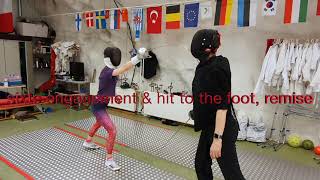
Ripostes to the foot require minimal forward commitment and maximum leg flexion. Rather than stepping forward, the defender bends the legs and lowers the torso to reach the low target while maintaining balance and blade control.
Distance Management Without Lunging
Proper parry-riposte execution relies on controlled distance rather than aggressive forward movement. Defenders should retreat only minimally during the parry phase, then adjust position through leg bending and slight weight shifts to reach varied targets efficiently.
Successful Epee Parry Riposte
Key Takeaways
- •Foundation of Parry-Riposte
- •Parry Four Mechanics
- •Distance Calibration in Drills
- •Selecting Parry Four or Six
Sorry had some camera focus problems, will be fixed for future videos! It is very simple, don't be lazy and take the bloody step back before parrying people. SURE YOU CAN DO WITHOUT IT...wait until you fence someone stronger/taller/quicker etc than you. If you want to win consistently then respect correct distance at all time, even when parrying the blade!
Related Techniques
Frequently Asked Questions
What does this video teach about epee parry?
This video covers foundation of parry-riposte, parry four mechanics, distance calibration in drills. It provides detailed instruction from Tim's Fencing Academy.
How long does it take to learn epee parry?
The basic mechanics can be understood in a single session, but developing reliable execution requires consistent drilling over weeks of practice. This 9-part breakdown helps structure your training by isolating each phase of the technique.
What are the key details for finishing epee parry?
Ripostes to the foot require minimal forward commitment and maximum leg flexion. Rather than stepping forward, the defender bends the legs and lowers the torso to reach the low target while maintaining balance and blade control.