Distance Control and Basic Footwork
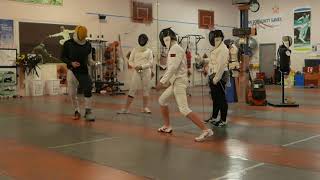
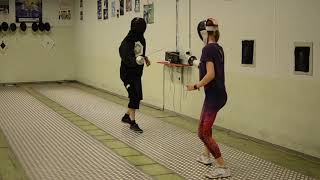
The instructor emphasizes proper distance management as a foundational skill in épée fencing. Students practice maintaining appropriate reach while keeping the tip elevated, executing simple advances and disengages to establish control of the fencing distance.
Indirect Counter-Attack Setup
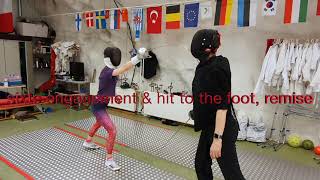
The instructor demonstrates a tactical sequence: provoking an opponent's attack, disengaging to create separation, and then executing a counter-attack to the arm. When the direct counter fails, the fencer shifts to an indirect stop-hit using a disengage on the opponent's parry response.
Tempo Control and Tactical Retreat
Rather than retreating out of fear, the fencer should use controlled backward movement as bait—a 'tactical retreat' that draws the opponent into range for a prepared stop-hit. The instructor stresses maintaining presence and control rather than panicking when facing an aggressive opponent.
Investigation Principle and Single Actions
The instructor advocates for attempting a single disengage or action before committing to more complex combinations. This 'investigation' approach allows the fencer to gather information about the opponent's defensive habits before executing a second-intention technique.
Posture and Non-Guard Positioning
Successful épée fencing relies on maintaining an upright, relaxed posture and neutral guard positions rather than overextending or leaning excessively. The instructor notes that once these fundamental positions become habitual through years of training, scoring becomes more intuitive and efficient.
Hand Targeting and Conservative Preparation
Attacks to the hand and wrist require restraint during initial preparation phases. The instructor advises that hand targeting should emerge naturally from investigation and controlled footwork rather than being executed prematurely or in isolation.
Finger Work and Lead Management
Fine motor control through finger and hand movements allows the fencer to adjust blade contact and create openings. When maintaining the attacking initiative, proper investigation of the opponent's responses enables the fencer to identify and exploit specific vulnerabilities through deliberate, rather than instinctive, actions.
Setting up Indirect Counter-Attack | Fencing Lesson | Epee
Key Takeaways
- •Distance Control and Basic Footwork
- •Indirect Counter-Attack Setup
- •Tempo Control and Tactical Retreat
- •Investigation Principle and Single Actions
Direct counter attack followed by indirect parry -riposte
Related Techniques
Frequently Asked Questions
What does this video teach about epee counter-attack?
This video covers distance control and basic footwork, indirect counter-attack setup, tempo control and tactical retreat. It provides detailed instruction from Tim's Fencing Academy.
How long does it take to learn epee counter-attack?
The basic mechanics can be understood in a single session, but developing reliable execution requires consistent drilling over weeks of practice. This 7-part breakdown helps structure your training by isolating each phase of the technique.
What are the key details for finishing epee counter-attack?
Attacks to the hand and wrist require restraint during initial preparation phases. The instructor advises that hand targeting should emerge naturally from investigation and controlled footwork rather than being executed prematurely or in isolation.