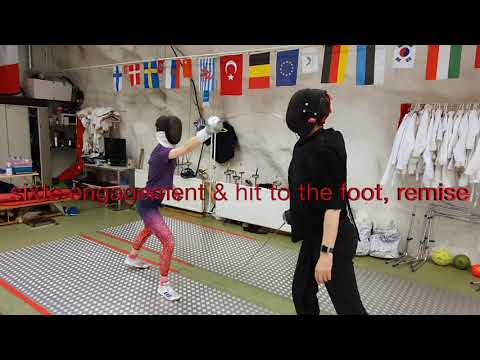
Epee Attack

SubFamily

エペ攻撃(Epe Kōgeki)

Hybrid

Translation: epee attack

Overview

The Epee Attack subfamily covers all offensive thrusting actions in epee, where the fencer extends the arm and advances to land the point on any part of the opponent's body. [1] Epee attacks are unique among the three weapons because there is no right-of-way convention — an attack does not gain priority, meaning both fencers can score simultaneously (double touch). [1],[2] This fundamentally changes attack strategy compared to foil or sabre: epee attacks must be executed with extreme precision and timing because a poorly timed attack invites a counter-attack that scores equally. [2],[3] Common epee attacks include the direct thrust, the disengage (deceiving the opponent's blade), and attacks to the hand, forearm, and foot — targets unique to epee. [3]

Also known as
Attaque d'Epee[1]Epee Offensive Action[2]

History & Origin

Epee attack technique evolved from duelling sword methodology, where the primary concern was striking without being struck in return. [1] The 'stop-hit to the hand' — an attack to the opponent's closest target — became a defining epee technique that has no equivalent in foil or sabre. [2],[3]

Effectiveness

Épée attacks can target any part of the body, making distance management and timing more critical than in foil or sabre. [1] The absence of right-of-way means both fencers can score simultaneously, rewarding patience and precision. [2]

Lineage

Épée attacking technique evolved from French duelling sword practice, with the emphasis on hitting without being hit reflecting actual duel conditions. [1]

Competition Record

Épée has been an Olympic event since 1900. [1] Notable champions include Edoardo Mangiarotti (Italy, 13 Olympic medals across career) and Pavel Kolobkov (Russia). [2]

Images

No images yet for this technique.

Sign in to suggest an image.

Biomechanical Mechanism

Primary ActionCutting, thrusting, or striking with a bladed weapon — edge alignment and trajectory determine cutting effectiveness
Joints InvolvedWrists (edge alignment and rotation), elbows (extension for thrusts, chambering for cuts), shoulders (arc of the cut), hips (power generation)
Force VectorVaries — downward diagonal cut (kesa-giri), horizontal cut (yoko-giri), thrust (tsuki), or rising cut (kiri-age)
Weapon MechanicEdge alignment (hasuji) is critical — the blade must travel along its cutting plane for effective cuts

Position & Entry

From en garde positionEstablish distance, extend the blade toward the target with a lunge or advance-lunge, recover to guard
As riposte (counter-attack)Parry the opponent's attack and immediately riposte with a thrust or cut to the exposed target
From distance (preparation)Use blade work (beats, feints, engagements) to create an opening before the final attack

Videos

Epee lesson

0
Epee Attack·Ivan Blagoev / Fencing & Music

Warm up, timing, choice of attacks, feint with disengagement, counter attack with binds, flèche & more

Epee Lesson

0
Epee Attack·Ivan Blagoev / Fencing & Music

Sixte and quarte counter-binds plus flick as an attack (with or without approach-step), or parry repost actions, remises

2 videos

Learn This Technique

No instructional courses yet for this technique.

Sign in to suggest a course.

Ratings

Danger Rating

Risk of injury to the person this technique is applied to

2
Low2/10

Modern sport fencing uses blunted weapons and full protective gear; injury rate ~2.5 per 1000 exposures (Harmer 2008)

Difficulty

Skill level needed to execute this technique reliably

Intermediate
Competition Legality

Whether this technique is allowed under major competition rule sets

FIE — Legal fencing technique — governed by FIE rules for...
FIE Rules of CompetitionPDF
HEMA — Legal in historical fencing competition {srcvarious organizations

Training Notes

Epee attacks are offensive actions designed to score a touch while minimizing exposure to the opponent's counter-attack — the absence of right of way makes every attack a calculated risk (Evangelista, The Art and Science of Fencing, 1996)
Epee attacks must account for the double touch: the attacker must either hit before the opponent can counter, or close the line (protect against the counter) while attacking
The primary epee attacks: direct attack (straight thrust to the nearest target), disengage attack (passing the blade to another line), and attack with preparation (advance, feint, then attack)
Attacks to the hand and forearm are primary in epee: these targets are closest, requiring the shortest extension
The 'attack au fer' (attack on the blade) — beat, press, or bind the opponent's blade before attacking to remove their counter-threat
Epee attacks are generally shorter than foil attacks: the risk of the counter-attack favours compact, efficient movements
The attack must be decisive: once committed, the attack should arrive before the opponent can establish a counter-attack

Common Mistakes

!Attacking without preparation — epee attacks require setup: feints, blade actions, or footwork to create the opening
!Ignoring the risk of the counter-attack — every attack exposes a forward target; protect while attacking
!Using only direct attacks — develop the full repertoire: disengage, coupe, attacks au fer
!Attacking from too far — the attack must arrive decisively; launching from excessive distance invites the counter
!Not closing the line during the attack — the blade must protect the attacker's line while delivering the touch
!Attacking the body exclusively — the hand and arm are often more accessible and safer targets
!Telegraphing the attack with preparatory movements — the attack should begin from the guard without visible preparation

Related Techniques

Counter Techniques

Setup Chain

1En Gardeassume the fencing ready position with proper blade presentation
2Advance/Lunge Preparationclose distance with footwork
3Attackexecute the touch with right-of-way (if applicable) and proper point/edge
4Recoveryreturn to en garde after the action

Sources & References

Primary Source

The Art of Fencing (Luigi Barbasetti, 1932)

1BookThe Art of Fencing (Barbasetti, 1932)

Alias sources — [1] FIE Rules of Competition [2] Classical Fencing (Rogers, 2014)

2BookOn Fencing (Nadi, 1943)

Effectiveness sources — [1] The Art and Science of Fencing (Evangelista, 1996) [2] FIE technical guidelines

3OtherJapanese Martial Arts Hybrid Terminology

Mixed Japanese-Western terminology — combines traditional Japanese terms with katakana loanwords

4CitationThe Art of Fencing (Barbasetti, 1932)

Alias sources — [1] FIE Rules of Competition [2] Classical Fencing (Rogers, 2014)

5CitationOn Fencing (Nadi, 1943)

Effectiveness sources — [1] The Art and Science of Fencing (Evangelista, 1996) [2] FIE technical guidelines

Community

Athletics

Requires

explosive lunge speed, finger/wrist dexterity, cardiovascular endurance

Favours

long reach (tall, long arms), fast-twitch legs

Key muscles

quadriceps (lunge), calves, forearm/finger flexors, core

Sub-techniques

Frequently Asked Questions

How does the Epee Attack work?

The Epee Attack subfamily covers all offensive thrusting actions in epee, where the fencer extends the arm and advances to land the point on any part of the opponent's body. Epee attacks are unique among the three weapons because there is no right-of-way convention — an attack does not gain priority, meaning both fencers can score simultaneously (double touch).

Where does the Epee Attack come from?

Epee attack technique evolved from duelling sword methodology, where the primary concern was striking without being struck in return. The 'stop-hit to the hand' — an attack to the opponent's closest target — became a defining epee technique that has no equivalent in foil or sabre.

Is the Epee Attack legal in competition?

FIE: legal — Legal fencing technique — governed by FIE rules for foil, épée, and sabre; HEMA: legal — Legal in historical fencing competition

How dangerous is the Epee Attack?

Danger rating 2/10. Low — modern sport fencing uses blunted weapons and full protective gear; injury rate ~2.5 per 1000 exposures (Harmer 2008)

How do I set up the Epee Attack?

The standard setup chain: En Garde → Advance/Lunge Preparation → Attack → Recovery.

How do I defend against the Epee Attack?

Standard counters include: Parry (Absetzen) — deflect the incoming blade with a counter-displacement / Void (Step Back) — withdraw from measure to avoid the cutting arc / Counter-Cut (Nachreisen) — strike into the opponent's opening during their attack.

What are the variants of the Epee Attack?

Common variants: Simple attack (single blade action (disengage, beat, or direct) to score); Compound attack (multiple blade actions (feint then disengage) to create a…); Riposte (immediate counter after a successful parry); Counter-attack (attacking into the opponent's attack with priority or rig…).

How effective is the Epee Attack in competition?

Épée has been an Olympic event since 1900. Notable champions include Edoardo Mangiarotti (Italy, 13 Olympic medals across career) and Pavel Kolobkov (Russia).

What are common mistakes when doing the Epee Attack?

Top errors to watch for: Attacking without preparation — epee attacks require setup: feints, blade actions, or footwork to create the opening / Ignoring the risk of the counter-attack — every attack exposes a forward target; protect while attacking / Using only direct attacks — develop the full repertoire: disengage, coupe, attacks au fer / Attacking from too far — the attack must arrive decisively; launching from excessive distance invites the counter.

What are other names for the Epee Attack?

The Epee Attack is also known as Epe Kōgeki, Attaque d'Epee, Epee Offensive Action.