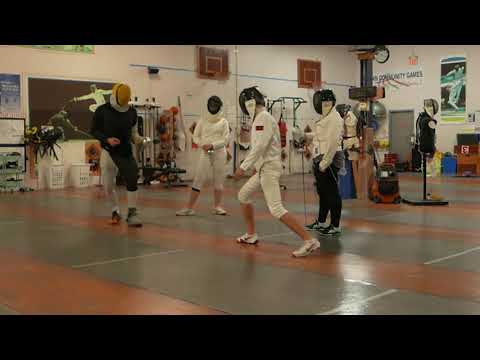
Successful Epee Parry Riposte
0
Epee Parry·Tim's Fencing Academy
Sorry had some camera focus problems, will be fixed for future videos! It is very simple, don't be lazy and take the bl…
Translation: epee parry
The Epee Parry subfamily covers all blade-deflection actions in epee, where the fencer uses their blade to redirect or block an incoming thrust before responding with a riposte. [1] Parries in epee must cover a wider defensive area than in foil because the entire body is a valid target — the fencer must be prepared to parry attacks to the hand, arm, leg, and torso, not just the torso. [1],[2] Epee parries tend to be smaller and more precise than sabre parries, using minimal blade movement to deflect the incoming point while maintaining readiness for the riposte. [2],[3]
Épée parry technique was adapted from classical foil and smallsword parries but expanded to cover the full body target area. [1]
Parry-riposte remains an effective scoring pattern in Olympic épée, though counter-attacks and remise actions are more common than in foil. [1]
No images yet for this technique.
Sign in to suggest an image.
Sorry had some camera focus problems, will be fixed for future videos! It is very simple, don't be lazy and take the bl…
Delivered as part of the FIE Epee Coaching Academy in Budapest from Hungarian coach educator, Bela Kopetka. They aim to …
No instructional courses yet for this technique.
Sign in to suggest a course.
Risk of injury to the person this technique is applied to
Modern sport fencing uses blunted weapons and full protective gear; injury rate ~2.5 per 1000 exposures (Harmer 2008)
Skill level needed to execute this technique reliably
Whether this technique is allowed under major competition rule sets
The Art of Fencing (Luigi Barbasetti, 1932)
Alias sources — [1] FIE Rules of Competition [2] Classical Fencing (Rogers, 2014)
Effectiveness sources — [1] The Art and Science of Fencing (Evangelista, 1996) [2] FIE coaching manuals
Mixed Japanese-Western terminology — combines traditional Japanese terms with katakana loanwords
Alias sources — [1] FIE Rules of Competition [2] Classical Fencing (Rogers, 2014)
Effectiveness sources — [1] The Art and Science of Fencing (Evangelista, 1996) [2] FIE coaching manuals
explosive lunge speed, finger/wrist dexterity, cardiovascular endurance
long reach (tall, long arms), fast-twitch legs
quadriceps (lunge), calves, forearm/finger flexors, core
Every move, in any martial art, shares a few universal traits. Mix and match below to pinpoint the right tool — or compare equivalents across styles.
Beth Speedy explains that you must start a rear parry (like grazing six) earlier to be ready in time, whereas a ceding parry can happen a moment later because it's only a modification of the wrist.
Tim's Fencing Academy emphasizes that maintaining distance at the moment your opponent attacks is most important; taking a step back as they advance gets them off balance and stretched out, setting up your parry and riposte.
Tim's Fencing Academy advises taking only a small step back—just an inch or so—rather than jumping back five inches, and to bend your legs and sit low to maintain reach; stepping back too much prevents you from reaching your opponent for the riposte.
Tim's Fencing Academy confirms that with a parry you can riposte to any target, and recommends becoming proficient at hitting the hand, elbow, shoulder, and other areas depending on the situation.
The Epee Parry subfamily covers all blade-deflection actions in epee, where the fencer uses their blade to redirect or block an incoming thrust before responding with a riposte. Parries in epee must cover a wider defensive area than in foil because the entire body is a valid target — the fencer must be prepared to parry attacks to the hand, arm, leg, and torso, not just the torso.
Epee parry technique was adapted from classical small sword fencing, where parries needed to protect the entire body from thrusting attacks. The traditional eight parry positions (prime through octave) were inherited from French and Italian fencing schools.
FIE: legal — Legal fencing technique — governed by FIE rules for foil, épée, and sabre; HEMA: legal — Legal in historical fencing competition
Danger rating 2/10. Low — modern sport fencing uses blunted weapons and full protective gear; injury rate ~2.5 per 1000 exposures (Harmer 2008)
The standard setup chain: En Garde → Advance/Lunge Preparation → Attack → Recovery.
Standard counters include: Beat Parry — deflect the blade with a sharp lateral beat before it reaches target / Displacement — move the body off the line while threatening with the point / Counter-Thrust — extend into the attacker's line during their advance.
Common variants: Simple attack (single blade action (disengage, beat, or direct) to score); Compound attack (multiple blade actions (feint then disengage) to create a…); Riposte (immediate counter after a successful parry); Counter-attack (attacking into the opponent's attack with priority or rig…).
Parry-riposte remains an effective scoring pattern in Olympic épée, though counter-attacks and remise actions are more common than in foil.
Top errors to watch for: Making parries too large — the parry should move the opponent's blade just enough to clear the target / Not riposting immediately after the parry — in epee, the opponent can withdraw and re-attack; the riposte must be imm… / Using the same parry for all attacks — different attack lines require different parry positions / Parrying with a stiff arm — the parry should use the wrist and forearm with a relaxed shoulder.
The Epee Parry is also known as Epe Uke, Parade d'Epee, Epee Defence.