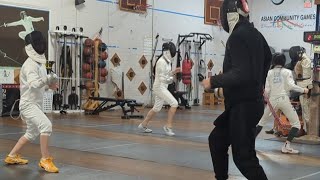
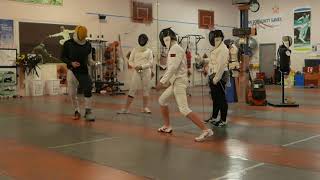
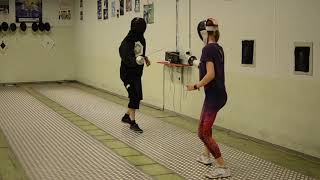
Introduction to Counter-Attack Setup
The instructor introduces a lesson on setting up counter-attacks in épée fencing, focusing on three distinct methodologies. The session begins on strip six with live demonstration and partner work.
First Method: Hand Target Provocation
The first counter-attack technique involves baiting the opponent's hand by stepping forward and lifting the tip to expose it. The fencer waits for the opponent to commit to a stop hit on the hand, then executes a lunge to score on the now-open target. This drill requires five attempts per partner before switching roles.
Varying Target Presentation
Rather than repeatedly exposing the same target, the defender rotates between presenting the hand, torso, and foot on successive advances. The attacker must adjust their stop-hit distance accordingly, learning to recognize and capitalize on different openings while maintaining proper spacing to execute the counter-attack.
Blade-Based Counter-Attack: Anticipated Remise
The second major method involves baiting the opponent's blade rather than a body part. The defender extends a half-arm, waiting for the opponent to make a beat on quarte, then performs an anticipated remise with angulation before the opponent can complete their attack. This technique proves particularly effective against opponents who execute beats followed by flashes.
Absorption and Angled Extension
Proper execution requires the defender to absorb the incoming beat with their arm rather than simply retreating, creating a genuine opening for the counter-attack. The defender must extend with angulation, particularly targeting the inside of the elbow, while the attacker commits to their original line.
Second Intention Counter-Attack
The third method employs second-intention timing, where the defender intentionally provokes the opponent's parry response on a particular line. As the opponent commits to the parry, the defender performs a counter-attack on the opposite side, stepping back to create distance and capitalize on the opponent's commitment.
3 Ways to Counter-Attack | Group Lesson | Epee
Key Takeaways
- •Introduction to Counter-Attack Setup
- •First Method: Hand Target Provocation
- •Varying Target Presentation
- •Blade-Based Counter-Attack: Anticipated Remise
Here are a few different looks on how to set up counter attacks
Related Techniques
Frequently Asked Questions
What does this video teach about epee counter-attack?
This video covers introduction to counter-attack setup, first method: hand target provocation, varying target presentation. It provides detailed instruction from Tim's Fencing Academy.
How long does it take to learn epee counter-attack?
The basic mechanics can be understood in a single session, but developing reliable execution requires consistent drilling over weeks of practice. This 6-part breakdown helps structure your training by isolating each phase of the technique.
What are the key details for finishing epee counter-attack?
Proper execution requires the defender to absorb the incoming beat with their arm rather than simply retreating, creating a genuine opening for the counter-attack. The defender must extend with angulation, particularly targeting the inside of the elbow, while the attacker commits to their original line.