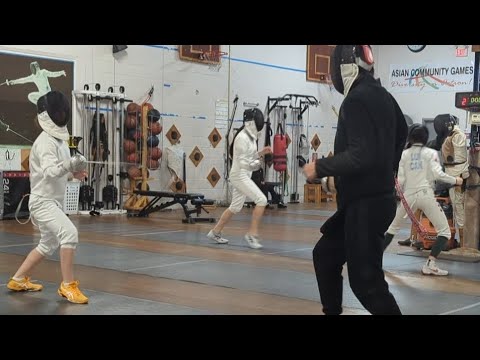
3 Ways to Counter-Attack | Group Lesson | Epee
0
Epee Counter-Attack·Tim's Fencing Academy
Here are a few different looks on how to set up counter attacks
Translation: epee counter-attack
The Epee Counter-Attack subfamily covers defensive-offensive actions in epee where the fencer responds to an opponent's attack by striking first or simultaneously, exploiting the absence of right-of-way rules. [1] Counter-attacks are arguably more central to epee than to any other fencing weapon because epee's rules allow a fencer to score by hitting the attacker during their attack — there is no penalty for being 'attacked into' as there is in foil and sabre. [1],[2] The stop hit (arrêt) — a counter-attack that lands before or simultaneously with the opponent's attack — is the quintessential epee tactic, particularly when directed at the opponent's advancing hand or arm. [2],[3]
Counter-attack technique in epee derives from the duelling principle of the 'time thrust' (temps), where a defender would simultaneously parry and riposte or strike into the attacker's advance. [1] The development of electronic scoring made simultaneous counter-attacks (double touches) objectively measurable, refining counter-attack timing to within 40 milliseconds (the lockout time in epee). [2],[3]
Counter-attacking in épée developed as fencers recognised that the absence of right-of-way rewarded hitting first regardless of who initiated. [1]
Counter-attacking is a hallmark of elite épée competition, with defensive-counter styles dominating at many World Championships. [1]
No images yet for this technique.
Sign in to suggest an image.
Here are a few different looks on how to set up counter attacks
Direct counter attack followed by indirect parry -riposte
No instructional courses yet for this technique.
Sign in to suggest a course.
Risk of injury to the person this technique is applied to
Modern sport fencing uses blunted weapons and full protective gear; injury rate ~2.5 per 1000 exposures (Harmer 2008)
Skill level needed to execute this technique reliably
Whether this technique is allowed under major competition rule sets
The Art of Fencing (Luigi Barbasetti, 1932)
Alias sources — [1] FIE Rules of Competition [2] Classical Fencing (Rogers, 2014) [3] Classical Fencing (Rogers, 2014)
Effectiveness sources — [1] The Art and Science of Fencing (Evangelista, 1996) [2] FIE technical guidelines
Mixed Japanese-Western terminology — combines traditional Japanese terms with katakana loanwords
Alias sources — [1] FIE Rules of Competition [2] Classical Fencing (Rogers, 2014) [3] Classical Fencing (Rogers, 2014)
Effectiveness sources — [1] The Art and Science of Fencing (Evangelista, 1996) [2] FIE technical guidelines
explosive lunge speed, finger/wrist dexterity, cardiovascular endurance
long reach (tall, long arms), fast-twitch legs
quadriceps (lunge), calves, forearm/finger flexors, core
Every move, in any martial art, shares a few universal traits. Mix and match below to pinpoint the right tool — or compare equivalents across styles.
According to Tim's Fencing Academy, you can bait your opponent by showing different target areas—the hand, body, or toe—and then anticipating their stop hit. You can also give a half extension to make your opponent want to carry your blade, then execute an anticipated remise or disengage to create the opening for your counter-attack.
If your direct stop hit fails, Tim's Fencing Academy teaches that you should move your tip out of the way and use an indirect counter-attack. Your opponent will likely fight back against your blade movement, and that's when you can disengage and score with a second-intention counter-attack.
Tim's Fencing Academy emphasizes using tactical retreat—stepping back to suck your opponent in rather than retreating out of fear. This controlled backward movement sets them up to commit to an attack, creating the opening you need for your counter-attack. Each step should have purpose and help reset opportunities for scoring.
Tim's Fencing Academy stresses that you must prove to your opponent through consistent execution that you will counter-attack their advances on specific targets. Your opponent has to believe they will be picked up on counter-attacks, so they'll eventually hesitate or give you the opening (called a refus) you need to score.
The Epee Counter-Attack subfamily covers defensive-offensive actions in epee where the fencer responds to an opponent's attack by striking first or simultaneously, exploiting the absence of right-of-way rules. Counter-attacks are arguably more central to epee than to any other fencing weapon because epee's rules allow a fencer to score by hitting the attacker during their attack — there is no penalty for being 'attacked into' as there is in foil and sabre.
Counter-attack technique in epee derives from the duelling principle of the 'time thrust' (temps), where a defender would simultaneously parry and riposte or strike into the attacker's advance. The development of electronic scoring made simultaneous counter-attacks (double touches) objectively measurable, refining counter-attack timing to within 40 milliseconds (the lockout time in epee).
FIE: legal — Legal fencing technique — governed by FIE rules for foil, épée, and sabre; HEMA: legal — Legal in historical fencing competition
Danger rating 2/10. Low — modern sport fencing uses blunted weapons and full protective gear; injury rate ~2.5 per 1000 exposures (Harmer 2008)
The standard setup chain: En Garde → Advance/Lunge Preparation → Attack → Recovery.
Standard counters include: Guard Position — return to a defensive ready stance / Distance Management — control the measure to avoid being in range / Counter-Attack — strike during the opponent's recovery or between movements.
Common variants: Simple attack (single blade action (disengage, beat, or direct) to score); Compound attack (multiple blade actions (feint then disengage) to create a…); Riposte (immediate counter after a successful parry); Counter-attack (attacking into the opponent's attack with priority or rig…).
Counter-attacking is a hallmark of elite épée competition, with defensive-counter styles dominating at many World Championships.
Top errors to watch for: Attempting the counter-attack too late — the counter must arrive before the attack to score alone / Counter-attacking against a feint — feints draw premature counter-attacks; only counter committed attacks / Not targeting the nearest part of the attacker — the advancing hand or arm is the optimal counter-attack target / Using the counter-attack without point control — the thrust must be precise despite the attacker's incoming movement.
The Epee Counter-Attack is also known as Epe Hangeki, Contre-Attaque, Arret, Stop Hit.