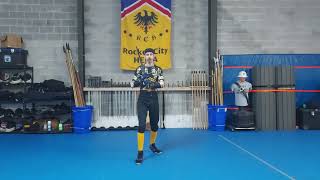
Introduction to Scheitelhau
The Scheitelhau (translated as "squinting strike") is a versatile technique effective against both extended and close-range sword positions. This lesson covers applications against long point and short guard positions, demonstrating why this technique merits extended study.
Deceiving with Gaze Against Long Point
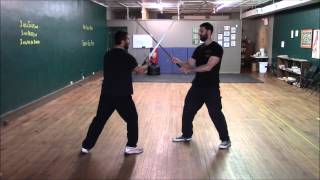
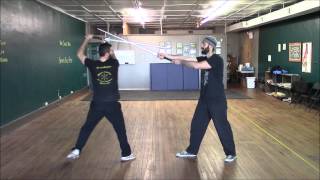
When the opponent maintains long point at distance, the practitioner employs visual misdirection by appearing to attack the sword while actually targeting the neck. The instructor maintains eye contact with the opponent's point while executing a cut over the sword that sets up a throat thrust.
Exploiting Defensive Reactions to Long Point
If the opponent withdraws their sword or raises their point to escape an apparent cut to their blade, the Scheitelhau continues through with a cut over the top of the sword into the neck. This technique succeeds whether the opponent holds their ground or attempts to parry the anticipated lower cut.
Head Feint Transitioning to Hand Cut
A secondary application against long point involves feinting a cut to the head to provoke an upward defensive movement. The practitioner then executes a Scheitelhau cut to the hands using the short edge from an unexpected angle, bypassing the opponent's hilt entirely.
Scheitelhau Against Short Guard Positions
The technique proves equally effective against opponents fighting from close guard positions such as plow, ox, or other defensive stances. In these situations, the Scheitelhau serves as a setup for displacing the opponent's sword to enable further attacks.
Recognizing Short Fighting Tendencies
Experienced practitioners should identify whether their opponent favors short-range defensive tactics early in the engagement. Recognizing these patterns allows the swordsman to employ the Scheitelhau proactively rather than reacting to committed attacks.
Scheitelhau Setup for Displacement
Against a defending opponent, the Scheitelhau can be executed with or without a step to position the practitioner on the far side of the opponent's blade. This displacement allows a follow-up thrust to the body or face while maintaining defensive positioning.
Binding and Winding After Displacement
After cutting around the opponent's sword with the Scheitelhau, the practitioner winds outward to bind on the far side of the blade before thrusting. This binding motion provides superior safety by controlling the opponent's sword during the final attack.
Disguising Range Through Short Fencing
When anticipating an opponent's defensive posture, the practitioner can pull their own sword short while appearing to commit a full-distance cut. This deception causes the opponent to misjudge range and distance, enabling a closer-range thrust to exploit their defensive setup.
Schielhau, Long and Short: Longsword Lesson 12
Key Takeaways
- •Introduction to Scheitelhau
- •Deceiving with Gaze Against Long Point
- •Exploiting Defensive Reactions to Long Point
- •Head Feint Transitioning to Hand Cut
Whether the opponent is fighting long or fighting short, the versatile Schielhau wins! I'm glad that many people find our videos useful, but please don't assume that anything shown in them is the only way to do something. We experimented with multiple variations of the techniques demonstrated here, and even continued experimenting after filming. It is my hope that no one is so set in their ways that they are unwilling to challenge their own ideas/interpretations. Keeping an open mind will ultimately take us farther. So, feel free to discuss and offer other possibilities, but let's not waste time arguing. You guys rock!
Frequently Asked Questions
What does this video teach about scheitelhau?
This video covers introduction to scheitelhau, deceiving with gaze against long point, exploiting defensive reactions to long point. It provides detailed instruction from Sword Carolina.
How long does it take to learn scheitelhau?
The basic mechanics can be understood in a single session, but developing reliable execution requires consistent drilling over weeks of practice. This 9-part breakdown helps structure your training by isolating each phase of the technique.
What are the key details for finishing scheitelhau?
After cutting around the opponent's sword with the Scheitelhau, the practitioner winds outward to bind on the far side of the blade before thrusting. This binding motion provides superior safety by controlling the opponent's sword during the final attack.