Scheitelhau: Longsword Lesson 13
0
Scheitelhau·Sword Carolina
In the first HEMA class I ever took, the instructor said that the Scheitelhau was a worthless cut and didn't work. Noth…
Translation: parting strike / crown cut (vertical descending longsword cut)
The Scheitelhau (Parting Strike) is one of the five master cuts (Meisterhauwe) of the German longsword tradition. [1] It is a vertical descending cut delivered straight down onto the crown of the opponent's head, splitting along the centerline. [1] Among the five master cuts, the Scheitelhau is the simplest in trajectory but requires precise timing and distance — it is most effective against an opponent in a low guard (such as Alber or Schrankhut) where the head is exposed and the blade cannot rise quickly enough to parry. [1] The cut is delivered with the true edge from a high position, using gravity and arm extension. [1]
The Scheitelhau is one of the five Meisterhauwe (master cuts) attributed to Johannes Liechtenauer's German longsword tradition. [1] The five master cuts — Zornhau, Krumphau, Zwerchau, Schielhau, and Scheitelhau — form the core offensive system of the Kunst des Fechtens (Art of Fighting). Each master cut is designed to defeat a specific guard or situation. [1]
German longsword lineage: Johannes Liechtenauer (14th century) → transmitted through the Gesellschaft Liechtenauers (Society of Liechtenauer) → documented in Fechtbücher by Sigmund Ringeck (c. 1440), Peter von Danzig (1452), Hans Talhoffer (1459), and Paulus Kal (1470). Reconstructed in modern HEMA from manuscript study beginning in the 1990s–2000s. [1]
Used in modern HEMA longsword tournaments sanctioned by HEMAA, HEMA Alliance, and regional federations. Scoring varies by ruleset (afterblow, first-touch, or exchange-based). [1]
No images yet for this technique.
Sign in to suggest an image.
In the first HEMA class I ever took, the instructor said that the Scheitelhau was a worthless cut and didn't work. Noth…
We are pleased that so many of you find these videos useful in your training, especially those of you fairly new to HEMA…
Whether the opponent is fighting long or fighting short, the versatile Schielhau wins! I'm glad that many people find ou…
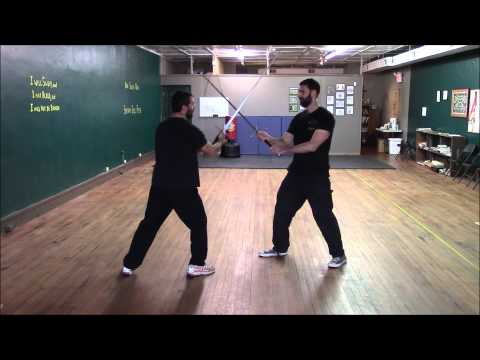
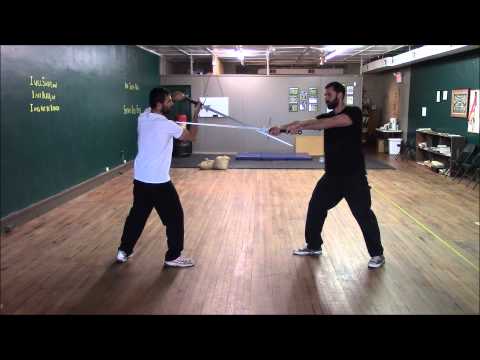
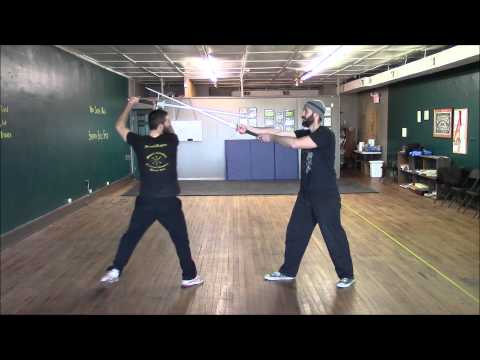
The Scheitelhau (also transliterated as Schielhau or shield how) is a vertical overhead strike derived from the Oberhau, distinguished by its straight downward trajectory aimed at the opponent's head or scalp rather than the diagonal entry of a Zornhau. According to Sword Carolina instructors, the defining characteristic is maintaining high hand position throughout the technique to maximize range, prevent defense, and transition smoothly into follow-up attacks—contrasting with techniques that conclude in low guards like Alber. The strike functions simultaneously as offense and defense, particularly effective against aggressive, forceful opponents (Buffel). When the defender blocks with Kron (point and hilt positioned above the head), the attacker can grab the pommel and thrust over the sword toward the face, then wind into Ox guard for a chest thrust if deflected laterally. The Scheitelhau disrupts the opponent's Durchwechsel (changing through), as the downward cut keeps the attacker's point online while the defender repositions. Against long-point distance, the technique can feint a cut to the head while thrusting to the throat, or feint toward the head to draw an upward block before cutting the hands. Against short guards (Plow, Ox, hangars), it enables a Durchwechsel to thrust on the sword's opposite side. Close-range defenses include winding into Ox to slice the opponent's arms and prevent wrestling entries. All three Sword Carolina videos emphasize experimental variation and contextual application rather than rigid execution.
Synthesized from 3 instructors
No instructional courses yet for this technique.
Sign in to suggest a course.
Risk of injury to the person this technique is applied to
A vertical cut to the crown of the head with a longsword is lethal.
Skill level needed to execute this technique reliably
Whether this technique is allowed under major competition rule sets
Clements, J. Medieval Swordsmanship. Paladin Press.
[1] Clements, Medieval Swordsmanship, Five Master Cuts chapter
[1] Clements, Medieval Swordsmanship, Five Master Cuts chapter
shoulder strength to control the descending cut, distance judgment
deltoids, triceps, core (stability during the cut)
The Scheitelhau (parting/crown cut) is one of the five Meisterhauwe (master cuts) of the Liechtenauer tradition — a vertical descending cut straight down onto the crown of the head. It is the simplest master cut in trajectory but requires precise timing, designed specifically to defeat the Alber (fool's) guard. (Clements, Medieval Swordsmanship; Tobler, Secrets of German Medieval Swordsmanship)
Don't stay in the same position after the thrust—quickly move into a defensive position. Even if you stab your opponent through the chest, they can still attack you with an after-blow, so you need to transition to defense immediately rather than getting stuck in the thrust position.
As your opponent closes in underneath your sword, transition from a thrust to a slice against their arms. This prevents them from entering into wrestling and may also damage their arms. You can use the same basic movement but vary the range and finish, adapting from a chest thrust to an arm slice as they get closer.
Yes—the Scheitelhau works against both long point and close range fighters. When facing Longpoint, you can feint a cut to the head to make them raise their hands to defend, then come in with the Scheitelhau to cut their hands instead, breaking their counter-setup.
By keeping your sword at greater range with the Scheitelhau, you make it harder for your opponent to hit you without being struck themselves, since they won't be able to reach you without closing distance where you can attack.
The Scheitelhau (Parting Strike) is one of the five master cuts (Meisterhauwe) of the German longsword tradition. It is a vertical descending cut delivered straight down onto the crown of the opponent's head, splitting along the centerline.
The Scheitelhau is one of the five Meisterhauwe (master cuts) attributed to Johannes Liechtenauer's German longsword tradition. The five master cuts — Zornhau, Krumphau, Zwerchau, Schielhau, and Scheitelhau — form the core offensive system of the Kunst des Fechtens (Art of Fighting).
HEMA tournaments: Legal: legal — standard technique in longsword competition; SCA Heavy Combat: Legal: legal — permitted in armored combat; HEMAA/HEMA Alliance: Legal: legal — recognized in all affiliated tournaments
Danger rating 10/10. Extreme — a vertical cut to the crown of the head with a longsword is lethal.
The standard setup chain: Opponent adopts Alber → Scheitelhau to the crown → Feint a diagonal cut → opponent moves guard offline → Scheitelhau down the center → After a successful Absetzen → opponent drops guard → immediate Scheitelhau.
Standard counters include: Vom Tag — hold high guard to easily parry vertical cuts / Ochs — thrust forward under the descending blade / Absetzen — set aside the cut with a counter-thrust.
Common variants: Short Scheitelhau (executed from close range with a shorter arc); Long Scheitelhau (full extension from Vom Tag with maximum power); Stepping Scheitelhau (combined with a forward lunge step); Scheitelhau to the hands (targeting the opponent's extended hands instead of the head).
Used in modern HEMA longsword tournaments sanctioned by HEMAA, HEMA Alliance, and regional federations. Scoring varies by ruleset (afterblow, first-touch, or exchange-based).
Top errors to watch for: Cutting offline — the Scheitelhau must travel the exact centerline / Not stepping forward — the cut arrives without reach / Telegraphing by raising the sword too slowly / Using against an opponent in Vom Tag — they can easily parry a vertical cut from above.
The Scheitelhau is also known as Shaiteruhau, Crown Cut, Parting Strike, Vertex Cut, Scheitelhauw.