Introduction to the X Pass Segment
This instructional series focuses on the X pass, one of the most fundamental yet frequently misunderstood guard passing techniques in Brazilian Jiu-Jitsu. The instructor emphasizes that despite its apparent simplicity, proper execution requires understanding specific control principles and positioning. This foundational video establishes the basics and control mechanics necessary for effective application.
The One-In-One-Out Passing Position
The one-in-one-out position forms the foundation for the X pass and most guard passing sequences. This position is characterized by placing one leg inside the opponent's guard (between their legs) while keeping one leg outside. Understanding and maintaining this fundamental passing position is essential for executing the X pass from various guard types, including De la Riva, spider guard, and lasso guard.
Grip Setup and Conceptual Framework
The X pass employs same-side collar and pants grips in gi, or chest and knee controls in no-gi. Rather than focusing solely on grip specifics, practitioners should understand the conceptual control principles: upper body pressure through the collar/chest and lower body control via the knee/pants. This flexible framework allows the technique to transfer seamlessly between gi and no-gi applications.
Leg Placement and Pressure Distribution
A critical error in X pass execution involves kicking only at the knee crook rather than at the groin and quadriceps. The passing leg must drive upward through the opponent's thigh with maximal pressure, requiring the passer to shift their body weight completely onto the non-passing leg. This weight transfer, often involving a slight jump, concentrates the passer's full body mass onto the passing leg for maximum effectiveness.
Weight Shift Mechanics and Execution
Successful X pass execution depends on precise weight distribution timing. The passer begins with pressure concentrated on the upper body grip, then simultaneously shifts all weight to the leg opposite the passing leg while driving the passing leg upward and pushing the opponent's leg downward. This explosive weight transfer generates the necessary force to clear the guard and establish a dominant position.
Position Transition to Knee-on-Belly
Rather than attempting an immediate transition to side control, the passer moves directly to knee-on-belly as an intermediate position. This prevents the opponent from exploiting the space between positions and positions the passer to either maintain knee-on-belly control or transition to a leg drag pass. The knee-on-belly position serves as a bridge to more dominant finishing positions.
Leg Control and Shrimp Prevention
Once in knee-on-belly, the passer must control the opponent's leg by pulling it upward rather than continuing to drive it away. This counter-intuitive positioning prevents the opponent from using their leg to generate shrimping momentum and escape the position. Proper leg management during this phase is crucial for maintaining positional dominance.
Finishing Options: Leg Drag Transition
From the knee-on-belly position, the passer can seamlessly transition to a leg drag pass by repositioning their legs and extending their back leg. The leg drag provides a more complete control structure and clearer path to side control. Understanding this finishing option demonstrates how the X pass integrates into a broader passing system.
No-Gi Application and Practical Adaptability
The X pass translates directly to no-gi grappling with minimal conceptual changes: chest pressure replaces collar control, and hand-on-leg replaces pants grips. The same weight distribution, leg placement, and timing principles apply regardless of gi or no-gi context. This versatility makes the X pass one of the most reliable and consistently applicable guard passing techniques.
Speed and Reactivity in Live Grappling
The X pass's simplicity and speed make it an ideal reactive technique during hand-fighting exchanges and when opponents attempt to re-establish guard position. Because execution requires minimal setup time, practitioners can deploy the X pass quickly when opponents sit up or shift positioning. This responsiveness distinguishes the X pass as both a systematic technique and a practical tool for dynamic grappling situations.
X Pass Basics and Control Principles
Key Takeaways
- •Introduction to the X Pass Segment
- •The One-In-One-Out Passing Position
- •Grip Setup and Conceptual Framework
- •Leg Placement and Pressure Distribution
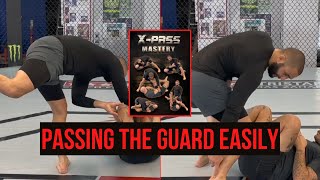
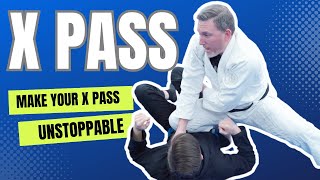
X PASS BASICS AND CONTROL PRINCIPLES // In this video I demonstrate some of the basics and principles of the X Pass. The X Pass is one of the most simple ways to pass the guard in bjj. It is a guard pass that requires almost no athleticism and it is not very technical. The most important attribute for a good x pass is timing. If you missed any of my recent leg drag videos check below: leg drag basics and principles - https://www.youtube.com/watch?v=bAxn19Pwf1c&t=16s leg drag vs open guard - https://www.youtube.com/watch?v=gxSukmVyFs8&t=3s leg drag vs de la riva - https://www.youtube.com/watch?v=1pgrTVDUWT8&t=11s leg drag vs reverse de la riva - https://www.youtube.com/watch?v=X_6WGs7wv1E&t=1s leg drag vs spider guard - https://www.youtube.com/watch?v=Udx7pSvGMZs&t=1s leg drag vs lasso guard - https://www.youtube.com/watch?v=krZNkYcIrTE&t=237s I am a Marcelo Garcia Brown Belt, Bernardo Faria Academy Instructor and avid Brazilian Jiu Jitsu competitor. Thanks for visiting my channel! Don't forget to LIKE & SUBSCRIBE FOR MORE! OSS!
Frequently Asked Questions
What does this video teach about x pass?
This video covers introduction to the x pass segment, the one-in-one-out passing position, grip setup and conceptual framework. It provides detailed instruction from Aaron Benzrihem bjj.
How long does it take to learn x pass?
The basic mechanics can be understood in a single session, but developing reliable execution requires consistent drilling over weeks of practice. This 10-part breakdown helps structure your training by isolating each phase of the technique.
What are the key details for finishing x pass?
The X pass translates directly to no-gi grappling with minimal conceptual changes: chest pressure replaces collar control, and hand-on-leg replaces pants grips. The same weight distribution, leg placement, and timing principles apply regardless of gi or no-gi context. This versatility makes the X pass one of the most reliable and consistently applicable guard passing techniques.