Introduction to the X Pass
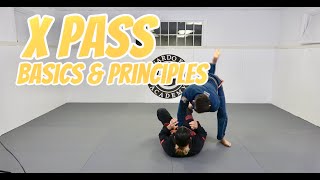
The X Pass is a specific guard passing technique that arrives at the same end position as the knee cut and folding pass—headquarters—but through a distinct mechanical approach. This pass becomes available whenever the opponent's legs are open and extended.
Initial Control and Positioning
The instructor establishes control by gripping the opponent's lapel at approximately mid-chest height and pulling their shoulders off the mat. The passing leg is stepped in deeply with the shin creating significant pressure on the foot, while maintaining an upright posture with feet flat on the floor. This connection prevents the opponent from creating space through kicks or sweep attempts.
Grip Setup and Mechanics
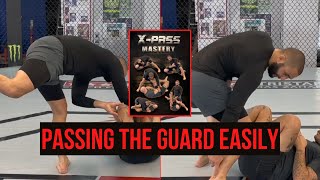
The X Pass requires two primary grips: one on the gi lapel to control the upper body, and another on the outside of the opponent's trousers at the knee level. Weight is shifted onto the outside leg, enabling the inside leg to execute a powerful hip-driven donkey kick rather than a simple leg flick. The kick must be forceful enough to prevent the opponent from easily following the leg's trajectory.
Completing the Pass Position
After the donkey kick clears the opponent's leg, the instructor punches across with the grip on the trousers and places the foot directly next to the opponent's hip. An additional step outward establishes balance before driving into the knee-on-belly position. The initial grips are maintained to control turning and prevent the opponent from establishing floor pressure with their leg.
Baiting with Preceding Passes
The X Pass functions most effectively as a reactive technique after attempting other passes, such as the knee cut or folding pass. When the opponent defends these initial attacks by centering their hips or bringing their legs back together, they become preoccupied with the original threat. This moment of divided focus provides the optimal opportunity to execute the X Pass.
The Timing Hop and Weight Transfer
A subtle hop with the outside leg—rising only one to two inches from the floor—accomplishes two critical objectives: it allows the passing leg to rise higher and enables the instructor to transfer bodyweight entirely through the legs rather than relying on arm strength. This technique compounds the effectiveness of the X Pass by adding explosive power and commitment to the movement. The hop should be executed as the opponent reacts defensively to the preceding pass setup.
Dynamic Execution Against Resistance
The instructor demonstrates the X Pass against a defending opponent who actively drives their hips to center and defend the initial knee cut or folding pass. By committing to the bait pass first, the instructor draws the opponent's defensive energy before explosively executing the X Pass with the timing hop. This sequence shows how the technique functions in realistic sparring conditions rather than static drilling.
BJJ X Pass || Make Your X Pass UNSTOPPABLE
Key Takeaways
- •Introduction to the X Pass
- •Initial Control and Positioning
- •Grip Setup and Mechanics
- •Completing the Pass Position
BJJ X Pass - If you are using headquarters to pass guard (Which you should be) X Pass is a must know! In this video we look at how to fundamentally do the x pass then we look at how to set it up and also some details on how to make your pass more effective. #bjj #jiujitsu #xpass Please don't forget to 'LIKE' this video and if you enjoyed the content please make sure you leave a 'COMMENT' and 'SUBSCRIBE' to the channel ... Thank you ❤️ // LINKS Facebook https://www.facebook.com/Oaebjjonline Instagram https://www.instagram.com/oae_bjjonline Webpage / Online Courses https://oaebjjonline.thinkific.com // SPONSORS Shoyoroll Europe https://shoyoroll-uk.myshopify.com
Frequently Asked Questions
What does this video teach about x pass?
This video covers introduction to the x pass, initial control and positioning, grip setup and mechanics. It provides detailed instruction from The Grapple Lab.
How long does it take to learn x pass?
The basic mechanics can be understood in a single session, but developing reliable execution requires consistent drilling over weeks of practice. This 7-part breakdown helps structure your training by isolating each phase of the technique.
What are the key details for finishing x pass?
A subtle hop with the outside leg—rising only one to two inches from the floor—accomplishes two critical objectives: it allows the passing leg to rise higher and enables the instructor to transfer bodyweight entirely through the legs rather than relying on arm strength. This technique compounds the effectiveness of the X Pass by adding explosive power and commitment to the movement. The hop should be executed as the opponent reacts defensively to the preceding pass setup.