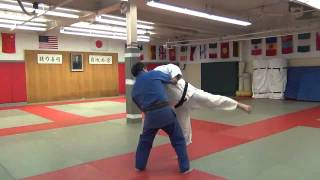
Ko Soto Gari as a Setup Technique
Ko Soto Gari functions as an effective fake or setup for more powerful finishing throws. When the opponent escapes or defends against the initial Ko Soto Gari attempt, the practitioner transitions into O Soto Gari, O Soto Garuma, or O Soto Otoshi. This combination approach teaches practitioners to develop fast, manipulative footwork similar to a boxer's hand combinations.
Hand Placement and Control
Proper hand positioning is critical to the success of Ko Soto Gari combinations. The left hand should maintain a tight grip and control on the opponent's upper body, with the practitioner actively pulling downward to disrupt the opponent's posture. This upper-body control directly facilitates the setup for the subsequent leg throw.
Ko Soto Gari Mechanics
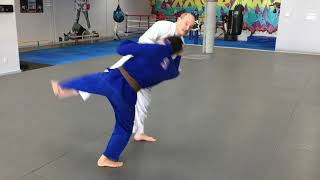
Ko Soto Gari is classified as a minor outer reaping movement. The practitioner reaches with the bottom of the foot to attack the opponent's leg while maintaining upper-body control. When executed with full power, this throw generates sufficient force to warrant the use of crash pads during practice.
Ko Soto to O Soto Gari Transition
The progression from Ko Soto Gari to O Soto Gari involves attacking a single leg with a major outer reaping action. After the initial Ko Soto plant, the practitioner pivots and sweeps the opponent's leg in a continuous motion, completing the throw. This two-step sequence develops timing and footwork coordination.
O Soto Garuma Variation
In the O Soto Garuma variation, the practitioner catches both of the opponent's legs after the Ko Soto setup. This technique differs from O Soto Gari by engaging both legs simultaneously, creating a more complete envelopment. The increased control over both limbs results in a more powerful throw.
O Soto Otoshi Dropping Action
O Soto Otoshi is executed by planting the foot and dropping rather than sweeping. After the Ko Soto setup, the practitioner plants a firm base with one foot while dropping the opposite leg downward into the opponent's body. The key distinction of Otoshi techniques is the dropping action rather than a sweeping motion.
Distinguishing Related Techniques
O Soto Garuma and O Soto Otoshi are distinct from O Soto Gari. O Soto Garuma involves a sweeping action with both legs engaged, while O Soto Otoshi emphasizes a dropping motion with a planted base. Understanding these distinctions allows practitioners to apply the appropriate technique based on the opponent's position and resistance.
Training Benefits and Safety
Practicing the Ko Soto Gari combination series develops rapid footwork, body posture control, and shin-to-shin engagement. Practitioners should begin with controlled, low-intensity throws before progressing to full power, as these techniques generate significant force. Using appropriate protective equipment and avoiding excessive speed during initial practice sessions prevents injury while building foundational competency.
Ko Soto Gari to O Soto Throws
Key Takeaways
- •Ko Soto Gari as a Setup Technique
- •Hand Placement and Control
- •Ko Soto Gari Mechanics
- •Ko Soto to O Soto Gari Transition
This is a common and effective throwing combination. Ko Soto Gari is often used as a set up for a variety of O Soto throws-not just O Soto Gari and this video presents this. Thanks to Brandon Smith for suggesting we do a series of videos on this. Look for our other video where we do just the opposite of this series and that is to do O Soto Gari as the set up for Ko Soto Gari or Tani Otoshi. Demonstrated by Derrick Darling and Mike Pennington and coached by Steve Scott.
Related Techniques
Frequently Asked Questions
What does this video teach about ko soto gari?
This video covers ko soto gari as a setup technique, hand placement and control, ko soto gari mechanics. It provides detailed instruction from welcomematstevescott.
How long does it take to learn ko soto gari?
The basic mechanics can be understood in a single session, but developing reliable execution requires consistent drilling over weeks of practice. This 8-part breakdown helps structure your training by isolating each phase of the technique.
What are the key details for finishing ko soto gari?
O Soto Garuma and O Soto Otoshi are distinct from O Soto Gari. O Soto Garuma involves a sweeping action with both legs engaged, while O Soto Otoshi emphasizes a dropping motion with a planted base. Understanding these distinctions allows practitioners to apply the appropriate technique based on the opponent's position and resistance.