Introduction to the Bridge Skill
The bridge is a foundational skill in escaping the kesa gatame pin. The instructor emphasizes that bridging must be practiced and maintained as a core technique before attempting the complete bridge and roll escape.
Two-Part Escape Sequence
The bridge and roll escape consists of two distinct phases: bridging first, then rolling. Attempting to roll without establishing a solid bridge is a common mistake that leaves the bottom player trapped.
The Urgency of Escape
In submission grappling, judo, and Brazilian jiu-jitsu, escapes must be initiated immediately upon recognizing danger. Delayed reactions allow the top player to establish a stronger position, making escape exponentially more difficult.
Body Lock Setup
From the bottom of kesa gatame, the escaping player secures a body lock around the top player's torso. The hands should be locked using a gable grip, square grip, or by gripping the belt or gi, never by lacing fingers together.
Body Positioning and Foot Placement
The bottom player must scoot their body close to the top player and position themselves on the balls of their feet. The hips should be angled to create leverage, and feet must remain in contact with the mat throughout the movement.
The Bridge Movement
The bridge directs the top player upward toward the bottom player's head, creating space and momentum. The feet drive into the mat to generate power, and the movement must be explosive and controlled.
The Roll Component
After establishing the bridge and creating separation, the bottom player rolls over their shoulder while driving with their feet. The feet remain planted throughout, never flailing or losing contact with the mat, ensuring continuous control.
Common Mistakes to Avoid
The most frequent error is losing foot contact with the mat or allowing feet to flail during the escape attempt. Maintaining strong foot placement throughout both the bridge and roll phases is essential for successful execution.
Bridging Drill Practice
Practitioners should isolate the bridging component before performing the complete escape. The drill involves the bottom player body-locking the top player and performing multiple bridges up and down, building the strength and technique required for the full movement.
Progressive Training Sequence
The recommended practice protocol is to perform three isolation bridges followed by one complete bridge and roll escape. This progression builds strength, muscle memory, and proper sequencing while maintaining cooperative training with a partner.
BRIDGE & ROLL PIN ESCAPE FROM KESA GATAME
Key Takeaways
- •Introduction to the Bridge Skill
- •Two-Part Escape Sequence
- •The Urgency of Escape
- •Body Lock Setup
For information on the Judo Black Belt Association (JBBA) Coach Education Program (JCEP), go to www.judoblackbelt.com. The videos on this channel are intended for the use of the JBBA Coach Education Program (JCEP). All material is copyrighted. No duplicating, broadcasting, showing or using these videos without consent is permitted. #judo #FreestyleJudo #JudoBlackBeltAssociation
Frequently Asked Questions
What does this video teach about standard bridge and roll kesa?
This video covers introduction to the bridge skill, two-part escape sequence, the urgency of escape. It provides detailed instruction from JBBA Judo Education Channel.
How long does it take to learn standard bridge and roll kesa?
The basic mechanics can be understood in a single session, but developing reliable execution requires consistent drilling over weeks of practice. This 10-part breakdown helps structure your training by isolating each phase of the technique.
What are the key details for finishing standard bridge and roll kesa?
Practitioners should isolate the bridging component before performing the complete escape. The drill involves the bottom player body-locking the top player and performing multiple bridges up and down, building the strength and technique required for the full movement.
Related videos
Mount Escape to Straight Knee Lock
welcomematstevescott
Third Law BJJ Naples, Florida Bridge and Shrimp techniques
Team Third Law Academy #2
The Kesa Gatame Kill System
The Grappling Academy
Bridge and Roll Escape by Travis Stevens
BJJ Fanatics
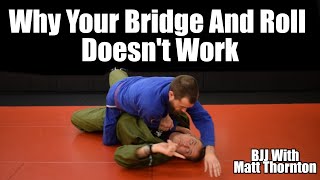
Why Your Bridge and Roll Doesn't Work in BJJ • BJJ with Matt Thornton
SBG PDX & Vancouver BJJ and MMA Videos