Introduction and Instructor Credentials
This instructional session covers four counter-techniques following a successful roundhouse kick catch, taught by Palang Pol Pechin Chi (Crew Day), a fighter with over 300 professional bouts and WBA Boxing Asia champion credentials. The techniques were demonstrated during training at Evolve MMA in Singapore and emphasize practical applications for both sport and combat scenarios.
Fundamental Principles of Kick Catching
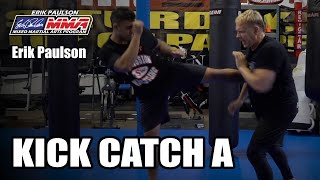
The foundation of effective kick catching requires lateral movement to absorb the kick's force and prevent rib injury. The practitioner must secure the caught leg with an airtight grip in the armpit to prevent the opponent from extracting their foot and creating separation.
Counter #1: Throw and Roundhouse Kick
After catching the kick, the defender steps backward to create space while maintaining a square stance toward the opponent. The rear leg springs forward to execute a counter roundhouse kick with maximum force and speed, avoiding excessive body rotation that compromises balance.
Counter #2: Lift, Push, and Chase
The defender catches the incoming kick, then lifts the opponent's leg while stepping forward and pushing their upper body to break their balance. The defender immediately closes distance and lands a roundhouse kick counter before the opponent can recover their stance.
Muay Thai Three-Step Rule
Referees enforce a maximum three-step limit after catching a kick; exceeding this threshold results in match stoppage. Practitioners must execute their counter technique—throw, sweep, release, or strike—within this constraint to maintain legal engagement.
Counter #3: Front Shin Sweep
The defender hooks the support leg's ankle while simultaneously pushing the opponent's head, shoulders, or neck to create downward leverage and unbalance. The sweep itself serves as a finishing technique after establishing superior positioning through lifting and pushing pressure.
Sweep Mechanics Based on Range
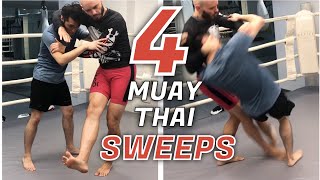
Close-range sweeps employ a hooking motion where the defender's ankle yanks the opponent's support leg from underneath them. At extended range, the defender executes a low shin kick to the support leg instead, maintaining the lifting pressure on the caught leg throughout the technique.
Counter #4: Cross-Leg Sweep
The defender steps forward with one leg while pushing with the same-side hand, but executes the sweep with the opposite leg to catch the support leg from underneath. This advanced technique requires timing coordination between upper body pressure and lower body sweeping mechanics.
4 Ways to Catch and Counter (Roundhouse Kick)
Key Takeaways
- •Introduction and Instructor Credentials
- •Fundamental Principles of Kick Catching
- •Counter #1: Throw and Roundhouse Kick
- •Counter #2: Lift, Push, and Chase
On my trip to Evolve MMA in Singapore, I had a session with 2x Rajadamnern Muay Thai champion, Kru Day (Palangpol Petchyindee Academy), where he showed me 4 ways to counter the roundhouse kick, after catching the leg. Seeing as how the roundhouse kick is one of the most commonly thrown strikes in #MuayThai, these defense & counters are essential! Join our fight team: https://team.fighttips.com EVOLVE MMA►https://evolve-mma.com/instructors/palangpol-petchyindee-academy/ SUBSCRIBE TO GET MORE #FIGHTTIPS►http://bit.ly/1APnzvw FOLLOW: Facebook | http://bit.ly/fightTIPSFacebook Twitter | http://bit.ly/fightTIPSTwitter Instagram | http://bit.ly/fightTIPSInstagram
Frequently Asked Questions
What does this video teach about standard kick catch?
This video covers introduction and instructor credentials, fundamental principles of kick catching, counter #1: throw and roundhouse kick. It provides detailed instruction from fightTIPS.
How long does it take to learn standard kick catch?
The basic mechanics can be understood in a single session, but developing reliable execution requires consistent drilling over weeks of practice. This 8-part breakdown helps structure your training by isolating each phase of the technique.
What are the key details for finishing standard kick catch?
Close-range sweeps employ a hooking motion where the defender's ankle yanks the opponent's support leg from underneath them. At extended range, the defender executes a low shin kick to the support leg instead, maintaining the lifting pressure on the caught leg throughout the technique.