Initial Lapel Control from Guard
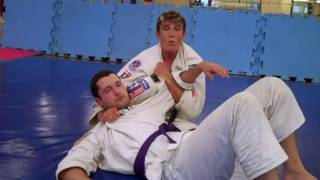
The instructor begins by sweeping the opponent's lapel across their back while breaking posture. Using both hands to maintain control, the practitioner pulls the gi material across the opponent's back while simultaneously collapsing their posture downward. This establishes a strong foundational hold before transitioning to the choke grip.
Palm-Up Grip and Elbow Positioning
Once sufficient lapel material is gathered, the practitioner shifts their hips and transitions to a palm-up grip, securing the fabric with all four fingers. Rather than keeping the elbow extended away from the body where it can be pushed off, the practitioner brings the elbow directly into the opponent's chest to prevent escape and maintain pressure.
Fake Choke to Hand Positioning
The instructor demonstrates using a feint choke to force the opponent to defend with their hands. When the opponent places their hand to defend, the practitioner pushes it through their guard, establishing the proper hand position needed to transition to a triangle choke setup.
Triangle Entry from Lapel Control
From the secured hand position, the practitioner sweeps the lapel out and shifts their hips to throw the leg over the opponent's shoulder. Using the elbow to help facilitate the hip rotation, the practitioner completes the triangle position with the opponent's arm trapped inside.
Dual-Neck Grip and Posture Breaking
The instructor establishes a grip on both sides of the opponent's neck while maintaining broken posture. By repeatedly pulling the opponent down and allowing them to lift slightly, the practitioner fatigues the opponent while preparing for the grip transition to palm-up position with the elbow at the sternum.
Thumb Rail Technique for Arm Clearance
Using the thumb as a lever or rail, the practitioner guides the opponent's hand over their body to create space. The elbow is used to actively push the opponent's arm through the leg triangle, ensuring complete clearance before locking the final position.
Final Triangle Lock and Elbow Control
Once the opponent's arm is cleared through the legs, the practitioner grips both elbows and uses this connection to rotate their hips into the triangle finish. The control of the elbows allows the practitioner to apply finishing pressure by rotating the hips while maintaining the triangle's structural integrity.
Hand Escape Dynamics
The instructor clarifies that even if the opponent's hand remains partially inside the triangle during the hip rotation, the angle of the turn will naturally pop the hand out. This demonstrates that precise hand clearance, while preferable, is not strictly necessary if the angle and hip rotation are executed correctly.
Lapel choke setup for various finishes
Key Takeaways
- •Initial Lapel Control from Guard
- •Palm-Up Grip and Elbow Positioning
- •Fake Choke to Hand Positioning
- •Triangle Entry from Lapel Control
#submissions #jeanjacquesmachado #bjj This position not only gives you a choke but also gives opportunities for arm bars, triangles, the whole shabang. ----- One of the pioneers of the art of Brazilian Jiu-Jitsu and one of its greatest champions, Jean Jacques Machado is one of five brothers of the world-renown Machado Brazilian Jiu-Jitsu family. This channel is dedicated to his work as a competitor as well as a world class instructor through his ground breaking online training program. Subscribe for more instructional media and the No Gi Required podcast. Join our channel membership for JJM 3.0 Online Training Program brought to you through YouTube! https://www.youtube.com/channel/UC8eFlweeoWP_RLSYrRhiYTA/join
Related Techniques
Frequently Asked Questions
What does this video teach about lapel overhook choke?
This video covers initial lapel control from guard, palm-up grip and elbow positioning, fake choke to hand positioning. It provides detailed instruction from JeanJacquesMachado.
How long does it take to learn lapel overhook choke?
The basic mechanics can be understood in a single session, but developing reliable execution requires consistent drilling over weeks of practice. This 8-part breakdown helps structure your training by isolating each phase of the technique.
What are the key details for finishing lapel overhook choke?
Once the opponent's arm is cleared through the legs, the practitioner grips both elbows and uses this connection to rotate their hips into the triangle finish. The control of the elbows allows the practitioner to apply finishing pressure by rotating the hips while maintaining the triangle's structural integrity.