Academy of Combat: BJJ Shin Choke
0
Shin Over Neck Choke·Academy of Combat
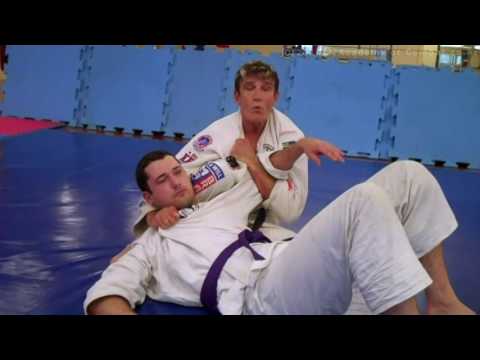
Setting up a shin lapel choke while moving from front control to side control. Demonstrated by BJJ black belt Dr Geoff …
Translation: Shin-Neck Strangle
Shin-over-neck chokes use the shin or calf placed across the opponent's throat from guard positions to create choking pressure using leg strength. [1],[2] The gogoplata is the most famous technique: from rubber guard or mission control, the attacker places the shin across the throat and pulls the opponent's head down onto the shin. [3],[4] These chokes require exceptional hip flexibility but generate enormous force due to leg musculature. [5]
The shin-over-neck choke uses the bony shin across the throat from behind or from top position to create a pressure choke. [1]
Shin chokes were developed in submission grappling and MMA as improvised finishing techniques from unusual positions. [1]
Shin chokes appear occasionally in MMA and advanced submission grappling competition. [1]
No images yet for this technique.
Sign in to suggest an image.
Setting up a shin lapel choke while moving from front control to side control. Demonstrated by BJJ black belt Dr Geoff …
No instructional courses yet for this technique.
Sign in to suggest a course.
Risk of injury to the person this technique is applied to
Shin-on-neck chokes use the sharp edge of the shin bone against the trachea or carotid
Skill level needed to execute this technique reliably
Whether this technique is allowed under major competition rule sets
Classical Jujutsu / Shooto — shin-across-neck control
Japanese terminology sourced from Classical Jujutsu / Shooto — shin-across-neck control
Japanese MMA pioneer organization — technique terminology
Standard Japanese martial arts terminology (kanji/hiragana)
Established Japanese martial arts naming convention — native Japanese term (和語/漢語)
Japanese terminology sourced from Classical Jujutsu / Shooto — shin-across-neck control
exceptional hip flexibility, long legs
extreme lower body flexibility (rubber guard practitioners)
hip flexors, hamstrings, adductors
Every move, in any martial art, shares a few universal traits. Mix and match below to pinpoint the right tool — or compare equivalents across styles.
Turn your leg in and place your feet to the side. Then bring your right knee up into the neck while hooking back on the opponent's arm.
Pass the gi with your left hand and cross to the right, hook back on the opponent's arm, and grab your own lapel with your left hand to secure the choke.
Shin-over-neck chokes use the shin or calf placed across the opponent's throat from guard positions to create choking pressure using leg strength. The gogoplata is the most famous technique: from rubber guard or mission control, the attacker places the shin across the throat and pulls the opponent's head down onto the shin.
Shin-across-throat techniques have roots in both Japanese grappling (using the shin as a choking surface) and modern BJJ innovation. The gogoplata was popularized by Nino Schembri and later by Eddie Bravo's rubber guard system.
IBJJF: legal — Legal at all belt levels, gi and no-gi — chokes are the safest submission cat…; IJF: legal — Legal (shime-waza) — strangulation techniques are one of three permitted subm…; ADCC: legal — Legal; Unified MMA: legal — Legal — choke submissions are among the most common finishes in MMA; FIAS Sport Sambo: banned — All chokes prohibited in Sport Sambo; FIAS Combat Sambo: legal — Legal
Danger rating 8/10. Shin-on-neck chokes use the sharp edge of the shin bone against the trachea or carotid
The standard setup chain: Achieve Controlling Position → Isolate the Neck → Set the Grip → Apply Pressure.
Standard counters include: Tuck Chin — protect the neck by lowering the chin to prevent the choke from sinking / Two-on-One Grip Fight — use both hands to strip the choking grip before it locks / Turn Into — rotate toward the choking arm to relieve carotid pressure / Posture Up — straighten the spine and create distance to break the choking angle.
Common variants: Standard gogoplata (shin placed across the throat from rubber guard or high g…); Mounted gogoplata (applied from mount position, shin across the throat); Reverse gogoplata (applied from behind or inverted position).
Shin chokes appear occasionally in MMA and advanced submission grappling competition.
Top errors to watch for: Placing the flat of the calf instead of the shin edge — the sharp edge of the shinbone creates the necessary focal pr… / Not controlling the opponent's posture — if they posture up, the shin falls away from the neck; maintain head control… / Attempting without hip flexibility — the leg must reach over the shoulder and across the neck; limited flexibility ma… / Not using the hands to reinforce — the hands should control the head, the shin-side foot, or the opponent's arm to ma….
The Shin Over Neck Choke is also known as Sune-kubi-jime, Shin Choke, Gogoplata Family, Instep Choke.