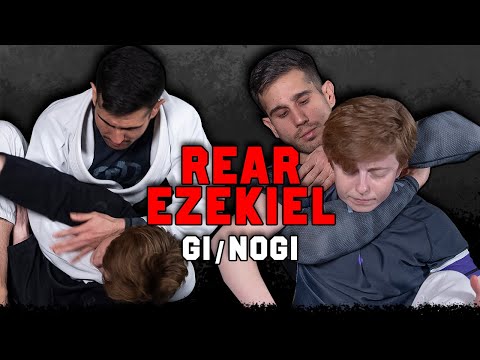
How To Do Rear Ezekiel Choke In Gi & No-Gi
0
Sleeve Assisted Forarm Strangle·Resenha BJJ
Marcio shows how to do a rear ezekiel choke in both gi and no-gi! The Best Made No-Gi Rashguards and Shorts: https://p…
Translation: Sleeve Wheel Strangle
Sleeve-assisted forearm strangles use the attacker's own gi sleeve as a fulcrum against the throat while the opposite arm provides compression from behind the head. [1],[2] The Ezekiel choke (sode-guruma-jime) is the defining technique: the attacker threads one arm behind the opponent's head, feeds the sleeve of that arm across the throat, and squeezes with the opposite forearm. [3],[4] The Ezekiel can be applied from mount, side control, and even inside the opponent's closed guard. [5]
Sode-guruma-jime (袖車絞め, sleeve wheel strangle) is a recognized Kodokan Judo shime-waza. [2],[3] The name 'Ezekiel choke' honors Brazilian judoka Ezequiel Paraguassú, who famously used this technique while training at the Carlson Gracie academy in the early 1990s, submitting multiple BJJ practitioners. [1],[4],[5]
The sleeve-assisted forearm strangle uses a grip on the opponent's sleeve combined with the forearm across the throat to choke. [1]
Sleeve-assisted strangles were developed in gi BJJ to exploit the gi material for enhanced choking mechanics. [1]
Sleeve-assisted strangles appear in gi BJJ competition at IBJJF events. [1]
No images yet for this technique.
Sign in to suggest an image.
Marcio shows how to do a rear ezekiel choke in both gi and no-gi! The Best Made No-Gi Rashguards and Shorts: https://p…
No instructional courses yet for this technique.
Sign in to suggest a course.
Risk of injury to the person this technique is applied to
Sleeve-assisted strangles use the gi sleeve as a fulcrum or extension of the forearm blade
Skill level needed to execute this technique reliably
Whether this technique is allowed under major competition rule sets
Kodokan Judo — Sode-guruma-jime
Japanese terminology sourced from Kodokan Judo — Sode-guruma-jime
Official Kodokan ground technique classification system
Standard Japanese martial arts terminology (kanji/hiragana)
Established Japanese martial arts naming convention — native Japanese term (和語/漢語)
Japanese terminology sourced from Kodokan Judo — Sode-guruma-jime
forearm strength, wrist control, top position stability
thick forearms for pressure across the throat
forearm flexors, wrist extensors, core
Every move, in any martial art, shares a few universal traits. Mix and match below to pinpoint the right tool — or compare equivalents across styles.
Set up the blade of your forearm on your opponent's neck and go as deep as possible—if your hand is positioned below your opponent's shoulder line, the choke won't be effective.
Your opponent will naturally worry most about the top arm, which is the one they'll try to prevent the choke with, while the bottom arm has more freedom for your work since it's primarily used to grab the collar or pants.
Bring your primary arm against your chest to squeeze the jugular while using your other arm to push your opponent's head down toward their chest, combining both motions together for the finish.
This choke can be applied from three-quarter mount, technical mount, back control, and when your opponent is positioned sideways.
Sleeve-assisted forearm strangles use the attacker's own gi sleeve as a fulcrum against the throat while the opposite arm provides compression from behind the head. The Ezekiel choke (sode-guruma-jime) is the defining technique: the attacker threads one arm behind the opponent's head, feeds the sleeve of that arm across the throat, and squeezes with the opposite forearm.
Sode-guruma-jime (袖車絞め, sleeve wheel strangle) is a recognized Kodokan Judo shime-waza. The name 'Ezekiel choke' honors Brazilian judoka Ezequiel Paraguassú, who famously used this technique while training at the Carlson Gracie academy in the early 1990s, submitting multiple BJJ practitioners.
IBJJF: legal — Legal at all belt levels, gi and no-gi — chokes are the safest submission cat…; IJF: legal — Legal (shime-waza) — strangulation techniques are one of three permitted subm…; ADCC: legal — Legal; Unified MMA: legal — Legal — choke submissions are among the most common finishes in MMA; FIAS Sport Sambo: banned — All chokes prohibited in Sport Sambo; FIAS Combat Sambo: legal — Legal
Danger rating 8/10. Sleeve-assisted strangles use the gi sleeve as a fulcrum or extension of the forearm blade
The standard setup chain: Achieve Controlling Position → Isolate the Neck → Set the Grip → Apply Pressure.
Standard counters include: Tuck Chin — protect the neck by lowering the chin to prevent the choke from sinking / Two-on-One Grip Fight — use both hands to strip the choking grip before it locks / Turn Into — rotate toward the choking arm to relieve carotid pressure / Posture Up — straighten the spine and create distance to break the choking angle.
Common variants: Gi Ezekiel (uses the sleeve for the choking grip, traditional technique); No-gi Ezekiel (uses the fist or forearm across the throat without sleeve…); Reverse Ezekiel (applied from the bottom position when opponent is in your…).
Sleeve-assisted strangles appear in gi BJJ competition at IBJJF events.
Top errors to watch for: Using the sleeve grip without proper forearm positioning — the sleeve assists, but the forearm must be correctly plac… / Gripping the sleeve too loosely — a tight sleeve grip creates the rigid structure needed; loose grips allow the forea… / Pressing the forearm against the trachea — target the lateral neck (carotid arteries), not the front of the throat; t… / Not using body weight — the forearm strangle requires weight behind it; muscular pressing alone fatigues quickly.
The Sleeve Assisted Forarm Strangle is also known as Sode-guruma-jime, Sleeve Choke, Ezekiel Family.