(How to) Side Kick Tutorial - Taekwondo
0
Snapping Side Kick·wootaekwon
(How to) Side Kick Tutorial - Taekwondo Please Subscribe! Side kick (WTF) Taekwondo is one of Taekwondo's representati…
Translation: snapping side kick
The Snapping Side Kick subfamily covers side kicks executed with a fast, snapping motion that prioritises speed and retraction over penetrating force. [1] The snapping side kick chambers by lifting the knee, extends the foot laterally to strike the target, and immediately retracts the leg back to the chambered position, minimising exposure time. [1],[2] This variation is useful for scoring in point-based competition, testing distance, and setting up follow-up techniques without committing fully to the kick. [2],[3]
The snapping side kick uses a quick snapping motion for speed. [1]
From TKD and karate. [1]
Used in competition. [1]
No images yet for this technique.
Sign in to suggest an image.
(How to) Side Kick Tutorial - Taekwondo Please Subscribe! Side kick (WTF) Taekwondo is one of Taekwondo's representati…
How to do a Side Kick Analysis #8? I'm going to first bring my knees up, pivot, and snap out with the bottom of my foot …
No instructional courses yet for this technique.
Sign in to suggest a course.
Risk of injury to the person this technique is applied to
Linear thrust kick; generates highest force among basic kicks
Skill level needed to execute this technique reliably
Whether this technique is allowed under major competition rule sets
Muay Thai: The Art of Fighting (Yod Ruerngsa, Khun Kao Charuad & James Cartmell, 2002)
Alias sources — [1] Karate-Do Kyohan (Funakoshi, 1935) [2] Kukkiwon Taekwondo Textbook (Kukkiwon, 2006) [3] Dynamic Karate (Nakayama, 1966)
Effectiveness sources — [1] Comprehensive Asian Fighting Arts (Draeger & Smith, 1969)
Official karate technique names (和語/漢語)
Established Japanese martial arts naming convention — native Japanese term (和語/漢語)
Alias sources — [1] Karate-Do Kyohan (Funakoshi, 1935) [2] Kukkiwon Taekwondo Textbook (Kukkiwon, 2006) [3] Dynamic Karate (Nakayama, 1966)
Effectiveness sources — [1] Comprehensive Asian Fighting Arts (Draeger & Smith, 1969)
hip abduction power, lateral hip flexibility, single-leg balance
flexible hips for high side kicks
gluteus medius, hip abductors, quadriceps, core
Every move, in any martial art, shares a few universal traits. Mix and match below to pinpoint the right tool — or compare equivalents across styles.
Keep your knee within your hips rather than moving it away from your body, as this generates significantly more power. According to wootaekwon's tutorial, moving your knee away from your hips will reduce force production.
You must push your hips into the kick rather than shooting straight up, otherwise your leg won't be able to support your body weight and you risk injury. The instructor experienced hip pain that prevented walking for a week or two from neglecting this fundamental.
For middle-level kicks, keep your knee more parallel to the floor and kick straight out. For higher kicks, angle your knee up before extending the kick.
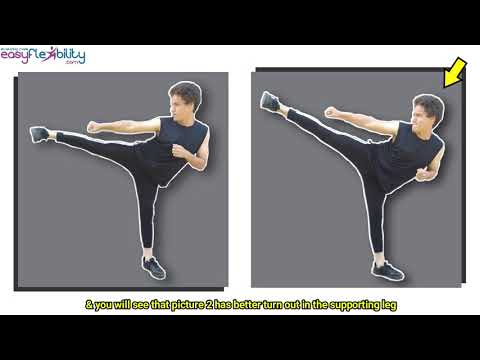
Turn your supporting leg and kick out simultaneously to generate the most force. Breaking these into two separate movements will significantly reduce the power of your kick.
Don't bend or curve your body during the side kick—keep your upper body upright. Additionally, time your body descent with your kick rather than bending down after the kick is already extended.
The Snapping Side Kick subfamily covers side kicks executed with a fast, snapping motion that prioritises speed and retraction over penetrating force. The snapping side kick chambers by lifting the knee, extends the foot laterally to strike the target, and immediately retracts the leg back to the chambered position, minimising exposure time.
The snapping side kick (yoko geri keage) was classified within karate's kicking taxonomy as the speed-oriented counterpart to the thrusting side kick. The technique is taught in Shotokan and other karate styles as a fundamental kick, and it appears in taekwondo curricula as well.
Unified MMA: legal — Legal striking technique; WBC/Boxing: banned — All kicks prohibited in boxing; WKF: legal — Legal, chudan (body) kick scores 2 points, jodan (head) kick scores 3 points; Kyokushin: legal — Legal at full power to body and head; WT: legal — Legal, body kick 2 points, head kick 3 points, spinning body 4 points, spinni…; WAKO: legal — Legal in Full Contact and Low Kick formats; K: legal — 1/GLORY — Legal; IFMA: legal — Legal — kicks are a core Muay Thai technique
Danger rating 6/10. High — linear thrust kick; generates highest force among basic kicks
The standard setup chain: Stance and Range → Chamber the Leg → Execute the Kick → Recover.
Standard counters include: Check (Shin Block) — raise the shin to intercept the kick before it lands / Catch and Sweep — catch the kicking leg and sweep the standing leg / Step Inside — close distance inside the kick's effective range to smother it.
Common variants: Standard side kick (driving the heel or blade of the foot laterally with hip …); Checking side kick (low side kick targeting the knee to stop the opponent's a…); Spinning side kick (adding a spin for extra rotational power); Step-through side kick (stepping through for deeper penetration).
Used in competition.
Top errors to watch for: Pushing through the target instead of snapping — this converts it into a thrusting side kick / Not retracting quickly enough, leaving the foot out to be caught / Chamber too low, which reduces the snap angle and makes the kick telegraphed / Turning the body too far past sideways, exposing the back.
The Snapping Side Kick is also known as Yoko-geri Keage, Yoko Geri Keage, Snapping Yop Chagi, Side Snap Kick.