Definition and Classification
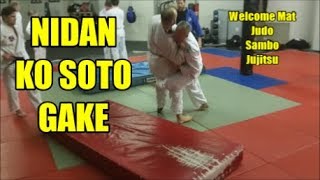
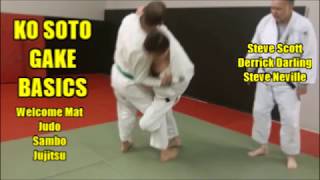
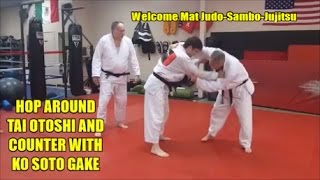
Ko soto gake translates to "small outside hook," with ko meaning small, soto meaning outside, and gake meaning to hook. Rather than a refined technique, it functions as a powerful striking throw (temiwaza) with historical roots extending back to sumo wrestling and classical jujutsu. This technique proves particularly effective for practitioners with longer limbs who can maintain greater distance from their opponent.
Kuzushi and Upper Body Mechanics
Proper kuzushi (off-balancing) begins by pushing the elbow down and inward while applying pressure to the side of the neck with the thumb. The instructor maintains a lowered elbow position to generate maximum power, using a palm-heel rotation and downward push. The throwing direction should be strictly downward rather than upward, similar to executing a heel strike.
Foot Positioning and Hook Mechanics
The attacking foot executes the hook behind the Achilles tendon with toes pointed outward, distinguishing it from kosotogari where the foot approaches differently. Practitioners may also catch behind the knee, though this requires slightly closer positioning. The critical element is not striking the knee with the heel, but rather executing the cutting (kari) motion once contact is established.
The Cutting Motion and Common Mistakes
The sickle-like cutting motion proves more important than achieving direct heel contact with the back of the knee. When the hook catches the knee hinge, the leg bends automatically regardless of exact positioning. Practitioners should avoid excessive practice attempting to place the heel precisely on the back of the knee, as the cutting action accomplishes the technique even with only partial calf contact.
Footwork and Pivot Mechanics
Proper foot placement requires pivoting before executing the hook to maintain balance and prevent falling. The attacking foot must not point straight ahead during entry, as this disrupts balance; instead, a controlled pivot precedes the upward hook motion. Once the throw is executed, the attacker should move the foot away from underneath the falling opponent.
Ground Control and Follow-Through
After executing the throw, the practitioner controls the opponent's hip bone while landing, keeping the foot elevated rather than trapped underneath. The technique can transition directly into osae waza (holding techniques) or ne waza (ground techniques). Proper positioning prevents injury to the attacking player's own joints during the descent.
Application Against Wrestling Stance
Ko soto gake proves particularly effective against wrestlers who naturally adopt low stances. The striking nature of the technique surprises opponents expecting traditional judo entries. Successful execution creates immediate opportunities to transition into pinning techniques before the opponent can mount an effective defense.
Practice and Technical Excellence
Mastery requires understanding and isolating each element of the throw before combining them into a fluid technique. The principle "practice makes permanent, but perfect practice makes perfect" emphasizes that improper repetition reinforces flawed mechanics. All judo throws prove effective when executed with proper technique, timing, and understanding of their fundamental components.
Ko-Soto-Gake Tips | Riki Judo Dojo
Key Takeaways
- •Definition and Classification
- •Kuzushi and Upper Body Mechanics
- •Foot Positioning and Hook Mechanics
- •The Cutting Motion and Common Mistakes
Riki sensei explained ko-soto-gake (小外掛 - small outer hook) during judo class on 2-18-2022. 0:00 Definition 0:20 Jujitsu origins 0:32 Sumo's sotogake 0:46 Kuzushi 1:14 Foot details 1:46 Against sideways fighters 2:12 Pivot & hook 3:29 It's a strike 3:53 Ko-soto-gake against wrestlers 4:09 Perfect practice makes perfect Riki sensei began Judo in Okinawa and is a Shichidan with over 56 years of study, practice, competition and teaching. He competed for 25 years at the local, national and international levels. A few of the great Judoka Riki sensei has studied and practiced with include: Kotani, Daigo, Ito, Inokuma, Okano, Kimura, Kaminaga and Nakatani. See Riki sensei teach every Monday, Wednesday, Thursday and Friday evening at 535 W. Iron Ave, Mesa, AZ 85210. Youth classes are 6 - 6:55 PM, adult classes are 7:00 - 8:30 PM. For more info, please visit rikidojousa.com The purpose of this YouTube channel is to pass on the original, traditional, authentic Kodokan Judo that Riki sensei loves so much. Riki sensei's students maintain this YouTube channel (and are responsible for any errors), but you can find more of his thoughts at the Riki Judo Dojo Facebook page: https://www.facebook.com/Riki-Judo-Dojo-USA-194351210607759 14
Frequently Asked Questions
What does this video teach about standard ko soto gake?
This video covers definition and classification, kuzushi and upper body mechanics, foot positioning and hook mechanics. It provides detailed instruction from Riki Judo Dojo.
How long does it take to learn standard ko soto gake?
The basic mechanics can be understood in a single session, but developing reliable execution requires consistent drilling over weeks of practice. This 8-part breakdown helps structure your training by isolating each phase of the technique.
What are the key details for finishing standard ko soto gake?
Ko soto gake proves particularly effective against wrestlers who naturally adopt low stances. The striking nature of the technique surprises opponents expecting traditional judo entries. Successful execution creates immediate opportunities to transition into pinning techniques before the opponent can mount an effective defense.