Ko-Soto-Gake Tips | Riki Judo Dojo
0
Standard Ko Soto Gake·Riki Judo Dojo·Added by Admin
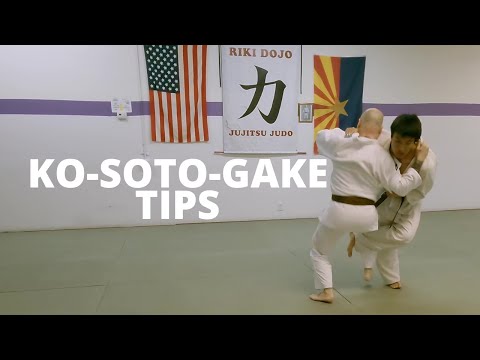
Riki sensei explained ko-soto-gake (小外掛 - small outer hook) during judo class on 2-18-2022. 0:00 Definition 0:20 Jujit…
Translation: minor outer hook
Standard Ko Soto Gake executes the classical minor outer hook where the thrower places the sole of the foot behind the opponent's heel from the outside, hooks it to prevent backward stepping, and drives the opponent rearward with chest and hand pressure. [1] The opponent, unable to retreat because the foot is trapped, falls backward over the hooked ankle. [1],[2] The throw requires the thrower to be close to the opponent, with strong forward pressure and precise foot placement behind the target heel. [2],[3]
Ko soto gake is classified in the expanded Kodokan nage-waza list, distinguished from reaping (gari) techniques by its hooking (gake) mechanic. [1]
The standard ko soto gake is seen in IJF competition. [1]
No images yet for this technique.
Sign in to suggest an image.
Riki sensei explained ko-soto-gake (小外掛 - small outer hook) during judo class on 2-18-2022. 0:00 Definition 0:20 Jujit…
No instructional courses yet for this technique.
Sign in to suggest a course.
Risk of injury to the person this technique is applied to
Hooking action can cause knee/ankle injury if resisted; moderate impact on landing
Skill level needed to execute this technique reliably
Whether this technique is allowed under major competition rule sets
Kodokan Judo — Official Nage-waza Classification
Traditional Judo throwing technique terminology (Kodokan Institute)
Official Kodokan ground technique classification system
Standard Japanese martial arts terminology (kanji/hiragana)
Established Japanese martial arts naming convention — native Japanese term (和語/漢語)
Traditional Judo throwing technique terminology (Kodokan Institute)
single-leg balance, hip flexibility, explosive driving power
long legs for hooking reach, strong standing balance
glutes, hip flexors, hamstrings, core, calves (balance)
No—Riki Judo Dojo emphasizes that getting your heel precisely on the back of the knee is difficult and unnecessary. Even if only a third of your calf makes contact with the knee, once you catch the hinge and it goes down, the throw will work.
The cutting motion (kari) is most critical. Rather than just hooking, you need to cut the leg with a sickle-like action, which will traumatize the knee and cause the throw to work effectively.
Your toes should point outward (unlike kuzutagari where they come in), and the hook should come from behind the Achilles tendon like a heel strike. Pivot into position before executing the hook motion.
Control the hip bone with your foot placement—come right down on the hip bone and keep your foot there rather than underneath the leg, making sure not to leave your foot trapped in that position.
Standard Ko Soto Gake executes the classical minor outer hook where the thrower places the sole of the foot behind the opponent's heel from the outside, hooks it to prevent backward stepping, and drives the opponent rearward with chest and hand pressure. The opponent, unable to retreat because the foot is trapped, falls backward over the hooked ankle.
The standard form of ko soto gake has been part of the Kodokan judo syllabus as a recognised nage-waza technique. It is commonly taught alongside the reaping techniques as an alternative finishing mechanic for close-range standing situations.
IJF: legal — Legal throwing technique; IBJJF: legal — Legal at all belt levels; UWW: restricted — Legal in freestyle, banned in Greco-Roman (no leg attacks below waist); Unified MMA: legal — Legal throwing technique; ADCC: legal — Legal; FIAS Sport Sambo: legal — Legal; FIAS Combat Sambo: legal — Legal
Danger rating 5/10. High — hooking action can cause knee/ankle injury if resisted; moderate impact on landing
The standard setup chain: Grip Setup (Kumi-kata) → Off-Balance (Kuzushi) → Entry (Tsukuri) → Execution (Kake).
Standard counters include: Lower Centre of Gravity — bend knees and drop hips to make the throw harder to execute / Grip Break — deny the thrower their preferred gripping configuration / Stiff-Arm — maintain distance with straight arms to prevent the entry.
Common variants: Standard technique (primary execution from standard grip and positioning); No-gi adaptation (modified without gi grips for submission grappling or MMA); Combination entry (entering from a failed attack or chain of techniques); Counter throw (applied as a direct counter to the opponent's throw or at…).
The standard ko soto gake is seen in IJF competition.
Top errors to watch for: Hooking the foot but not driving forward — the opponent simply lifts their foot off the hook / Placing the hook and then pausing before driving — the hook and drive must be simultaneous / Leaving the upper body upright instead of driving the chest forward and down / Hooking the wrong foot — target the foot that is weighted as you push them backward.
The Standard Ko Soto Gake is also known as Ko Soto Gake, Classical Minor Outer Hook, Standard Small Outside Hook.