The Instability Problem in Standard Mount
When a mounted opponent rolls backward, the top player faces a critical stability issue. If the defender successfully rolls the top player over, the mounted position collapses entirely. Maintaining top control requires understanding the structural weaknesses of standard mount to prevent this common escape.
Foot Placement Prevents Backward Falls
Proper foot positioning in mount is essential for maintaining balance. When one foot is elevated with the knee up, the top player cannot fall backward even if the defender shifts laterally. Conversely, if both knees remain low and the defender rolls, the top player's leg becomes trapped, resulting in a lost position.
Why Traditional Teaching Misses Key Details
Most instructors teach standard mount without explaining the mechanical reasons behind proper positioning. Understanding the vulnerability created by low foot placement helps students recognize why certain adjustments are necessary. This conceptual foundation prevents common mistakes where practitioners rely solely on hand strength to maintain control.
Defining S-Mount vs. Technical Mount
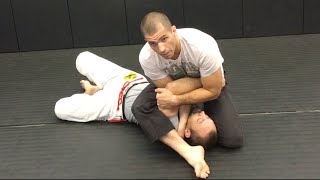
S-mount occurs when the top player tucks one leg under the opponent's back while the opponent is flat. Technical mount is used when the opponent turns to their side, with the top player keeping their foot flat on the mat. The distinction between these positions determines which control techniques and submissions become available.
Positioning Against Flat-Back Opponents
When an opponent lies flat on their back, the top player must immediately establish S-mount by tucking their leg deeply under the opponent's back. This position makes it extremely difficult for the opponent to turn to their side and escape. Failing to establish this tuck creates opportunities for the defender to execute back door escapes or wedding sweeps.
Technical Mount Foot Placement for Side-Turned Opponents
When an opponent turns to their side, maintaining S-mount becomes problematic as it compromises the top player's balance. Instead, the top player should keep their foot flat on the mat with the toe pressed into the ground. This base prevents the top player from falling forward if the opponent continues rolling while still allowing easy transitions back to S-mount when needed.
Dynamic Adjustments During Position Changes
Skilled top players must continuously adjust their foot positioning as the opponent transitions between flat and side-turned positions. When an opponent attempts to turn back to their back, the top player secures an underhook and shifts their foot back under the opponent's hips. This anticipatory positioning prevents the opponent from creating the necessary space for escape techniques.
Preventing Frame-Based Escapes
An opponent with a low leg position can capture the top player's leg in the middle to frame and escape. By tucking the foot high under the elbow, the top player makes it significantly harder for the opponent to create a successful frame. While shrimping and other movements remain possible, this positioning dramatically increases the difficulty of leg-based escapes.
Transition Mechanics for Armbar Submission
As the top player secures dominant positioning, they can transition into an armbar by pummeling their hand under the opponent's arm. The transition must occur before the opponent returns to a fully flat position, as timing is critical. The top player must get their leg over the opponent's chest before the opponent sits up, or the armbar will be lost.
Adapting to Opponent Size and Movement Patterns
Control strategies must adapt based on the opponent's body type, size, and movement tendencies. Larger or stronger opponents may require more aggressive underhook positioning and foot placement adjustments. Observing whether an opponent moves erratically early in exchanges or waits to exploit perceived vulnerabilities allows the top player to adjust their control level and positioning accordingly.
Technical Mount VS S-Mount Differences??? (For Beginners)
Key Takeaways
- •The Instability Problem in Standard Mount
- •Foot Placement Prevents Backward Falls
- •Why Traditional Teaching Misses Key Details
- •Defining S-Mount vs. Technical Mount
This video I teach the simple difference of when I use the technical mount and s-mount. Check out the details and you are sure to find something useful! Enjoy! If you have any questions, comments, or suggestions, please comment below. More videos to come! Please like, share, and subscribe!! PLEASE Click this link to SUPPORT the TeachMeGrappling Channel!!! https://www.patreon.com/TeachMeGrappling or https://www.paypal.me/CoachBrianPeterson To purchase TMG or PG Merchandise go to... https://www.petersongrapplers.com/shop Your contribution is much appreciated and will help me continue to bring you content! 🙏 www.NextLevelGuy.com The NextLevelGuy Podcast with Coach Brian Peterson has been released!! Check it out!
Frequently Asked Questions
What does this video teach about standard s-mount?
This video covers the instability problem in standard mount, foot placement prevents backward falls, why traditional teaching misses key details. It provides detailed instruction from TeachMeGrappling Coach Brian.
How long does it take to learn standard s-mount?
The basic mechanics can be understood in a single session, but developing reliable execution requires consistent drilling over weeks of practice. This 10-part breakdown helps structure your training by isolating each phase of the technique.
What are the key details for finishing standard s-mount?
As the top player secures dominant positioning, they can transition into an armbar by pummeling their hand under the opponent's arm. The transition must occur before the opponent returns to a fully flat position, as timing is critical. The top player must get their leg over the opponent's chest before the opponent sits up, or the armbar will be lost.