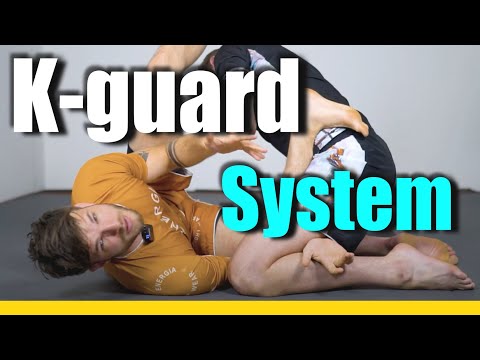
K Guard system
0
Z-Guard·Energia Martial Arts
K Guard system Turns out we didn't cover this amazing guard yet on the channel! Even though I went full in-depth on the …
Translation: Z-guard
The Z-Guard subfamily covers the half guard variation that combines the knee shield across the opponent's body with half guard leg control, creating a 'Z' shape with the legs. [1] Z-guard is essentially a specific configuration of the knee shield half guard, with the top leg creating a frame across the opponent's chest/belly and the bottom leg controlling the opponent's leg. [1],[2] The Z-guard provides excellent distance management and is used as a platform for sweeps, transitions to other guard positions, and submissions. [2],[3]
The Z-guard (knee shield half guard) is one of the most effective half guard variations because the knee frame creates space and prevents the top player from flattening the guard player. [1] The knee shield provides both defensive structure and offensive opportunities, making it a preferred half guard variation at all levels. [2]
Z-guard was popularised in the 2000s as a proactive half guard position in competitive BJJ. [1]
Z-guard is one of the most common half guard variants in modern BJJ competition. [1]
No images yet for this technique.
Sign in to suggest an image.
K Guard system Turns out we didn't cover this amazing guard yet on the channel! Even though I went full in-depth on the …
No instructional courses yet for this technique.
Sign in to suggest a course.
Risk of injury to the person this technique is applied to
Guard positions are defensive; injury risk comes from transitions, not the position itself
Skill level needed to execute this technique reliably
Whether this technique is allowed under major competition rule sets
Jiu-Jitsu University (Saulo Ribeiro, 2008)
Alias sources — [1] Jiu-Jitsu University (Ribeiro, 2008) [2] The Guard (Moreira & Beneville, 2003) [3] The Guard (Moreira & Beneville, 2003)
Effectiveness sources — [1] Jiu-Jitsu University (Ribeiro, 2008) [2] The Guard (Moreira & Beneville, 2003)
Standard katakana transliteration of Western martial arts terminology (外来語) — used in Japanese MMA, boxing, and BJJ communities
Alias sources — [1] Jiu-Jitsu University (Ribeiro, 2008) [2] The Guard (Moreira & Beneville, 2003) [3] The Guard (Moreira & Beneville, 2003)
Effectiveness sources — [1] Jiu-Jitsu University (Ribeiro, 2008) [2] The Guard (Moreira & Beneville, 2003)
hip flexibility, active legs, grip management
long legs for distance control and guard retention
hip flexors, adductors, quadriceps, core, grip
Every move, in any martial art, shares a few universal traits. Mix and match below to pinpoint the right tool — or compare equivalents across styles.
Get your hip high on your opponent's hip with your knees squeezing on their floating ribs, forcing them to either posture up or pass over you with their weight distributed accordingly.
Control the lower body by managing the hip and backside of the knee, while framing the upper body—typically by making a frame underneath the armpit with your high knee to defend against cross-face pressure.
Threaten your opponent with upper body attacks like guillotines or sit-ups to provoke them to posture up, which creates the entry opportunity for Z-Guard.
The Z-Guard subfamily covers the half guard variation that combines the knee shield across the opponent's body with half guard leg control, creating a 'Z' shape with the legs. Z-guard is essentially a specific configuration of the knee shield half guard, with the top leg creating a frame across the opponent's chest/belly and the bottom leg controlling the opponent's leg.
The Z-guard nomenclature developed in BJJ to describe the specific knee shield half guard configuration where the legs form a Z shape. It has become a widely used guard position at all levels of competition, valued for its versatility and defensive properties.
IBJJF: legal — Legal — guard is fundamental to BJJ, sweeps from guard score 2 points; IJF: restricted — Guard pulling penalized as non-combativity — groundwork from guard permitted …; ADCC: legal — Legal, guard pull penalized -1 point in points portion; Unified MMA: legal — Legal — no penalty for playing guard; FIAS Sport Sambo: legal — Legal
Danger rating 2/10. Low — guard positions are defensive; injury risk comes from transitions, not the position itself
The standard setup chain: Achieve Guard Contact → Control Grips → Manage Distance → Threaten Submissions/Sweeps.
Standard counters include: Guard Pass — systematically work to clear the legs and establish a dominant position / Leg Pin — control one or both legs to neutralize guard retention / Pressure Passing — use heavy chest pressure to flatten and immobilize the guard player.
Common variants: Standard half guard (one leg trapped between both legs with an underhook); Deep half guard (fully under the opponent with the leg fully entangled); Lockdown half guard (figure-four leg lock on the trapped leg (10th Planet)); Z-guard (knee shield) (knee across the opponent's chest creating a frame).
Z-guard is one of the most common half guard variants in modern BJJ competition.
Top errors to watch for: Using Z-guard as a purely defensive frame — the diagonal angle is designed for offense / Not using the knee to push and create angles — the knee actively drives into the opponent to off-balance / Keeping the Z-guard flat — angle the hips to maximize the frame's effectiveness / Not transitioning to deep half when the opportunity presents — Z-guard to deep half is a fundamental chain.
The Z-Guard is also known as Z Gādo, Z-Guard, Knee Shield Guard, 93 Guard.