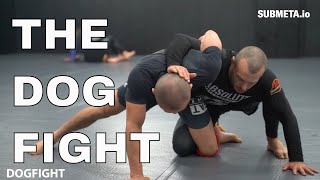
Half Guard Position and Setup
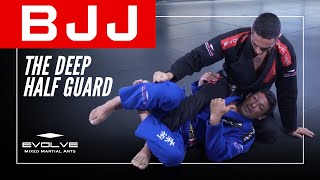
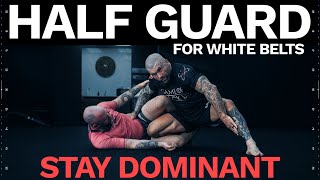
The lockdown system is most effective when the top player has achieved deep half guard positioning with their hip on the mat, cross-face applied, and the bottom player's spine turned. In this dominant position, the top player prevents bridging and makes sweeping difficult for the bottom player. The instructional focus begins by identifying this specific scenario as the optimal entry point for lockdown defense.
Hip Displacement Objective
The primary defensive goal from deep half guard is to displace the top player's hip off the mat, which is accomplished through proper leg positioning. When the top player's hip remains on the mat rather than over the bottom player's hips, the bottom player faces reduced leverage for sweeping or transitioning. Maintaining the trapped knee line within the half guard is essential before attempting hip displacement.
Lockdown Mechanics and Leg Configuration
The lockdown is executed by wedging the free foot under the opponent's instep at the shoelaces, then extending the legs into a triangle configuration. The bottom player's free foot first finds and kicks back the top player's heel to create space before sliding the second leg down to the ankle. This creates a locked triangular leg position that applies controlled pressure to the opponent's leg while keeping their hip elevated off the mat.
Pressure Management and Shoulder Control
Once the lockdown is secured, the bottom player uses the leg lock to reduce shoulder pressure from the top position while maintaining hip displacement. The extended lockdown makes it mechanically difficult for the top player to push the trapped knee away, as they must reach lower with their arm than in standard half guard. This defensive advantage allows the bottom player to square back up and regain composure in the position.
Calf Slicer Submission from Lockdown
From the lockdown position, the bottom player can transition to a calf slicer submission by turning their toes inward toward the opponent's knee and stepping over. The heel is then curled toward the opponent's buttocks while hip pressure is applied, creating a cranking submission on the calf. Though this submission is not typically devastating, it can be effective as a controlling mechanism or potential tap depending on the opponent's pain tolerance.
Guard Transition from Lockdown
The lockdown enables the bottom player to transition from half guard back to full closed guard by blocking the top player's leg while bringing their knee to their chest. Once the knee is extracted and elevated, the bottom player can either maintain a butterfly hook or use it to initiate a sweep. If the foot becomes stuck during extraction, the bottom player can squeeze their knee toward the opponent's oblique and windshield-wiper the foot out to re-establish closed guard.
Sweep Integration with Lockdown
After displacing the opponent's hip with the lockdown and controlling their leg, the bottom player can score points by executing a sweep rather than simply defending. If the top player returns their knee to the mat, the bottom player can use their hook to rotate and transition to a dominant top position. This offensive application of the lockdown system converts defensive pressure management into positional advancement.
Lockdown Positioning Limitations
The lockdown system is most effective against opponents in deep half guard with their hip on the mat. If the opponent's leg is positioned too high or they have already adjusted their posture significantly, alternative upper-body techniques may be required. The instructor indicates that positional adjustments will be addressed in subsequent instructional segments.
Lockdown halfguard
Key Takeaways
- •Half Guard Position and Setup
- •Hip Displacement Objective
- •Lockdown Mechanics and Leg Configuration
- •Pressure Management and Shoulder Control
Lockdown halfguard In today's video we take a look at bottom halfguard and how we can sweep or re-guard back to closed guard from there. We will be using the lockdown, a nice leg configuration to control our opponent, and some upper body mixups. As always; I hope you guys enjoy and let me know what you think. Osú Chapters 0:00 - Start 0:37 - Lockdown setup 3:23 - Calf slicer 4:10 - Sweep and re-guard 5:47 - Upper body sweep 8:42 - Overview ! Remember to put on notifications to receive an update anytime we drop a new video ! For more content, videos, solo drills and behind the scenes click on this link: https://www.patreon.com/Energia_martialarts?fan_landing=true Visit BJJ Fanatics for Leglocks Unlocked: https://bjjfanatics.com/collections/all/products/the-keys-to-leg-locks-by-tum-energia-voorn To check out our gear go to: https://energia-martialarts.com/energia-fight-wear/ Instagram: @Tumenergia Instruction: Tum Energia Assisting: Niek Magel Music: Mr. Ortiz #lockdown #halfguard #guard #submissions #counters #rearnakedchoke #bjj #submission #energiamartialarts #strangle #submissiongrappling #mma #brazilianjiujitsu #UFC #submission #leglock #rearnakedchoke #choke #mma #guard #backtake #chokes
Related Techniques
Frequently Asked Questions
What does this video teach about lockdown system?
This video covers half guard position and setup, hip displacement objective, lockdown mechanics and leg configuration. It provides detailed instruction from Energia Martial Arts.
How long does it take to learn lockdown system?
The basic mechanics can be understood in a single session, but developing reliable execution requires consistent drilling over weeks of practice. This 8-part breakdown helps structure your training by isolating each phase of the technique.
What are the key details for finishing lockdown system?
After displacing the opponent's hip with the lockdown and controlling their leg, the bottom player can score points by executing a sweep rather than simply defending. If the top player returns their knee to the mat, the bottom player can use their hook to rotate and transition to a dominant top position. This offensive application of the lockdown system converts defensive pressure management into positional advancement.