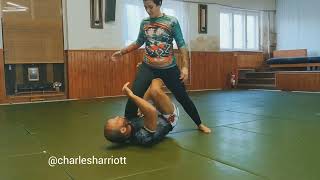
Guard Escape and Leg Lock Opening
When an opponent stands up from guard while defending against an armbar, they typically open their legs and become vulnerable to leg lock attacks. This creates an opportune moment to transition from upper body submissions to lower body submissions.
K-Guard Position Setup
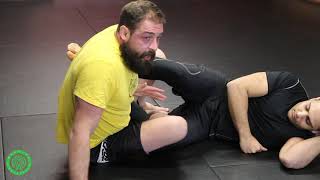
The instructor establishes K-guard by placing the right hand on the opponent's knee and left hand on the ankle. The near leg is positioned inside the opponent's legs with toes hooked on the hips, establishing two critical points of control.
Far Leg Hook and Knee Orientation
The right leg is extended and hooked over to the far side, preventing the opponent from escaping with lateral movement. The primary objective becomes driving the opponent's knees toward the mat while maintaining control.
Three-Quarter Top Position
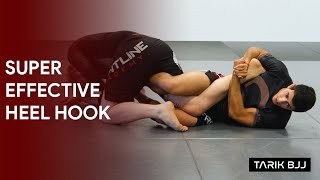
The legs are interlocked by sliding the left foot across the opponent's body, creating a three-quarter control position rather than a true triangle. The heel is then elevated toward the attacker's hip to expose it for finishing pressure.
Heel Hook Finish
Once the heel is positioned near the hip, a palm-to-palm grip is secured around the heel. The finishing technique involves bridging through the opponent's knee, generating rotational pressure that typically results in a break.
Outside Versus Inside Attack Positioning
While the knee control is positioned inside the opponent's legs, the overall attack structure comes from an outside angle. This outside-attack approach differs from other leg lock lineages that favor purely inside-position techniques, reflecting the instructor's personal strategic preference.
50/50 Guard Application
The instructor favors 50/50 guard positioning for competitive leg lock exchanges, finding that opponents at their competition level struggle with defensive strategies from this position. This position serves as a natural progression when the initial K-guard setup is threatened.
Heel Hook Entry
Key Takeaways
- •Guard Escape and Leg Lock Opening
- •K-Guard Position Setup
- •Far Leg Hook and Knee Orientation
- •Three-Quarter Top Position
Attacking the inside heel hook from K-Guard is my personal favorite. In this video, I discuss attacking the Arm Bar initially. As your opponent begins defending the Arm Bar, we transition to our leg lock entries. Learning to blend your Arm and Leg submissions will greatly increase your finishing rate as a BJJ player. Whenever your opponent defends an armbar specifically through posturing, he/she will inevitably open up their lower body for leg attacks. Obviously, I prefer Heel Hook's to other finishing options, but the choice is yours once you enter the legs. Heel Hook Entry Subscribe: https://www.youtube.com/stevenstranglespeople Social Media: Website: https://www.thevikingacademy.com/ Email: [email protected] Instagram: https://www.instagram.com/stevenstranglespeople Facebook: https://www.facebook.com/thevikingaca... Twitter: https://twitter.com/stevenstrangles I hope you enjoy the video! #InsideHeelHook #ArmbarsandLeglocks #Leglocks
Related Techniques
Frequently Asked Questions
What does this video teach about inside heel hook entry?
This video covers guard escape and leg lock opening, k-guard position setup, far leg hook and knee orientation. It provides detailed instruction from Steven Strangles People.
How long does it take to learn inside heel hook entry?
The basic mechanics can be understood in a single session, but developing reliable execution requires consistent drilling over weeks of practice. This 7-part breakdown helps structure your training by isolating each phase of the technique.
What are the key details for finishing inside heel hook entry?
While the knee control is positioned inside the opponent's legs, the overall attack structure comes from an outside angle. This outside-attack approach differs from other leg lock lineages that favor purely inside-position techniques, reflecting the instructor's personal strategic preference.