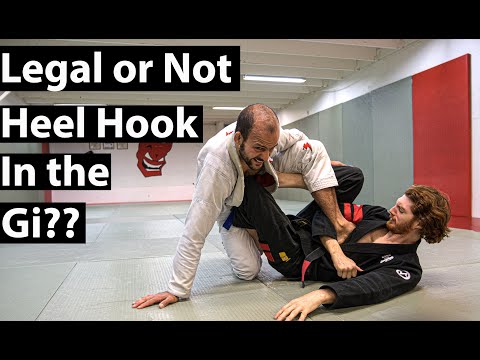
Legal Heel Hook in the Gi?
0
Reaping Heel Hook·JonThomasBJJ
This video I go over my details for the inside Ankle Lock. This ankle lock not only attacks the inside of the foot but …
Not yet documented
The Reaping Heel Hook covers heel hook attacks applied with a 'reaping' leg configuration — where the attacker's outside leg crosses over the opponent's hip line, creating additional rotational control that amplifies the heel hook's force. [1] 'Reaping' (placing the leg across the opponent's centre line in leg entanglements) is specifically banned in IBJJF competition due to the increased knee injury risk but is legal and commonly used in ADCC, EBI, and MMA. [1],[2]
Developed within the modern BJJ competition framework. [1]
Used in IBJJF, ADCC, and/or EBI competition. [1]
No images yet for this technique.
Sign in to suggest an image.
This video I go over my details for the inside Ankle Lock. This ankle lock not only attacks the inside of the foot but …
No instructional courses yet for this technique.
Sign in to suggest a course.
Risk of injury to the person this technique is applied to
Varies based on the submissions accessible from this position
Skill level needed to execute this technique reliably
Whether this technique is allowed under major competition rule sets
Jiu-Jitsu University (Saulo Ribeiro, 2008)
Description sources — [1] Modern BJJ positional development [2] Competition evolution
Standard katakana transliteration of Western martial arts terminology (外来語) — used in Japanese MMA, boxing, and BJJ communities
Description sources — [1] Modern BJJ positional development [2] Competition evolution
positional awareness, body control, specific attribute for this position
core, hip flexors, legs
Every move, in any martial art, shares a few universal traits. Mix and match below to pinpoint the right tool — or compare equivalents across styles.
The reaping heel hook (outside ashi garami to heel hook) is the most devastating leg lock combination in grappling. Reaping — crossing the leg over the opponent's centerline — was banned in IBJJF until 2021 when it was legalized at brown/black belt no-gi. The reap creates a secondary control that prevents the opponent from extracting their leg. (IBJJF Rules v6.0; Danaher, Enter the System; ADCC competition records)
According to JonThomasBJJ, the key is setting the heel correctly on your hip or chest. When you establish this position properly, if your opponent tries to rotate their knee inward to escape, they won't be able to because their foot is already controlled and can't turn the way they need it to.
JonThomasBJJ emphasizes setting the heel on your chest ribcage, then threading your arm as deep as possible and squeezing it tightly to contract the muscles with no room for movement—rather than just pulling up at the finish.
JonThomasBJJ prefers setting this up from bottom position because when underneath your opponent, you can better gauge the distance to their foot and control it even if they try to place it on the floor.
JonThomasBJJ explains that you should focus on making the muscles tight with your arm squeeze to eliminate room for movement, then switch your hip and clip out to prevent your opponent from putting weight back on that foot before finishing the rotation.
The Reaping Heel Hook covers heel hook attacks applied with a 'reaping' leg configuration — where the attacker's outside leg crosses over the opponent's hip line, creating additional rotational control that amplifies the heel hook's force. 'Reaping' (placing the leg across the opponent's centre line in leg entanglements) is specifically banned in IBJJF competition due to the increased knee injury risk but is legal and commonly used in ADCC, EBI, and MMA.
This position developed within the modern BJJ/grappling positional framework as the art evolved.
IBJJF: legal — Legal — guard is fundamental to BJJ, sweeps from guard score 2 points; IJF: restricted — Guard pulling penalized as non-combativity — groundwork from guard permitted …; ADCC: legal — Legal, guard pull penalized -1 point in points portion; Unified MMA: legal — Legal — no penalty for playing guard; FIAS Sport Sambo: legal — Legal
Danger rating 5/10. Moderate — varies based on the submissions accessible from this position
The standard setup chain: Establish Entry Position → Transition to This Position → Consolidate Control → Attack or Transition → Maintain or Advance.
Standard counters include: Positional escape / Prevention (not allowing the position to be established) / Transition to a more advantageous position.
Common variants: Standard execution (the fundamental version); Modified variation (adapted for specific scenarios); Transitional version (used as a waypoint between positions).
Used in IBJJF, ADCC, and/or EBI competition.
Top errors to watch for: Entering without proper control / Not understanding the position's purpose / Staying too long without attacking / Not chaining with transitions to other positions.
The Reaping Heel Hook is also known as Outside Ashi Garami, Reap, Cross Ashi.