Introduction and Drill Setup
Instructor Brian Peterson and partner Megan Paradise demonstrate the Jiu-Claw technique, a back control method derived from wrestling fundamentals. The drill begins from a back control position where the opponent attempts to escape by bridging and moving northward.
Understanding the Seatbelt Problem
When both arms end up underneath the opponent's armpits (double-under position), the instructor loses the traditional seatbelt control that normally prevents northward movement. This vulnerability allows the opponent's body to shift upward and escape the back control.
The Claw Grip Foundation
The claw grip is executed by threading the arm under the opponent's armpit and across their neck, establishing a firm grip on the trapezius muscle. Combined with leg control and wrist control, the claw creates a tight control system that prevents the opponent from maneuvering away.
Claw Advantage Over Standard Lock
Unlike a standard squeeze lock, the claw grip maintains effectiveness when the opponent attempts to maneuver their arm over the attacker's head. The claw's positioning prevents the opponent from creating obstacles for back control recapture while the leg control prevents twisting escapes.
Bridge Disruption and Mount Transition
As the opponent bridges to escape, the attacker kicks out their base by striking the bridge with their foot. The attacker then posts on their head, brings the knee toward their shoulder, sits into their buttocks, and secures double hooks to reestablish back control.
Alternative Finish: The Vine Control
When in the double-under position, the attacker can alternatively use wrist control and the claw grip to drive the opponent onto their side using a vine leg control. This transition bypasses the mount entirely and maintains back control through superior leg positioning.
Triangle Attack Opportunity
If the opponent twists aggressively during the transition to mount position, the attacker can lose wrist control but maintain positional advantage. Following up on top allows the attacker to establish a dominant triangle attack position.
Use the "CLAW" to Attack from the Back!
Key Takeaways
- •Introduction and Drill Setup
- •Understanding the Seatbelt Problem
- •The Claw Grip Foundation
- •Claw Advantage Over Standard Lock
In this video I breakdown a "Claw" attack you can use from the back when your opponent starts to slide out from your control. Check out the details and you are sure to find something useful! Enjoy! If you have any questions, comments, or suggestions, please comment below. More videos to come! Please like, share, and subscribe!! PLEASE Click this link to SUPPORT the TeachMeGrappling Channel!!! https://www.patreon.com/TeachMeGrappling or https://www.paypal.me/CoachBrianPeterson Your contribution is much appreciated and will help me continue to bring you content! 🙏 www.NextLevelGuy.com The NextLevelGuy Podcast with Coach Brian Peterson has been released!! Check it out! http://teachmegrappling.com
Related Techniques
Frequently Asked Questions
What does this video teach about jiu-claw?
This video covers introduction and drill setup, understanding the seatbelt problem, the claw grip foundation. It provides detailed instruction from TeachMeGrappling Coach Brian.
How long does it take to learn jiu-claw?
The basic mechanics can be understood in a single session, but developing reliable execution requires consistent drilling over weeks of practice. This 7-part breakdown helps structure your training by isolating each phase of the technique.
What are the key details for finishing jiu-claw?
When in the double-under position, the attacker can alternatively use wrist control and the claw grip to drive the opponent onto their side using a vine leg control. This transition bypasses the mount entirely and maintains back control through superior leg positioning.
Related videos
BJJ Triangle Choke: Gi Jiu Jitsu Rubber Guard Submission presented by Self Defined Fitness
Self Defined
19 Submissions/Transitions From Closed Guard You've Probably Never Seen Before - BJJ Techniques
Ben Eddy Bravo
Ice Pick on the Ground
Kalah UK
The Carni Shoulder Lock From BJJ Z Guard by Richie "Boogeyman" Martinez
Bernardo Faria BJJ Fanatics
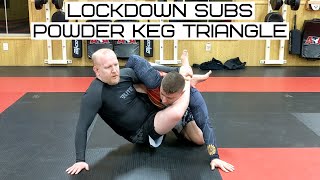
Lockdown Half Guard, Part 12: Powder Keg Triangle
Cheat Code Jiu Jitsu