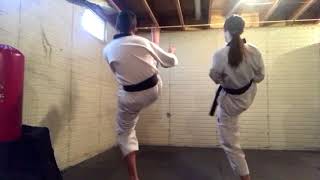
Counter Setup and Opportunity Recognition
The drop kick presents itself as an ideal counter technique when an opponent commits to a high kick. By recognizing the moment the opponent's kick reaches its apex, the defender can exploit the opening beneath their guard. This timing is critical for executing an effective under kick response.
Defensive Positioning and Evasion
As the opponent initiates their kick, the defender leans back while maintaining a stable stance. The right hand stays anchored near the centerline while the left hand provides balance. This backward lean creates the necessary space to deliver an under kick with the front leg.
Shoulder Movement and Weight Transfer
The shoulders play a crucial role in executing the under kick effectively. As the opponent's kick reaches its apex, the defender dips their shoulder back while simultaneously driving their front leg underneath. This coordinated movement generates power while maintaining defensive posture.
Distance and Slide Mechanics
The defender may need to adjust depth by sliding backward rather than simply dipping. This lateral adjustment ensures proper range while keeping the counter technique effective. The slide should be subtle and measured to maintain control.
Drop Kick Trajectory and Head Movement Avoidance
The drop kick extends outward differently than standard kicks, creating a longer reach that forces the opponent's head to turn away. Rather than tilting the head back—a poor defensive habit—the opponent must rotate their entire body to evade. This involuntary head movement creates additional opportunities for the under kick counter.
Commitment and Intent in Attack
Successful execution requires full commitment to the counter attack. The defender must advance with the intention of landing the under kick while simultaneously positioning the opponent where they cannot execute their own counter. Hesitation or partial commitment invites being struck.
Anticipation and Geometric Positioning
The defender must anticipate the opponent's movement and adjust target placement accordingly. Understanding that the opponent will move to create distance, the defender should aim where the opponent will be, not where they currently stand. This principle of geometric precision prevents short-range misses that leave the defender vulnerable.
Distance Management Against Taller Opponents
When facing a taller opponent, closing the distance is advantageous. If the initial drop kick misses, being in close range allows the defender to execute the under kick without exposure. Attempting the counter from too far away negates the tactical advantage of the technique.
Difference Between Hitting and Striking
Hitting involves pushing the body against the opponent to establish position and control, while striking aims to damage or score points. Effective execution requires first hitting to position the opponent, then striking with the counter kick. This two-part action ensures the technique lands with maximum effect.
Drop Kick Techniques
Key Takeaways
- •Counter Setup and Opportunity Recognition
- •Defensive Positioning and Evasion
- •Shoulder Movement and Weight Transfer
- •Distance and Slide Mechanics
Master Mason Williams demonstrates how to execute an effective defense against a drop kick and an effective drop kick attack.
Related Techniques
Frequently Asked Questions
What does this video teach about drop twin front kick?
This video covers counter setup and opportunity recognition, defensive positioning and evasion, shoulder movement and weight transfer. It provides detailed instruction from Jun Chong Martial Arts.
How long does it take to learn drop twin front kick?
The basic mechanics can be understood in a single session, but developing reliable execution requires consistent drilling over weeks of practice. This 9-part breakdown helps structure your training by isolating each phase of the technique.
What are the key details for finishing drop twin front kick?
When facing a taller opponent, closing the distance is advantageous. If the initial drop kick misses, being in close range allows the defender to execute the under kick without exposure. Attempting the counter from too far away negates the tactical advantage of the technique.