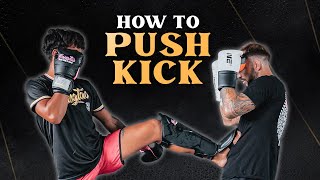
Introduction to the Double Jumping Push Kick
The Double Jumping Push Kick is a powerful striking technique that effectively closes distance while transferring significant body weight into the strike. This technique is particularly valuable in both MMA and self-defense applications, as it can be directed to multiple target zones including the face, body, and legs.
Tactical Applications and Target Zones
The Double Jumping Push Kick can be deployed against multiple targets depending on the opponent's positioning and balance. While the technique is relatively easy to identify, proper timing against an off-balanced opponent allows practitioners to land strikes to the face, body, or lower extremities with considerable force and potential destructive effect.
Fundamental Mechanics
The technique begins by lifting the rear leg, executing a forward hop, and then driving forward with the front leg to deliver the strike. The sequence follows a consistent rhythm: rear leg lifts, hop forward, front leg extends, and impact occurs in one fluid motion.
Coordination and Rhythm Development
Practitioners should focus on synchronizing the rear leg lift and forward hop as a single movement unit, followed immediately by the front leg extension and strike. This coordinated timing ensures maximum efficiency and power transfer throughout the technique.
Striking Height Variation
The Double Jumping Push Kick can be executed at multiple heights to target different anatomical zones. Practitioners can direct strikes upward to the head, horizontally to the torso and ribs, or downward to the knees and lower body depending on tactical objectives.
Impact versus Push Methodology
The technique can be deployed with two distinct force distributions: an 80/20 impact-to-push ratio for damaging strikes, or an 80/20 push-to-impact ratio for defensive positioning. The impact-focused variation targets maximum damage to the opponent, while the push-focused variation prioritizes repositioning and environmental exploitation.
Force Distribution Adjustment
When executing a push kick, practitioners should maintain approximately 20% striking force while emphasizing the pushing component to create distance and movement. Eliminating all impact force results in ineffective technique, so maintaining some snap in the extension ensures proper mechanics and desired results.
Self-Defense Applications and Environmental Awareness
In self-defense scenarios, the pushing variant of this technique becomes valuable when the opponent is positioned near environmental hazards such as furniture, stairs, or elevation changes. Strategic use of the push kick can direct an aggressor into these hazards, creating injury through environmental contact rather than direct impact alone.
MMA made EASY: Double Jumping Push Kick Tutorial
Key Takeaways
- •Introduction to the Double Jumping Push Kick
- •Tactical Applications and Target Zones
- •Fundamental Mechanics
- •Coordination and Rhythm Development
How to do a double jumping push kick Join our fan page today! http://www.facebook.com/MMAmadeEASY
Related Techniques
Frequently Asked Questions
What does this video teach about drop twin front kick?
This video covers introduction to the double jumping push kick, tactical applications and target zones, fundamental mechanics. It provides detailed instruction from STRIKINGmadeEASY.
How long does it take to learn drop twin front kick?
The basic mechanics can be understood in a single session, but developing reliable execution requires consistent drilling over weeks of practice. This 8-part breakdown helps structure your training by isolating each phase of the technique.
What are the key details for finishing drop twin front kick?
When executing a push kick, practitioners should maintain approximately 20% striking force while emphasizing the pushing component to create distance and movement. Eliminating all impact force results in ineffective technique, so maintaining some snap in the extension ensures proper mechanics and desired results.