Introduction and Instructor Context
The instructor introduces Jada Kintley, an Australian-raised martial artist fluent in Thai language and culture, as the primary demonstrator for the push kick technique. The instructor acknowledges that Kintley possesses superior technical proficiency in this strike compared to himself.
Target Area and Strike Mechanics
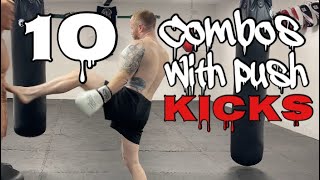
The push kick, or teep, should contact the target using the ball of the foot in a stabbing motion rather than a pure pushing action. The strike is most effective when directed at the bladder area around the belt line, where it can fold the opponent's torso due to the anatomical vulnerability of the core in that region.
Stance and Weight Distribution (A-Frame Position)
Proper push kick execution requires an A-frame stance in which the striker's weight is positioned forward while the kicking leg angles slightly backward, maintaining a grounded base. This configuration allows the striker to generate knockback force without being displaced backward themselves, in contrast to an improper technique where the striking leg aligns with the base leg.
Hand Position Options
Advanced practitioners confident in push kick accuracy may execute the technique with dropped hands, as taught in Thai training methods. Less experienced practitioners can maintain hands in guard position while delivering equivalent power and effectiveness.
Leg Retraction and Control
Upon missing a push kick, the striker must retract the leg cleanly without falling forward, allowing the knee to snap back under control. This recovery is critical when the opponent deflects the kick, enabling the striker to maintain balance and defend against counters.
Heavy Bag Training Method
Practitioners can develop push kick proficiency by training against a weighted heavy bag, pushing it forward and landing successive kicks as the bag swings back. This method, common in Thai training, develops timing, accuracy, hip flexor and glute strength, and requires the striker to maintain contact with the bag's center to avoid spinning and disrupting rhythm.
How to Push kick/Teep !!
Key Takeaways
- •Introduction and Instructor Context
- •Target Area and Strike Mechanics
- •Stance and Weight Distribution (A-Frame Position)
- •Hand Position Options
Thai fighters are renowned and famous for their skill and ability to throw and time push kicks(teep). I held some pads for Jada while i was at Bangtao and really admired the power and accuracy of her push kick. Especially the fact that she could knock me back quite easily even though I am much heavier. Jada grew up in Thailand so it was a fundamental of learning Muay Thai there. If you enjoy seeing more vlogs like this or instructional tutorials, be sure to subscribe and hit the notification bell. Also, if you are interested in learning more, sign up for early access course and be the first to know when it launches: https://www.quakecombat.com/early-access-1 Outside of Youtube, you can find me at: Facebook: Facebook.com/bradquakeriddell Instagram: Instagram.com/bradquakeriddell Also, be sure to join my closed facebook group for the weekly discussions in between the videos and be part of a community of like minded martial artists. Just be sure to answer the three questions to be added. https://www.facebook.com/groups/QuakeCombat/
Related Techniques
Frequently Asked Questions
What does this video teach about push kick-teep?
This video covers introduction and instructor context, target area and strike mechanics, stance and weight distribution (a-frame position). It provides detailed instruction from Brad Riddell - Student of the Fight Game.
How long does it take to learn push kick-teep?
The basic mechanics can be understood in a single session, but developing reliable execution requires consistent drilling over weeks of practice. This 6-part breakdown helps structure your training by isolating each phase of the technique.
What are the key details for finishing push kick-teep?
Upon missing a push kick, the striker must retract the leg cleanly without falling forward, allowing the knee to snap back under control. This recovery is critical when the opponent deflects the kick, enabling the striker to maintain balance and defend against counters.