Introduction & Closed Guard Setup
Mike DeWitt Jr. begins by establishing the foundational position for rubber guard: closed guard with the opponent maintaining posture. The instructor emphasizes that breaking the opponent's posture is essential before advancing to rubber guard techniques. This can be achieved through various methods including hugging, securing an S-grip, or finding underhooks.
Breaking Posture & Hand Control
The defender curls their feet toward their glutes while pulling the knees inward to open the opponent's elbows and force them to collapse. DeWitt notes that the opponent's hands typically remain on the chest, ribs, or stomach during this transition. Maintaining tight control throughout the posture break is critical to preventing the opponent from re-establishing their base.
Crown Control & Head Positioning
Once posture is broken, controlling the crown of the opponent's head becomes paramount. The defender must keep their grip high around the neck to prevent the opponent from looking up, which would restore their strength and ability to posture. This maintained control sets up the subsequent hip escape movement.
Hip Escape & Mission Control Setup
The defender places one foot on the opponent's hip and escapes their own hips to create angle. The ankle on the escape side is brought up along the opponent's back toward the defender's wrist, establishing the position known as mission control. A strong, angled hip escape is essential for maintaining leverage in the ensuing techniques.
Mission Control & The Zombie
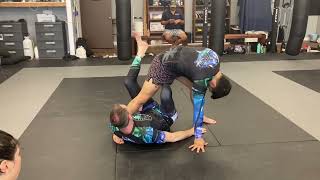
From mission control, the defender maintains a tight knee pinch toward their stomach while the opposite foot positions toward the opponent's hip. Using the outside arm, the defender goes under the opponent's elbow and circles toward the wrist in a movement called the zombie. This arm repositioning reinforces the knee pinch and transitions the defender into the New York position.
New York Position & Neck Clear
In New York, the defender brings their elbow across the top of the opponent's head to create a frame against the neck. The defending arm, still holding the ankle, clears the opponent's neck while the knee pinch remains tight. This precise positioning prevents the opponent from rotating away and escaping the subsequent techniques.
Chill Dog & Entry to Omoplata
The defender executes the kung fu move by circling their foot in front of the opponent's face while maintaining the elbow frame. The bottom leg is pulled through as the top leg extends, transitioning into Jukla position with feet crossed. The defender sits up and turns their legs outward while maintaining tight knee compression.
Omoplata Application & Pressure
From the final position, the defender leans all their weight into the knee, rolling the opponent's shoulder and applying intense pressure. This weight distribution creates the finishing mechanism for the omaplata submission. Maintaining constant pressure throughout prevents the opponent from escaping or reversing position.
Variations: Gogoplata & Alternative Paths
DeWitt demonstrates two primary variations from the basic path. The gogoplata is set up by pushing the foot under the opponent's chin and reaching through to grab the inside of the foot for a pedal submission. Alternatively, the defender can push away to find the opponent's hip and transition into omaplata position from there.
Mastery & Belt Progression Requirements
DeWitt emphasizes that mastering the basic rubber guard path is essential for advancement through 10th Planet belt levels. While online resources are valuable, live instruction and community feedback from qualified instructors are necessary to refine technique and achieve proper execution. Dedicated training with experienced coaching accelerates progress and ensures technical proficiency.
Rubber Guard Basic Path- Mike Dewitt Jr
Key Takeaways
- •Introduction & Closed Guard Setup
- •Breaking Posture & Hand Control
- •Crown Control & Head Positioning
- •Hip Escape & Mission Control Setup
10th Planet Springfield Head Instructor Mike Dewitt Jr Rubber Guard Basic Path The basic path of Rubber Guard goes through Mission Control, New York, Zombie, Chill Dog, Kung-Fu Move, Omaplata. There are a lot of variations to the rubber guard but this path is one of the best and most common ways to attack from the position.The basic path has been used in high level promotions such as UFC and ADCC successfully. The basic path is a staple for all 10th Planet students to know like the back of their hand. Superhero Jiu Jitsu academy is the only 10th Planet Academy in Lane County Oregon. 10th Planet Springfield 824 Q st Springfield, OR 97477 612-888-4376 http://springfield10thplanet.com
Related Techniques
Frequently Asked Questions
What does this video teach about mud dog control?
This video covers introduction & closed guard setup, breaking posture & hand control, crown control & head positioning. It provides detailed instruction from Superhero Jiu Jitsu Academy .
How long does it take to learn mud dog control?
The basic mechanics can be understood in a single session, but developing reliable execution requires consistent drilling over weeks of practice. This 10-part breakdown helps structure your training by isolating each phase of the technique.
What are the key details for finishing mud dog control?
DeWitt demonstrates two primary variations from the basic path. The gogoplata is set up by pushing the foot under the opponent's chin and reaching through to grab the inside of the foot for a pedal submission. Alternatively, the defender can push away to find the opponent's hip and transition into omaplata position from there.
Related videos
10th Planet 101 - Rubber Guard (Triangle Choke & Inside Position)
Brandon Mccaghren
Rubber Guard Cradle | Weird Jiu-Jitsu Position
Knight Jiu-Jitsu
Mounted Rubber Guard - 10th Planet Jiu Jitsu
Brandon Mccaghren
10th Planet Fundamentals Half Guard Stomp & Super Stomp 2 of 2 Heather
10th Planet Denver Jiu Jitsu
Ways to use Mini Stomp, 10th Planet Orange Park Jiu Jitsu
10th Planet Orange Park