Foundation: Closed Guard Setup
Begin in closed guard with a low squeeze around the opponent's hips and crossed ankles. Pull the opponent forward to uproot their base and force their hands to the mat. This establishes the foundational control necessary for the transition.
Transition: Hip Bump to Back Control Position
Initiate a hip bump sweep motion by posting on the opponent's wrist and transitioning through the elbow to hand position. Drive across the opponent's body as if moving to their back, establishing what appears as an air guitar control over the opponent's torso.
Establishing the Underside Cradle
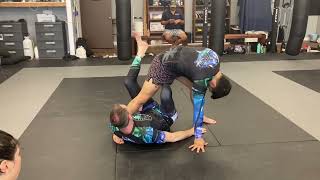
Tuck the hand outside the opponent's leg and fall to the side while scooping the leg upward. This creates a strong underside cradle that prevents the opponent from resquaring their guard or regaining leg positioning underneath the body.
Neck Squeeze Submission Option
Secure the cradle by gripping inside the near knee to free the upper hand. Execute a meat hook control around the opponent's leg and head, then grab the foot and feed it to establish a tight neck squeeze underneath the chin. Despite appearing to have space, this choke is a high-percentage submission.
Kimura Arm Lock Alternative
If the opponent defends the neck squeeze by grabbing the foot or wrist, use the cradled leg to pick up their arm. Grab the opponent's elbow and pull it forward while pushing the wrist backward, creating a manual Kimura with foot assist that is extremely difficult to escape.
Gogoplata Variations
Free the leg to the opposite side of the body to set up a one-handed gogoplata. If the opponent attempts to grab the foot, transition to a two-handed gogoplata by bringing the foot in front of the neck. From this position, release the leg and shoot through to establish gogoplata clinch control.
Armbar Finish from Cradle Control
If submissions are being defended, maintain the cradled leg and push the opponent backward. This creates significant rotational torque on the opponent's trapped arm, leading to a high-percentage armbar finish.
System Summary and Advanced Variations
The underside cradle from closed guard provides multiple submission pathways including gogoplata, neck squeeze, Kimura, and armbar. When opponents establish an underhook defense, back-take opportunities emerge as an advanced variation worthy of separate detailed study.
Rubber Guard Cradle | Weird Jiu-Jitsu Position
Key Takeaways
- •Foundation: Closed Guard Setup
- •Transition: Hip Bump to Back Control Position
- •Establishing the Underside Cradle
- •Neck Squeeze Submission Option
Hundreds more class instruction videos at Patreon.com/KnightJiuJitsu Firstly, I don't know what else to call this position and I definitely don't claim to have invented it. This is however a fun and frustrating position with lots of great submission possibilities from it. This is a bottom cradle variation with rubber guard elements, making for a really strong position. Watch the video and let me know what you think about it after you try it out. Thanks as always for watching! Please be sure to turn on notifications for new videos if you haven’t, so you can find out as soon as I upload a new one each week. Become a member of this channel for exclusive class videos not available for free. Super cheap cost for access to lots of exclusive content. ------------------------------------------------------------------------------------------------------------------------------------------ If you haven’t checked out my Jiu-Jitsu Deep Dive yet, go to www.martialartsdigitalseminars.com/Jiu-Jitsu-Deep-Dive to get it. • Exclusive Class Content at Patreon.com/KnightJiuJitsu • BJJ Fanatics Instructionals here: https://bjjfanatics.com/search?q=eli+knight • T-Shirts available here: tinyurl.com/wzu6ufb • Instagram @knight_jiu_jitsu_ • TikTok @knightjiujitsu • Follow me on DTube: https://d.tube/#!/c/knightbjj • Follow me on Steemit: https://steempeak.com/@knightbjj
Related Techniques
Frequently Asked Questions
What does this video teach about mud dog control?
This video covers foundation: closed guard setup, transition: hip bump to back control position, establishing the underside cradle. It provides detailed instruction from Knight Jiu-Jitsu.
How long does it take to learn mud dog control?
The basic mechanics can be understood in a single session, but developing reliable execution requires consistent drilling over weeks of practice. This 8-part breakdown helps structure your training by isolating each phase of the technique.
What are the key details for finishing mud dog control?
If submissions are being defended, maintain the cradled leg and push the opponent backward. This creates significant rotational torque on the opponent's trapped arm, leading to a high-percentage armbar finish.
Related videos
10th Planet 101 - Rubber Guard (Triangle Choke & Inside Position)
Brandon Mccaghren
Rubber Guard Basic Path- Mike Dewitt Jr
Superhero Jiu Jitsu Academy
Mounted Rubber Guard - 10th Planet Jiu Jitsu
Brandon Mccaghren
10th Planet Fundamentals Half Guard Stomp & Super Stomp 2 of 2 Heather
10th Planet Denver Jiu Jitsu
Ways to use Mini Stomp, 10th Planet Orange Park Jiu Jitsu
10th Planet Orange Park