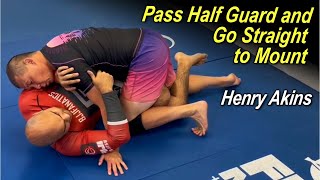
Half Guard Passing Fundamentals
Half guard passing relies on two primary control points: head control via cross face and the underhook. The instructor emphasizes that underhooks should be taken reactively when available rather than forced, as cross face control from half guard is more accessible and effective for initiating the pass.
The Hip Turn Pass: Two-Step Progression
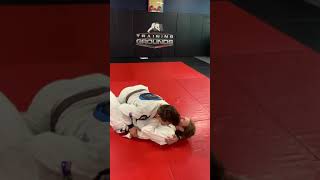
Half guard passing consists of two sequential steps: first freeing the knee, then freeing the foot. The hip turn pass begins by securing a solid head control grip, then sitting the hips back as far as possible to create base and prevent being rolled. This extended hip positioning allows the top player to counter sweep attempts by mounting the opponent.
Knee Wedging Techniques
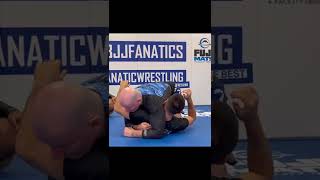
To free the trapped knee, the top player uses a wedge by either pushing down with the hand while bridging the hips upward, or using the instep of the free foot. The key is maintaining a straight leg line rather than a ramp position when pulling the leg free, which increases mechanical advantage.
Knee Slide and Lateral Transitions
When unable to fully free the foot, the knee slide becomes available as an alternative. If the foot becomes stuck during a knee slide, the top player can use the opposite foot to pry it free with a deliberate, controlled push. Alternatively, bringing the knee to the other side creates multiple options including mount entry or a second knee slide.
Rolling Back Attacks from Quarter Guard
Rolling back attacks from the three-quarter mount or quarter guard position are highly effective and require precise angle rather than momentum. The technique involves hooking the toes on the shin, stepping back, and dropping the shoulder as close to the opponent's hips as possible, with optional foot control to emphasize correct shoulder placement.
Defeating the Knee Shield
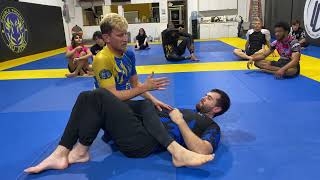
The knee shield defense complicates head control, underhook access, and weight distribution. The instructor presents two primary counters: flattening the opponent by hovering overhead and trapping the leg above the knee, or using the arm weave pass by compressing the legs together, controlling the collar, and sliding the knee through to establish side control.
Managing Half-Butterfly Hooks
When the opponent establishes a half-butterfly hook, the top player should work the hips closer to the opponent's buttocks to flatten them against the mat. Controlling the pants or legs prevents the opponent from following the backstep. Two reliable finishing options—forcing the knee down or stepping over to mount—ensure at least one remains available since the opponent cannot defend both simultaneously.
Countering Opponent Underhook Attacks
Underhooks pose significant risk, enabling back takes and sweeps especially when the opponent is on their elbow. The top player should posture them flat by pressing on the head with the forearm, then circle in their own underhook. Controlling the head combined with securing an underhook provides grip options for executing either the knee slide or hip turn pass.
How To Pass Half Guard | BJJ Fundamentals
Key Takeaways
- •Half Guard Passing Fundamentals
- •The Hip Turn Pass: Two-Step Progression
- •Knee Wedging Techniques
- •Knee Slide and Lateral Transitions
✅ BJJ Beginner Course: https://bjjbeginnercourse.com ✅ Jiu-Jitsu Theory Course: https://jiujitsutheorycourse.com 📩 Newsletter: http://jordanteachesjiujitsu.com/newsletter/ ✅ BJJ Games: A Constraints-Led Approach To Grappling: https://playbjjgames.com ✅ Wrestling For BJJ Course: http://wrestlingforbjj.com/ 💥 Kimura Trap Mastery: http://kimuratrapmastery.com ✅ Rides & Escapes Course: https://ridesescapes.com 🏖️ Trinidad & Tobago BJJ Camp: https://www.rollingintobago.com/ 🔥 X-Martial - https://www.xmartial.com/search?q=limitless --- Support my work: ❤️ Patreon: https://www.patreon.com/jordanteachesjiujitsu 👕 Merch: https://limitless-apparel-22.creator-spring.com/ 🥋 BJJ Fanatics: https://bjjfanatics.com/collections/new-releases/products/jordan-teaches-bottom-half-guard-by-jordan-preisinger Social: 💥 Instagram: https://www.instagram.com/jordanteachesjiujitsu/?hl=en 💥 Facebook: https://www.facebook.com/jordanteachesjiujitsu 💥 Facebook group: https://www.facebook.com/groups/jordanteachesjiujitsugroup/ 💥 TikTok: https://www.tiktok.com/@jordanteachesjiujitsu 0:00 bow in for class 00:22 head control vs underhook 00:40 hip turn to pass with cross face 1:15 don't put your hips too close 1:46 leg above knee 2:04 switch to underhook and knee slide 2:17 intro 2:35 back to the knee slide 2:59 don't step out too far 3:28 go to mount 3:48 other side knee slide 4:03 rolling back attack 4:36 flatten your partner (nicely) 4:50 arm weave pass 5:08 back step 5:19 step over to mount 5:30 countering the underhook 6:30 dealing with the lock down (the leg kind)
Frequently Asked Questions
What does this video teach about half mount pass?
This video covers half guard passing fundamentals, the hip turn pass: two-step progression, knee wedging techniques. It provides detailed instruction from Jordan Teaches Jiujitsu.
How long does it take to learn half mount pass?
The basic mechanics can be understood in a single session, but developing reliable execution requires consistent drilling over weeks of practice. This 8-part breakdown helps structure your training by isolating each phase of the technique.
What are the key details for finishing half mount pass?
When the opponent establishes a half-butterfly hook, the top player should work the hips closer to the opponent's buttocks to flatten them against the mat. Controlling the pants or legs prevents the opponent from following the backstep. Two reliable finishing options—forcing the knee down or stepping over to mount—ensure at least one remains available since the opponent cannot defend both simultaneously.