Introduction to Angle Creation
Establishing proper angles is fundamental to executing a triangle choke from closed guard. Gordon Ryan's approach emphasizes positioning the opponent's posture before committing to the submission. This foundational concept prevents defensive stacking and creates the geometry necessary for a tight finish.
Breaking Opponent's Posture
The first critical step involves collapsing the opponent's forward posture using collar and sleeve control. By controlling the head and arm simultaneously, the practitioner prevents the opponent from creating distance or achieving a strong defensive base. This posture breakdown is essential before transitioning into triangle mechanics.
Hip Positioning and Leverage
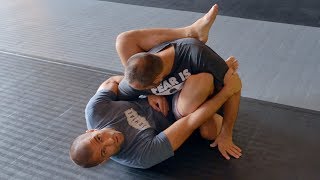
Hip placement determines the effectiveness of angle creation in closed guard. The practitioner should position their hips to create an acute angle that traps the opponent's arm and head in the triangle's geometry. Proper hip movement also facilitates weight distribution that prevents escape routes.
Foot Placement and Triangle Setup
As the opponent's posture breaks down, the feet hook strategically to control the opponent's spine and prevent base recovery. The triangle entry requires precise foot positioning over the opponent's back to complete the leg configuration. This foot placement transforms the guard into a submission-ready position.
Controlling the Arm
Isolating and controlling one arm prevents the opponent from framing or creating space within the triangle. The guard player uses their upper body grip to pin the arm while completing the leg lock. This arm control is non-negotiable for executing Ryan's high-percentage triangle system.
Finishing Mechanics
Once the triangle is fully locked, pressure application combines hip pressure with neck compression. The practitioner tightens the triangle by pulling the knee toward the chest while maintaining collar control. These finishing details ensure the submission becomes inescapable through proper pressure distribution rather than just position.
How to Create Angles in Closed Guard Like Gordon Ryan
Key Takeaways
- •Introduction to Angle Creation
- •Breaking Opponent's Posture
- •Hip Positioning and Leverage
- •Foot Placement and Triangle Setup
Hi everyone, my name is Gordon Ryan. This is a look into my life. If you enjoy it, watch it. If you hate it, watch it. If you don't want to watch it, I don't care. I'll be rich and famous either way. Enjoy ❤️ ______________________________________________ All My Links: https://linktr.ee/Gordonlovesjiujitsu Worlds best Jiu Jitsu instructionals⬇️⬇️⬇️ https://gordonthekingryan.com/ ______________________________________________ Follow Me Here: Official IG 👉🏻 https://www.instagram.com/gordonlovesjiujitsu/ Technique breakdowns 👉🏻 https://www.instagram.com/gordonlovesjiujitsu_/ ______________________________________________
Related Techniques
Frequently Asked Questions
What does this video teach about triangle from closed guard?
This video covers introduction to angle creation, breaking opponent's posture, hip positioning and leverage. It provides detailed instruction from Gordon Ryan.
How long does it take to learn triangle from closed guard?
The basic mechanics can be understood in a single session, but developing reliable execution requires consistent drilling over weeks of practice. This 6-part breakdown helps structure your training by isolating each phase of the technique.
What are the key details for finishing triangle from closed guard?
Isolating and controlling one arm prevents the opponent from framing or creating space within the triangle. The guard player uses their upper body grip to pin the arm while completing the leg lock. This arm control is non-negotiable for executing Ryan's high-percentage triangle system.
Related videos
Triangle from Closed Guard w/ Over-hook (Lachlan Giles)
Absolute MMA St Kilda - Melbourne
Triangle from the Closed Guard?
Matt Arroyo Jiu Jitsu
My Favourite Triangle Set Ups From Closed Guard!
The Grappling Academy
Triangle Choke from Closed Guard by Giancarlo Bodoni
Bernardo Faria BJJ Fanatics
Basic Triangle Choke Set Up From Closed Guard
MMA Leech